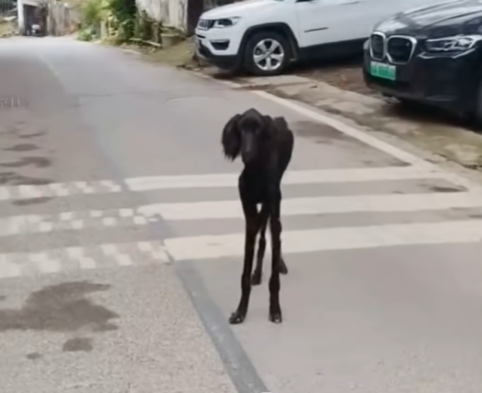
At first glance, everyone thought it was a monster.
It stood at the edge of the abandoned lot, half-hidden behind rusted metal sheets and tall weeds. Its silhouette was wrong—too sharp, too thin, like something drawn from a nightmare rather than real life. People slowed their steps, whispered to one another, and hurried past. Some crossed the street entirely. A few even took photos from a distance, posting them online with captions full of fear and disgust.
“What is that thing?”
“Is it sick?”
“It looks dangerous.”
I had heard the rumors before I saw it myself. But nothing prepared me for the reality.
When I finally approached, my heart dropped.
It wasn’t a monster. It was a dog.
Or at least, it had once been one.
Its body was so emaciated that every bone was visible, pushing sharply against its skin like it was trying to escape. The spine rose in jagged peaks, the ribs fanned out like broken branches, and its hips jutted so far they looked painful even to imagine. Patches of fur were missing, leaving raw, grayish skin beneath. Its head seemed too large for its body, its eyes sunken deep into dark hollows.
And yet… those eyes.
They weren’t wild. They weren’t aggressive.
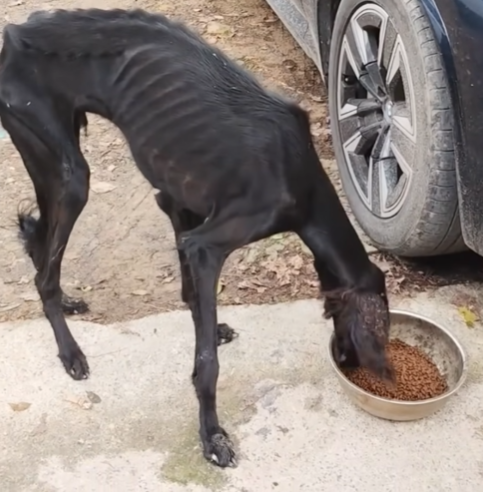
They were tired.
The dog stood still, barely moving, as if even breathing required careful effort. When it noticed me, it didn’t bark or growl. It didn’t run. It simply stared, frozen between fear and a fragile thread of hope.
I took a slow step closer.
It flinched immediately, shrinking back, legs trembling. That was when I understood—this creature that everyone feared was terrified of humans. Terrified, and starving.
“I’m not going to hurt you,” I whispered, though my voice shook. I wasn’t sure if I was trying to calm the dog or myself.
Up close, the smell hit me—old wounds, dirt, infection, and hunger. The kind of hunger that doesn’t just empty the stomach but hollows out the soul. This wasn’t a dog that had missed a few meals. This was a dog that had been forgotten for a very long time.
I crouched down slowly and placed a small piece of food on the ground, then backed away. The dog watched it like it might disappear. Seconds passed. Then minutes. Finally, with movements so weak they looked almost painful, it took one step forward.
Then another.
Each step seemed to cost it something.
When it reached the food, it didn’t pounce. It sniffed carefully, nervously, then began to eat—slowly, desperately, as if afraid it might choke or that the food would be taken away. Tears blurred my vision. No animal should ever look like this. No living being deserves to be reduced to bones and fear.
As it ate, I noticed scars—old ones and fresh ones. Some looked like burns. Others like bite marks. The story of its life was written all over its body, a story of neglect, cruelty, and survival against impossible odds.
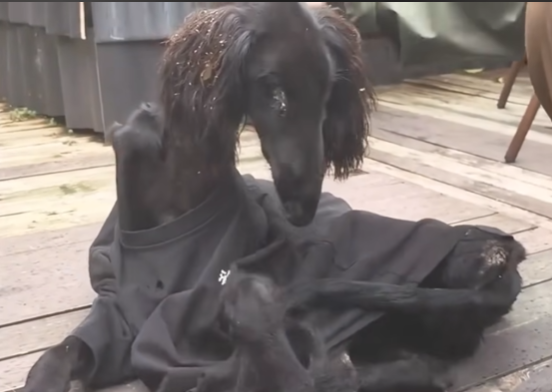
People began to gather, keeping their distance.
“That thing looks scary,” someone muttered.
“Be careful, it might attack,” another warned.
I turned to them, anger rising in my chest. “It’s not a monster,” I said firmly. “It’s starving.”
The dog finished the food and looked up at me. Its tail didn’t wag. It didn’t come closer. It simply looked at me with an expression I will never forget—a mix of exhaustion, confusion, and something dangerously close to trust.
That look broke me.
I called for help immediately. Animal rescuers arrived not long after, though to the dog, every minute felt like an eternity. When they approached with blankets and gentle voices, the dog panicked, trying to retreat, legs giving out beneath it. It collapsed to the ground, breathing fast, eyes wide.
“It’s okay,” one rescuer whispered, wrapping the blanket carefully around its frail body. “You’re safe now.”
Safe.
I wondered how long it had been since that word applied to this dog.
As they lifted it, I saw just how light it was. Too light. The kind of weight—or lack of it—that tells you the body has been consuming itself just to stay alive. People nearby fell silent. Fear turned into shock. Shock turned into shame.
At the shelter, the vet confirmed what we already knew. Severe malnutrition. Dehydration. Parasites. Infections. The dog was on the edge—one step closer to death than life. Feeding had to be slow, careful. Too much too fast could kill it.
Even starving, the dog never showed aggression. When hands touched it, it flinched, yes—but it didn’t bite. It didn’t snap. It endured.
Days passed.
The first sign of change was subtle. Its eyes became a little brighter. Its breathing steadied. It began to lift its head when someone entered the room. Then one day, barely noticeable, its tail moved. Not a wag—just a small, uncertain flick.
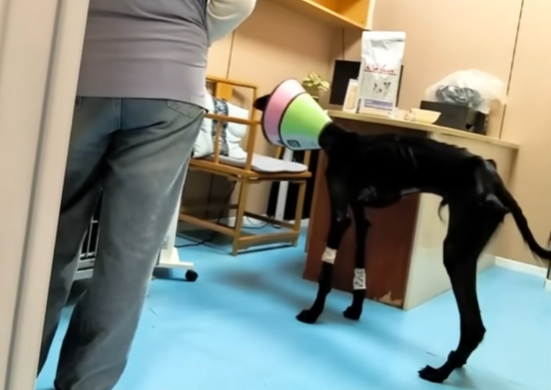
The staff cried when they saw it.
Weeks later, the transformation was undeniable. The bones were still visible, but they no longer looked like they would tear through the skin. Patches of fur began to grow back. The dog learned what a full bowl meant—and that it didn’t need to guard it with fear.
And then came the moment that silenced everyone.
When I visited again, the dog recognized me.
It walked toward me slowly, carefully, and rested its head against my leg. No fear. No hesitation. Just trust.
The “monster” from the abandoned lot was gone.
In its place stood a dog—gentle, quiet, and unimaginably resilient.
I think about that first moment often. About how easily fear blinds us. How quickly we label what we don’t understand. How close we came to letting this dog die simply because it looked strange, because hunger had twisted its body into something unfamiliar.
It was never a monster.
It was a victim.
A starving, suffering soul that survived long enough for someone to finally see the truth.
And now, every time I hear someone say, “That looks dangerous,” or “That’s not normal,” I remember those eyes—sunken but still pleading—and I remind myself:
Sometimes the most terrifying thing you see isn’t a threat at all.
Sometimes… it’s just hunger, wearing the shape of survival.