In the remote mountains of southern China, where mists curl around jagged cliffs and streams sing the songs of centuries, lived Grandpa Kuang, a man well into his eighties. He had seen many seasons pass, many faces fade, and yet there was one thing in his life that had remained steadfast—his wife, Mei Ling. Despite the wear of age, their love had endured the turmoil of life, wars, and poverty. They had grown together like two trees whose roots intertwined in secret beneath the earth, sharing warmth and silence alike.
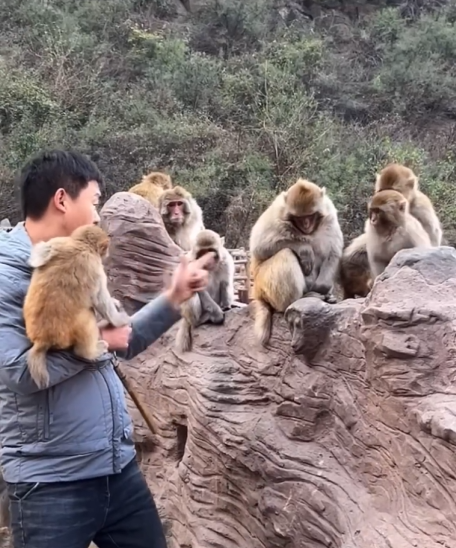
However, not long ago, a peculiar incident had begun to disturb the calm of their village life. It all started with a small monkey—an unusually clever one with a little crooked tail, known among villagers as Don. No one remembered where Don had come from; he seemed to appear overnight near Grandpa Kuang’s orchard. He had an unusual gleam in his eyes, and his movements were quick, almost unnervingly intelligent. At first, the villagers dismissed him as a mischievous creature, stealing fruit or teasing the village children. But soon, it became clear that Don was no ordinary monkey.
One evening, as the sun dipped behind the mountains, Grandpa Kuang returned home from the fields, expecting the usual greeting from his wife. Instead, he found Don perched on the wooden railing outside their home, his little crooked tail twitching with a strange intensity. Mei Ling smiled at the sight of the monkey, offering him a piece of sweet persimmon. Don took it gently but did not leave. He stayed, eyes never leaving Mei Ling, and a subtle tension seemed to fill the air.
Over the following days, something even stranger began to happen. Whenever Grandpa Kuang approached his wife to help her with chores, or to offer a comforting hand, Don would barge in between them. He would screech and chatter, his little tail curling like a warning, and he would snatch at Grandpa Kuang’s sleeve if he got too close. At first, Grandpa Kuang laughed at the absurdity, thinking the monkey was merely playful or territorial. But soon, the villagers noticed too. They whispered among themselves, calling it a curse or a bad omen.
“Old Kuang,” one neighbor warned, “that monkey… it isn’t normal. You should be careful.”
“Careful?” Grandpa Kuang chuckled. “It’s just a monkey. I’ve dealt with wild animals all my life. What harm could he do?”
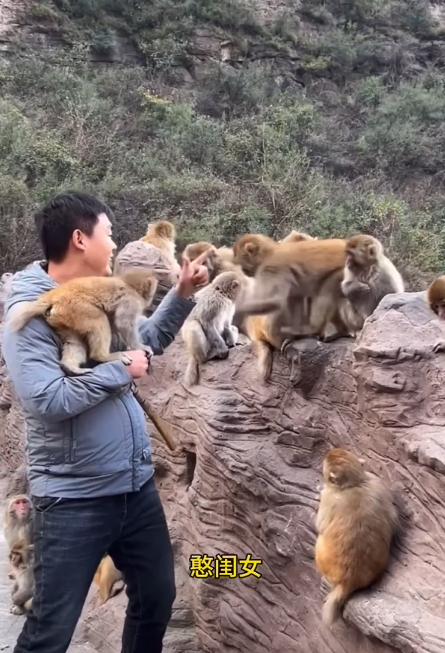
But harm, it seemed, was precisely what Don intended—though not in the conventional sense. Over the next few weeks, Don’s behavior became more protective, almost human. He would patrol the perimeter of the house, watch Grandpa Kuang’s every movement, and even imitate Mei Ling’s actions in a strange, eerie mimicry. He had grown unnaturally strong for his size, and his eyes glowed with an intensity that chilled even the bravest villagers.
Then came the night that changed everything. The air was thick with fog, and the mountains seemed to hum with a hidden rhythm. Grandpa Kuang, tired from work, sat by the hearth, rubbing his aching back. Mei Ling prepared some tea, moving slowly in the dim light. Don sat on the windowsill, tail crooked in an unnatural spiral, eyes fixed on Grandpa Kuang.
As Grandpa Kuang reached out, perhaps to take Mei Ling’s hand, Don leaped with surprising speed, landing between them. His screech echoed through the silent house, a sound that seemed to pierce not just the walls but the very air around them. Grandpa Kuang froze, seeing a strange transformation in the monkey’s eyes. They no longer seemed just alive; they seemed ancient, like the eyes of a spirit that had seen centuries pass.
Mei Ling whispered, “Kuang… I think Don… he’s not just a monkey.”
“What do you mean?” Grandpa Kuang asked, heart pounding.
Before Mei Ling could answer, a cold wind swept through the room, snuffing out the candles. Shadows twisted along the walls, and in the dim starlight that filtered through the window, Don seemed to grow larger, his little crooked tail extending unnaturally as though it were part of a ritual. He emitted a soft, humming chant, one that sounded like a voice carried on the wind. Grandpa Kuang felt a shiver run down his spine. It was then he realized: Don had become a spirit, a guardian not of the house, but of Mei Ling herself.
For nights after, Grandpa Kuang could not touch his wife. Every attempt was met with Don’s vigilant presence, sometimes even more intense than before. Yet, strangely, Mei Ling seemed unafraid. She treated Don with gentle words, patting his head, feeding him delicacies, as if acknowledging a pact that Grandpa Kuang could not see. The villagers murmured in awe and fear, speaking of the monkey spirit that had taken residence in the household, protecting love in a way no human could.
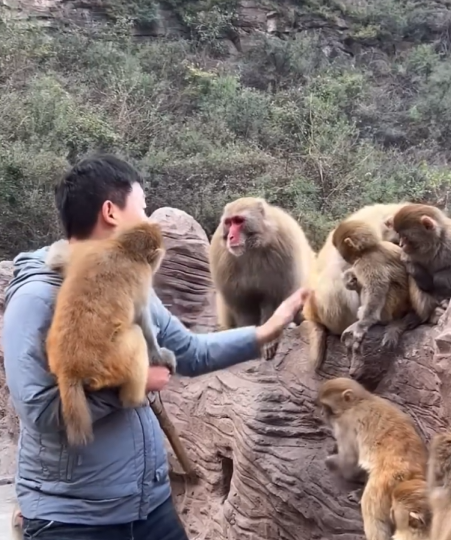
Grandpa Kuang, however, was not one to bow to fear. He studied Don, observing every twitch of his tail, every gleam of his eyes, every subtle shift in behavior. Slowly, he realized that Don was not hostile in the usual sense. He was not trying to harm; he was trying to preserve. Don’s actions were extreme, yet his purpose was clear: to safeguard Mei Ling from any threat, real or imagined. The little crooked tail had become the symbol of vigilance, loyalty, and, strangely, love.
Time passed, and Grandpa Kuang adapted. He learned to coexist with Don, understanding that some forces could not be fought but could be respected. The monkey spirit would sit beside Mei Ling at dawn, watching over her as she prepared breakfast. At night, he would curl up near her feet, tail crooked like a protective sigil. Grandpa Kuang would sit at a respectful distance, content to watch the bond between spirit and wife flourish.
In the village, stories spread of the little crooked tail that would not let an old man touch his wife—not out of malice, but out of a supernatural devotion. People came from far and wide, hoping to catch a glimpse of the monkey spirit, and some even claimed that merely seeing him could bring fortune or protection. Grandpa Kuang and Mei Ling lived the remainder of their days peacefully, under the watchful eye of Don, whose mischievous antics had transformed into a sacred duty.
The villagers would later say that love itself had the power to manifest in forms beyond comprehension. Don, the little crooked tail, was proof of that—a reminder that devotion could transcend species, life, and even death. Grandpa Kuang never touched Mei Ling as he once had, but he understood that the truest love was not possession but protection, respect, and the willingness to coexist with the forces that cared for what you cherished most.
And so, in that small house nestled in the mists of the mountains, the old man, his wife, and the monkey spirit lived together. Don’s little crooked tail remained a constant, twisting symbol of loyalty, a gentle but unyielding guardian who had crossed the threshold between the wild and the divine. In the end, Grandpa Kuang learned a truth he could never have imagined: some love is too sacred to be touched, and some spirits too wise to be ignored.