The chain was so rusted it almost crumbled when it finally snapped free.
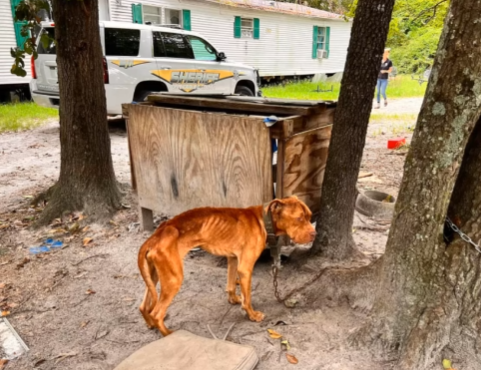
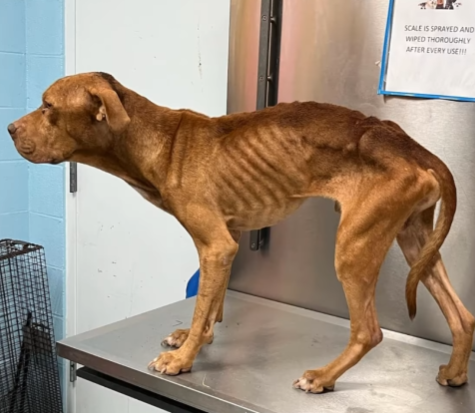
For a brief, breathtaking moment, the dog didn’t seem to understand what had happened. He stood there, blinking in the sunlight, the weight around his neck suddenly gone. His body was skeletal—hips jutting sharply, ribs pressing against thin, dirty skin—but his eyes shone with something fierce and alive.
Freedom.
His tail began to wag.
At first it was hesitant, as if he feared the movement itself might be punished. Then it picked up speed, sweeping the air wildly behind him. He took one step forward, then another, paws touching ground he had never been allowed to explore. His mouth opened in what looked like a smile, tongue lolling as a soft, breathless sound escaped his chest.
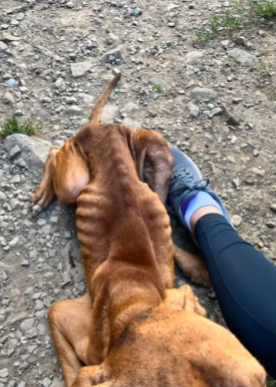
And then his legs buckled.
He collapsed onto the dirt just a few steps from the place where he had spent months—maybe years—tethered and forgotten.
Everyone froze.
“Oh no… no, no,” someone whispered, rushing forward.
The joy that had lit his face seconds earlier vanished, replaced by confusion and fear. His body trembled, muscles too weak to support the excitement that had surged through him. He tried to stand again, front paws scrabbling helplessly, but he fell back with a quiet whimper that cut straight to the heart.
They knelt around him immediately, careful hands touching his sides, his neck, his fragile legs. Up close, the extent of his suffering became impossible to ignore. His fur was patchy and dull. Old scars crossed his back like a map of pain. His belly was sunken so deeply it looked hollow.
This dog hadn’t just been neglected.
He had been forgotten.
The rescuers spoke softly, voices trembling with urgency and care. “Easy, boy. You’re okay. You’re safe now.” One slipped a jacket beneath him to lift his body gently off the cold ground. Another offered water, which he lapped weakly, spilling more than he drank.
Despite the collapse, his tail still tried to wag.
That was the part no one would ever forget.
Even lying there, barely able to hold his head up, he kept wagging—as if freedom itself had given him strength his body no longer had.
They learned his story from neighbors who had watched helplessly from a distance. He had belonged to someone who tied him behind a rundown shed and slowly stopped coming back. Food became rare. Water came only when it rained. Seasons changed, but the chain remained.
Until that day.
The ride to the veterinary clinic was silent except for the sound of shallow breathing. The dog lay on a blanket in the back seat, eyes half-closed, head resting in a rescuer’s lap. Every bump in the road made his body flinch, but he didn’t cry out. He simply endured, the way he always had.
At the clinic, the diagnosis was devastating.
Severe malnutrition. Extreme dehydration. Muscle atrophy so advanced that standing was painful. His organs were struggling, running on reserves that should have been gone long ago. The vet shook her head slowly. “He’s been surviving on almost nothing for a very long time.”
Surviving.
Not living.
They named him Chance.
Because that was what they were giving him—maybe the first real chance he had ever known.
The first days were critical. He couldn’t eat normal meals; his body wasn’t ready. Instead, he received tiny portions every few hours, fluids through an IV, and constant monitoring. He slept most of the time, his body finally allowed to rest without fear.
But even in weakness, his spirit refused to disappear.
When someone entered the room, his tail tapped softly against the blanket. When a gentle hand stroked his head, his eyes opened, cloudy but trusting. He leaned into touch like it was something sacred.
On the third day, he tried to stand again.
Everyone held their breath.
Slowly, shakily, Chance pushed himself up. His legs trembled violently, joints quivering under the strain. For a second, it looked like he might fall again. But he didn’t. He stood there, wobbling, eyes wide with disbelief.
Then—inevitably—he sat back down, exhausted.
But this time, he didn’t collapse.
It was a victory.
Weeks passed. Progress came in small, precious steps. An ounce gained. A scar healing. Muscles slowly remembering their purpose. Chance learned how it felt to lie on a soft bed, how it sounded when someone called his name with affection, how food could arrive regularly instead of randomly.
He learned that hands didn’t always hurt.
Sometimes, in the quiet hours of the night, the volunteers would sit beside him and wonder how a creature so gentle had survived so much cruelty. How he could still greet the world with a wagging tail after being shown so little kindness.
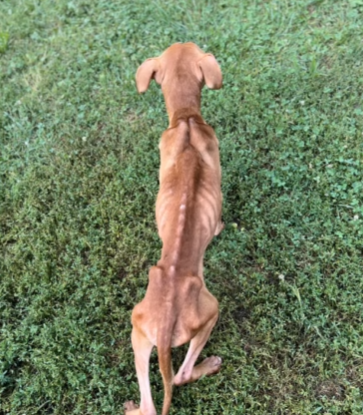
One afternoon, during a supervised walk in the clinic yard, Chance stepped into the grass. He froze, sniffing cautiously, as if afraid it might disappear. Then he took a step. Another.
He walked.
Not far. Not fast. But on his own.
This time, he didn’t fall.
The people watching cried openly, laughter and tears mixing in the warm air. Chance looked back at them, confused by the reaction, tail wagging harder than ever.
Freedom no longer knocked him down.
Months later, Chance’s body told a different story. His ribs were no longer visible. His coat shone in the sunlight. His eyes sparkled with curiosity instead of fear. He loved slow walks, soft toys, and curling up near someone’s feet, always close—but no longer desperate.
He would never forget the chain. Some nights, loud metallic sounds still made him flinch. But he had learned something stronger than fear.
He had learned love.
The day he was adopted, Chance walked proudly out the door, leash loose, head held high. He paused at the threshold, turned back once, and wagged his tail at the people who had saved him.
He had collapsed after his first steps into freedom.
But he rose again.
And this time, he walked toward a life he never knew he was allowed to have.