He lived in the shadows of the village, a place where broken bricks, weeds, and trash met the edge of human life. Most people barely noticed him. Some pretended he didn’t exist at all. But the children noticed. They always did. And not in the way a suffering soul hopes to be seen.
He was small, thin, and constantly trembling. His fur was matted with dust, his ribs visible beneath fragile skin. Every sudden sound made him flinch. Every footstep sent him scrambling for cover. He had learned, through pain and fear, that humans often brought harm.
The children threw stones.
Not always hard enough to kill, but hard enough to hurt. Hard enough to teach fear. Hard enough to remind him, again and again, that he was unwanted.
A Life Shaped by Fear
No one knew how long he had lived like this. Days blended into nights, hunger into exhaustion. He survived on scraps, rainwater, and instinct. When people passed by, he lowered his head and pressed himself against the ground, hoping invisibility might protect him.
His eyes told the story before his body ever could.
They were not angry eyes. They were not aggressive. They were eyes filled with confusion and terror—eyes that asked a silent question: Why do they hurt me?
When stones hit the ground near him, he didn’t bark or fight back. He froze. Sometimes he cried out, a soft, broken sound that barely escaped his throat. Other times, he simply accepted it, curling into himself as if pain were just another part of existing.
Fear had become his normal.
The Day Everything Changed
We first saw him from a distance. He was crouched near a wall, shaking even though the sun was warm. When he noticed us, his body stiffened instantly. His tail tucked tightly under his legs. His ears flattened. He expected pain. He always did.
We stopped moving.
No sudden steps. No loud voices. Just stillness.
That alone seemed to confuse him.
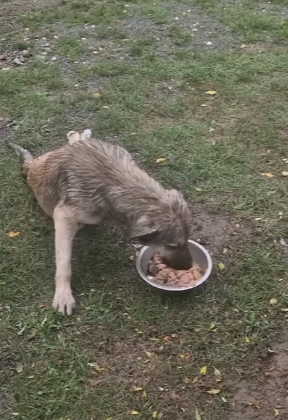
We slowly placed food on the ground—not close enough to scare him, but close enough that he could smell it. Then we stepped back.
He didn’t move at first.
Minutes passed. His eyes stayed locked on us, his body tense, ready to run. Hunger battled fear inside him. His stomach betrayed him with a soft sound, and he flinched at even that.
Finally, inch by inch, he crept forward.
The Moment He Realized
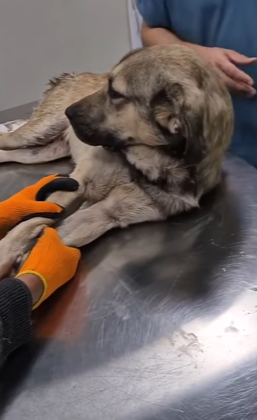
The first bite changed everything.
He froze again, food in his mouth, as if waiting for the stone to come. It didn’t. No shouting. No laughter. No pain.
So he took another bite.
Then another.
Suddenly, his body began to shake—not from fear this time, but from something else entirely. His shoulders hunched, his head lowered, and then it happened.
He burst into tears.
Real, uncontrollable sobs. His body trembled as if years of suffering were pouring out all at once. The sounds he made were heartbreaking—soft cries filled with disbelief and release. It was as if his soul finally understood something his body never had before:
This time, no one is hurting me.
We knelt down, not touching him yet, just letting him be. His tears soaked the dirt beneath him as he continued to eat, cry, and breathe all at once. Hunger, relief, and fear tangled together in that fragile moment.
Trust Is Not Built in a Day
After he finished eating, he didn’t run.
That alone felt like a miracle.
He stayed where he was, watching us cautiously. When one of us slowly extended a hand—not reaching, just offering—it took him several long seconds to respond. Then, barely, he leaned forward and sniffed.
His whole body shook.
When our fingers gently touched his head, he didn’t pull away. Instead, he collapsed into the ground, crying again—this time louder. His legs gave out beneath him, as if he had been holding himself up for years and could finally rest.
That touch wasn’t just physical.
It was proof that kindness existed.
Healing the Invisible Wounds
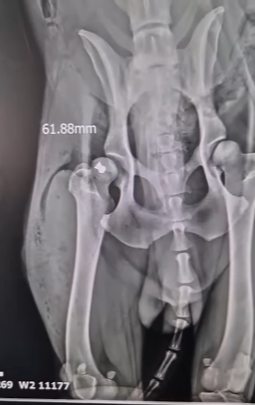
Food filled his stomach, but love began to fill something deeper.
Over the following days, we returned. Each time, his fear softened just a little. His steps became less frantic. His eyes less wide. His body still bore scars, but his spirit began to breathe again.
He learned that hands could feed, not throw.
That voices could soothe, not shout.
That humans could protect, not harm.
Still, there were moments when sudden movement sent him cowering, memories flashing through his body before his mind could catch up. Trauma does not disappear easily. But patience works miracles that force never can.
The Children Never Knew
The children who threw stones never knew his name. Never knew his story. Never saw the tears he cried when kindness finally reached him. To them, he was just something to target. Something weaker.
But weakness was never his truth.
Surviving that level of cruelty required unimaginable strength. Enduring fear every day and still choosing not to bite, not to attack, not to give up—that was resilience.
He wasn’t weak.
He was broken—and breaking is not the same thing.
A New Beginning
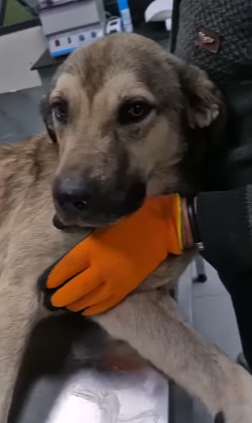
Now, when he eats, his tail wags slightly. When he sees us, he lifts his head instead of lowering it. Sometimes, he even dares to hope.
He still flinches at loud sounds. He still watches children from afar. But he no longer lives only in fear. He knows what food tastes like when it’s given with love. He knows what it feels like to be seen—not as a target, but as a life that matters.
That single meal didn’t just feed him.
It reminded him he was worthy of kindness.
A Quiet Promise
As we left that day, he watched us go—not with fear, but with trust. And in his eyes was something we will never forget: gratitude mixed with disbelief, as if he were afraid kindness might disappear the moment we turned away.
But it won’t.
Because once you see suffering like his, you cannot unsee it. And once you witness tears born not from pain, but from relief, your heart is changed forever.
He was frequently stoned by children.
He lived in fear.
He cried when given food.
But now, he is no longer invisible.