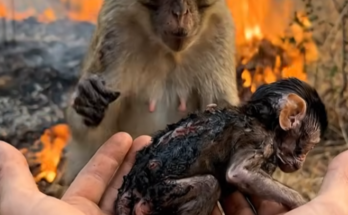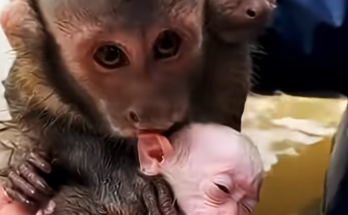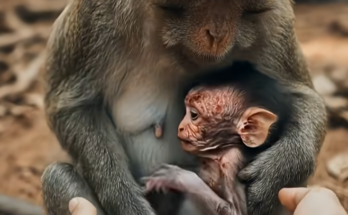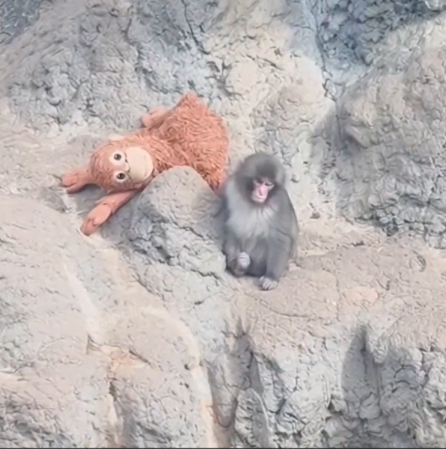
In the heart of a dense tropical forest, life among the monkeys was always a delicate balance of play, survival, and exploration. The forest was alive with the chatter of birds, the rustling of leaves, and the distant calls of other troops, but within this vibrant ecosystem, one young male monkey — known to the troop as Punch — was about to experience a lesson that would stay with him for the rest of his life.
Punch was energetic, curious, and daring beyond his months. His golden-brown fur glistened in the sunlight that filtered through the thick canopy, and his dark, expressive eyes constantly scanned for adventure. He had learned quickly to climb the tallest trees, leap between branches, and imitate the adults’ foraging techniques. Yet, like many young monkeys, his confidence often bordered on recklessness.
The Cliff
There was a particular ridge in the forest that captured Punch’s attention for weeks. From a distance, it seemed like a place of promise — wide rocks, scattered with moss, overlooking a sheer drop into a deep ravine below. The adults of the troop would never venture too close, cautious of the danger it posed. But to Punch, it was irresistible.
“Look at that!” he would squeal to his friends, bouncing on branches. “I want to see what’s down there!”
His mother often called him back, warning him not to approach the edge. But Punch, like many young monkeys, was guided as much by curiosity as by instinct. The thrill of the unknown tugged at him relentlessly.
Approaching Danger
One bright morning, Punch made his move. With the troop distracted by a patch of ripe berries, he climbed higher and higher, weaving through branches until he reached the very edge of the cliff. The wind gusted through the trees, ruffling his fur, adding an adrenaline rush to the view below.
He balanced carefully on the rock’s edge, peering down at the steep drop. The forest floor looked far away, littered with shadows, roots, and jagged rocks. His tiny chest heaved with excitement. Punch had always been agile, and he believed he could handle any challenge the forest threw at him.
But sometimes, even the most capable climbers miscalculate.
The Slip
Punch shifted his weight to get a better look at a lizard scuttling along a moss-covered rock. In that moment, his foot slipped. Moss, wet from morning dew, betrayed him. He let out a startled squeal as gravity took hold.
For a second, time seemed to stretch. Punch flailed his arms, claws scraping the air and rock as he tried desperately to regain footing. But the slope was steep, and momentum pulled him downward, causing him to tumble uncontrollably.
The troop gasped. From their vantage points, the older monkeys could see the young one slipping, twisting, and spinning as he careened toward the bottom. It was a terrifying sight, the kind that froze every monkey in place, even as instinct urged them to act.
A Mother’s Instinct
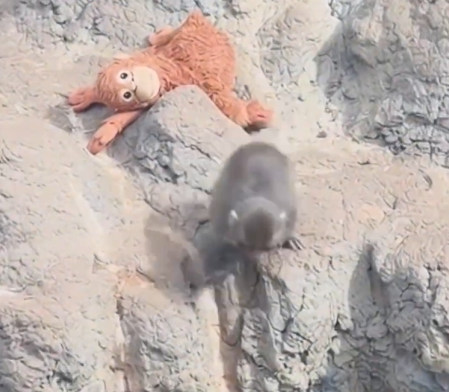
Punch’s mother reacted immediately. Without hesitation, she leapt from branch to branch, her movements fluid and precise. Years of experience navigating the forest allowed her to follow Punch’s descent without getting herself into danger. Her calls rang out, sharp and urgent, a mix of alarm and guidance.
“Punch! Hold on!” she cried, urging him to grab a root or branch along the cliff face.
Punch’s tiny hands grasped desperately at the rough bark, missing sometimes and barely catching at others. The wind and the momentum of his fall made it nearly impossible to find stability. Every slip sent him spinning closer to the bottom.
Yet, the mother’s eyes never left him. Her movements mirrored his, predicting where he might land or what branch could slow his tumble. Her mind worked in overdrive, calculating angles, distances, and timing, all to save her child.
The Tumble
Punch tumbled several meters, bouncing off mossy rocks, rolling over exposed roots, and narrowly missing jagged edges. He let out frightened squeaks with every roll. But in the midst of chaos, there was an underlying resilience — a combination of youth, instinct, and the natural ability of monkeys to survive falls.
The troop watched in anxious silence, hearts pounding as the young monkey fought gravity. Younger monkeys clung to each other nervously, while older ones vocalized warnings, encouragements, and alarms.
Rescue and Recovery
As Punch approached a ledge partway down, his mother made her move. She reached out with a swift leap, grabbing his torso with strong arms just as he slid past the edge. Her claws dug into the rock, anchoring them both. The sudden hold stopped Punch’s fall, giving him a chance to catch his breath.
He clung to her, trembling, eyes wide with fear and shock. His small body shook as adrenaline faded and reality sank in. The mother’s steady presence reassured him. She wrapped her limbs protectively around him, grooming his fur to calm him, murmuring soft, soothing sounds.
Lessons Learned
After the incident, Punch stayed unusually close to his mother. He observed every move, listened to every warning, and hesitated before making bold leaps. The forest was no less inviting, but his recklessness had been tempered by a harrowing lesson in gravity and caution.
Monkeys, like humans, learn through experience. This incident was a harsh, visceral lesson for Punch — the kind that textbooks or verbal warnings could never convey. He understood now that some adventures carried real risk, and that his mother’s guidance was rooted in wisdom and care.
The Role of Family in Monkey Life
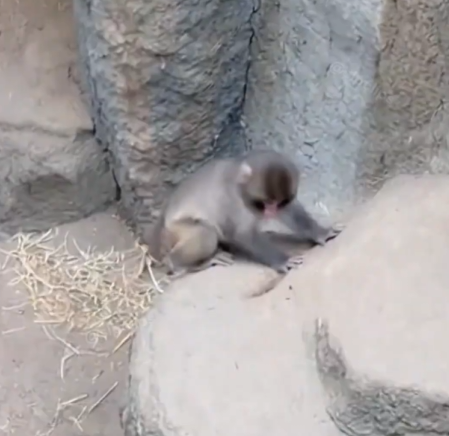
The story of Punch slipping off the cliff illustrates the delicate balance between freedom and protection in a monkey’s life. Young monkeys must explore, test limits, and develop physical and mental resilience. But mothers — and other experienced adults — are ever-present to guide, correct, and protect.
Discipline, correction, and protection coexist with love and teaching. Punch’s mother punished minor recklessness before the cliff incident, often swatting or scolding to reinforce boundaries. Yet, when the real danger appeared, she acted decisively and without hesitation to save her child. Her love was both firm and nurturing, ensuring survival while encouraging growth.
Emotional Recovery
Punch spent the rest of the day under his mother’s watchful eye, slowly regaining confidence. He tentatively explored branches close to her, moving with care and deliberate thought. Every now and then, he glanced back toward the cliff, a silent acknowledgment of the lesson he had learned.
The mother, understanding the psychological impact of such an incident, continued to provide comfort and reassurance. She offered grooming, shared food, and allowed him to cling to her for security. This balance of discipline and affection strengthened the bond between mother and child, reinforcing trust in a world full of risk.
Conclusion
The forest can be a dangerous place, and the lives of monkeys are filled with moments that teach resilience, caution, and skill. Punch’s tumble off the cliff was a terrifying experience, yet it became a crucial lesson in survival. His mother’s swift intervention, combined with the natural instincts of youth, turned what could have been tragedy into a moment of growth and learning.
Through this incident, Punch learned to respect the boundaries of his environment, understand the importance of caution, and appreciate the unwavering protection and love of his mother. His mother demonstrated that discipline, guidance, and immediate action are all expressions of profound care.
Life of monkeys is not only about climbing, foraging, and social play — it is about learning, surviving, and growing under the watchful eyes of those who love and protect them. Punch’s story reminds us that even in moments of chaos and danger, the bond between a mother and her child is a powerful force — one that can stop a fall, teach a lesson, and instill confidence that lasts a lifetime.