Deep in the heart of the lush jungle, where sunlight filtered through thick green leaves and the air was alive with the sounds of birds and insects, a troop of monkeys lived together in a complex hierarchy of social bonds. Among them was a mother macaque named Meera, known for her strength and vigilance, and her little baby, Kiko, whose golden fur glimmered in the sunlight as he tumbled and played with reckless curiosity.
Life in the jungle was not easy. Every day was a struggle for food, shelter, and survival. Meera, like all mother monkeys, had to be both protector and disciplinarian. She loved Kiko dearly, but the jungle demanded respect and discipline if one wished to live. Any mistake, even one born from innocence, could have consequences.
One bright morning, Meera had left Kiko in a shaded part of the canopy while she went to forage for food with the other monkeys. Kiko, bored and restless, noticed a brightly colored fruit hanging from a thin branch that arched over a fast-flowing stream. The fruit was tempting, a glowing orange against the green background. Ignoring the warning calls of other monkeys, Kiko climbed down and reached for it.
Meera had seen the dangerous area from afar but could not leave the group. She hoped Kiko would stay safe. But monkeys, especially young ones, are impulsive creatures. Kiko’s curiosity got the better of him. Just as he grabbed the fruit, the branch snapped under his tiny weight, sending him tumbling toward the water below.
The stream was shallow but fast, and the current threatened to carry Kiko away. Screaming, he tried to grab a nearby root, but his hands slipped. His cries echoed through the jungle canopy.
Meera’s heart raced as she saw her baby in peril. She dashed toward him, her strong limbs carrying her swiftly through the trees. With an incredible leap, she caught Kiko just before the current could sweep him away. She held him tightly, her heart pounding in fear and anger.
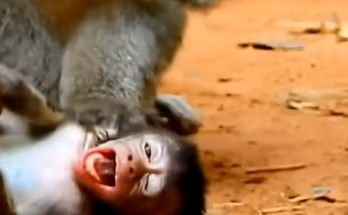
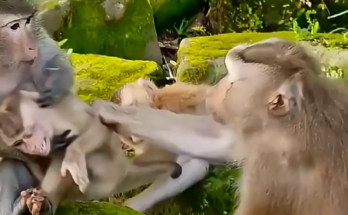
Back in the safety of a sturdy branch, Meera’s emotions boiled over. Relief mixed with frustration. Kiko had been reckless, careless, and oblivious to the dangers around him. In a swift motion, she slapped him across the face. Kiko squealed, startled and frightened by the sudden display of anger.
“Why, Kiko? Why didn’t you listen?” Meera seemed to scream at him, her voice trembling with tension. “Do you not understand the dangers of this jungle?”
Kiko, tears welling in his eyes, whimpered. “I… I just wanted the fruit, mother. I didn’t mean to fall.”
Meera’s anger was not cruelness born from hatred—it was fear and frustration mixed with responsibility. In the jungle, mistakes could mean death. She knew that if Kiko had fallen into the stream alone, predators could have caught him, or he might have drowned. Her “cruel” beating was a harsh lesson designed to teach him boundaries, survival instincts, and respect for danger.
Other monkeys in the troop observed quietly. Discipline, though harsh, was part of the social order. Young monkeys had to learn quickly; hesitation or repeated mistakes could cost them their lives. Meera’s actions, while frightening to Kiko, were in line with the survival rules of the jungle.
Kiko sniffled and looked up at his mother, trying to understand her rage. “But… I was only curious,” he said softly.
“Curiosity is good,” Meera replied, her voice softening slightly, though her gaze remained firm. “But curiosity without caution can kill you, Kiko. The jungle is not safe for careless monkeys. You must learn quickly, or you won’t survive.”
Kiko’s small hands clutched his mother’s fur as he listened. The sharp sting of the slap still lingered, but so did the lessons hidden behind it. In the days that followed, Kiko began to observe more carefully, to listen to the warnings of older monkeys, and to weigh risks before acting.
Meera, though stern, never abandoned her baby. She fed him, groomed him, and protected him. The beating was a momentary expression of fear and frustration, not cruelty in its purest sense. It was a way for her to communicate the seriousness of the dangers he had faced.
The jungle, however, continued to challenge them. Days later, the troop faced a group of humans who had come to collect fruits near the edge of the forest. Meera had always warned her young ones to stay close and avoid humans. But Kiko, curious as ever, ventured too close to the edge. The humans’ sudden movements scared him, and he fell from a low branch, scraping his leg.
This time, Meera’s response was less physical but just as firm. She gathered Kiko, nuzzled him gently to soothe the fear, and then held him firmly, teaching him with calm, deliberate gestures that danger could come from many directions.
Kiko began to understand that his mother’s anger was a protective instinct. She was not cruel because she disliked him; she was cruel in her actions because she loved him and knew the world outside his innocence was unforgiving.
Weeks passed, and Kiko grew more cautious. He still explored, but he observed first, weighed risks, and stayed close to his mother when venturing into dangerous areas. Meera’s anger had taught him lessons that words alone could not convey.
One day, while the troop rested on a high cliff overlooking the river, Kiko watched a younger monkey try to imitate him by reaching for a distant fruit. Kiko called out, “Don’t! The branch is weak!” He rushed over, guiding the smaller monkey to safety. He realized that the fear and discipline his mother had instilled in him were valuable lessons—not just for survival, but for helping others.
Meera watched him from a distance, a proud gleam in her eyes. Kiko had learned, not only from fear but from her actions, that the jungle required respect, caution, and awareness.
Yet, even as Kiko grew wiser, the lessons of that first harsh slap lingered in his memory. He realized that in life, love and discipline were often intertwined. A mother’s anger, while painful, was sometimes the strongest form of protection.
One evening, as the sun set and the jungle was bathed in warm orange light, Kiko approached his mother. “Mother,” he said softly, “I understand now. You weren’t angry because you hated me… you were angry because you cared. You wanted me to live.”
Meera nuzzled him, her eyes softening. “Yes, Kiko. The world is not easy. You must learn quickly, for every mistake has consequences. But I will always protect you, even when you make mistakes. My anger is only because I fear for you.”
Kiko looked at her, understanding completely. The jungle had tested him, but through the trials, the discipline, and the love hidden in harsh actions, he had grown. He had learned caution, responsibility, and respect for the dangers that surrounded him.
In the weeks that followed, Kiko became more independent. He still explored and played, but he moved with awareness. When he fell or made mistakes, he remembered the lessons his mother had taught him through anger and protection. He began to teach younger monkeys in the troop, gently guiding them and warning them of risks, just as Meera had guided him.
The jungle, once a place of fear and peril, became a classroom of life. Meera’s “cruel” anger had transformed into wisdom passed down from mother to child. Kiko had learned that in the wild, love often comes with tough lessons, and survival depends not only on strength but on awareness and careful decision-making.
Months later, when Kiko was a strong, confident young monkey, he faced a dangerous situation with poachers entering the jungle. He quickly remembered the lessons his mother had taught him—the dangers, the caution, the observation. Using his knowledge, he led younger monkeys to safety and avoided capture. He survived because of the lessons learned from the fear and anger that once seemed cruel but were truly acts of love.
That night, as the troop rested and the jungle quieted, Kiko curled up beside Meera. “Thank you,” he whispered. “For everything… even when I thought you were cruel.”
Meera gently groomed him, her eyes shining with pride. “You are welcome, Kiko. Remember, anger is not always cruelty. Sometimes it is the fire that teaches you how to survive. Never forget what you have learned.”
Kiko nodded, feeling the warmth of understanding and the strength of lessons that had been painful but essential. He had survived the dangers, learned caution, and grown wiser because of his mother’s fierce love.
In the jungle, the cycle continued. Young monkeys tumbled, fell, and tested boundaries. Mothers like Meera used discipline, sometimes harsh, sometimes firm, to teach lessons that ensured survival. And through this tough love, the young monkeys learned, grew, and eventually became strong protectors themselves, passing wisdom to the next generation.
The jungle was not cruel—it was real. And in that reality, Meera’s anger, though frightening in the moment, was a shield, a guide, and an expression of love that ensured her baby would live, learn, and thrive.
In the end, Kiko understood something profound: love and discipline are not always gentle, but when combined with patience, care, and guidance, they are the tools that prepare one to survive the world. The cruelty he had once felt was transformed into gratitude, respect, and understanding—a lesson of life in the jungle that would remain with him forever.