

In a dense tropical forest where the canopy formed a living roof of green, a troop of monkeys moved through their daily routines with practiced ease. Sunlight filtered through layers of leaves, casting shifting patterns on branches and forest floor alike. Among the chatter and movement lived a young baby monkey whose days were shaped by a mother known throughout the troop for her strict nature.
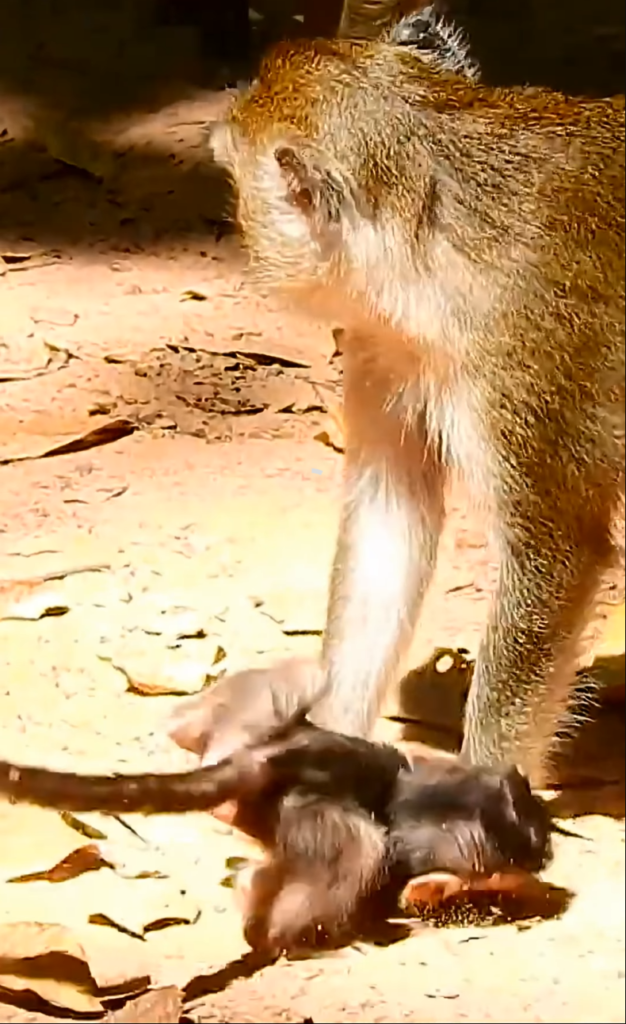
While many mothers carried their babies close, offering frequent grooming and soft reassurance, this mother was different. She watched constantly, her sharp eyes noticing every movement. She corrected quickly — a firm tug when the baby wandered too far, a warning call when it climbed carelessly, a stern posture when play became too rough. To her, the forest was full of dangers, and vigilance was the greatest form of love.
But to the baby, still new to the world, her strictness felt overwhelming.
One morning, as the troop gathered near a fruiting tree, young monkeys chased one another across low branches, squealing with delight. The baby watched from a short distance, curiosity shining in its eyes. It wanted to join, to feel the thrill of play and the warmth of companionship.
Taking a tentative step forward, it began to follow the others.
Before it could go far, its mother issued a sharp call. The baby froze instantly. She approached, gently but firmly guiding it back to a safer perch. Her message was clear: stay close, stay cautious.
The baby lowered its head, unsure. While it understood her authority, a quiet sadness settled in. It watched as other youngsters tumbled and explored, laughter echoing through the trees.
As days passed, the pattern continued. Whenever the baby ventured too far, she intervened. When it reached for unfamiliar food, she inspected it first. When it lingered near the edge of branches, she repositioned it securely.
To the troop, her behavior was not unusual. Many experienced mothers adopted stricter approaches, especially in environments where predators were common or resources unpredictable. Survival often depended on discipline learned early.
Yet the baby began to feel hesitant in her presence.
It would sometimes sit a few steps away, glancing toward her with cautious eyes. When she approached, it stiffened slightly, unsure whether comfort or correction would follow. Though she groomed it regularly — a sign of deep care — her watchfulness never seemed to soften.
One afternoon, while the troop rested in a shaded grove, an older female observed the pair quietly. She had raised many offspring and carried the calm wisdom of experience. Watching the baby’s subtle tension, she moved closer and offered gentle grooming, a gesture of reassurance.
The baby relaxed slightly, leaning into the soft touch.
The strict mother watched from nearby. Though her expression remained composed, she noted the interaction. In the social world of monkeys, learning did not happen only through instinct but also through observation of others.
Later that day, the troop moved toward a stream where cool water flowed over smooth stones. Juveniles splashed playfully at the edges, discovering reflections and chasing drifting leaves. The baby lingered behind its mother, curious but unsure.
Sensing no immediate threats, the mother paused. She gave a low call — softer than usual — and allowed the baby to step forward on its own. The baby hesitated, then cautiously approached the water, touching it with tentative fingers.
It looked back.
The mother remained still, watching but not intervening.
Encouraged, the baby explored a little more, dipping its hands and observing the ripples. A small spark of confidence flickered within. Though she was strict, her presence nearby felt like a protective boundary rather than a barrier.
As evening approached, the troop settled high in a cluster of trees. The forest glowed with warm light, and a gentle breeze rustled through leaves. The baby climbed slowly toward its mother, uncertain but seeking closeness.
She responded by grooming it carefully, her movements precise yet gentle. In those quiet moments, the baby sensed a different side — one not defined by rules but by steady care.
Over time, subtle changes emerged.
The mother still corrected when necessary, but she allowed slightly longer moments of exploration. She watched as the baby played briefly with others, stepping in only when risk increased. The baby, in turn, grew more comfortable approaching her, learning that discipline and affection could coexist.
One day, a sudden alarm call rang through the canopy — a signal of potential danger. The troop reacted instantly, climbing higher and gathering close. The baby rushed toward its mother without hesitation, clinging tightly.

She held it securely, scanning the surroundings.
In that moment, the baby understood something profound: her strictness was rooted not in distance but in protection. Every correction, every watchful glance, every firm guidance had been shaped by a deep instinct to keep it safe in an unpredictable world.
As the alarm faded and calm returned, the baby remained close, feeling a renewed sense of trust. The forest, with all its beauty, also held challenges, and the mother’s vigilance was a shield against them.
Weeks passed, and the baby grew stronger, more confident in climbing and foraging. It ventured out with curiosity, returning often to check in. The mother’s demeanor softened subtly as she recognized its growing abilities.
Their bond evolved — from one marked by caution to one balanced with mutual understanding.
One quiet morning, as sunlight streamed through the canopy, the baby sat beside its mother, watching the troop begin another day. It no longer felt afraid to be near her. Instead, it felt grounded, aware that her strictness had been a form of guidance rather than rejection.
She reached over and groomed its fur, a simple yet powerful gesture. The baby leaned in, relaxed and content.
Life in the forest continued with its endless cycles — moments of play, lessons of caution, and bonds strengthened through shared experience. Within this rhythm, the story of a strict mother and her once-hesitant baby became a testament to the many ways care can be expressed.
Sometimes love is soft and constant; other times it is firm and watchful. For this baby monkey, understanding grew slowly, shaped by patience and time.
And high among the branches, under the vast green canopy, mother and child moved together — no longer divided by fear, but connected by trust forged through life’s quiet lessons.