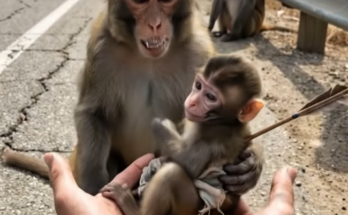
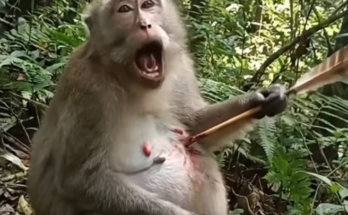
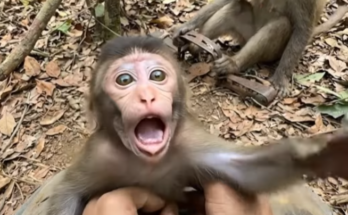
The forest was never truly silent, but that afternoon it felt heavy. The air hung thick beneath the tall trees, trapping every sound and stretching it thin. Leaves shifted overhead, branches creaked softly, and somewhere far away a bird gave a sharp warning call that seemed to echo longer than it should have.
He hadn’t meant to wander so far.
The young monkey had been following the others, leaping from branch to branch, keeping up as best as he could. The troop moved quickly through the canopy, always alert, always in motion. But he had paused for just a second — distracted by a bright butterfly dancing near a low branch.
One second.
Then two.
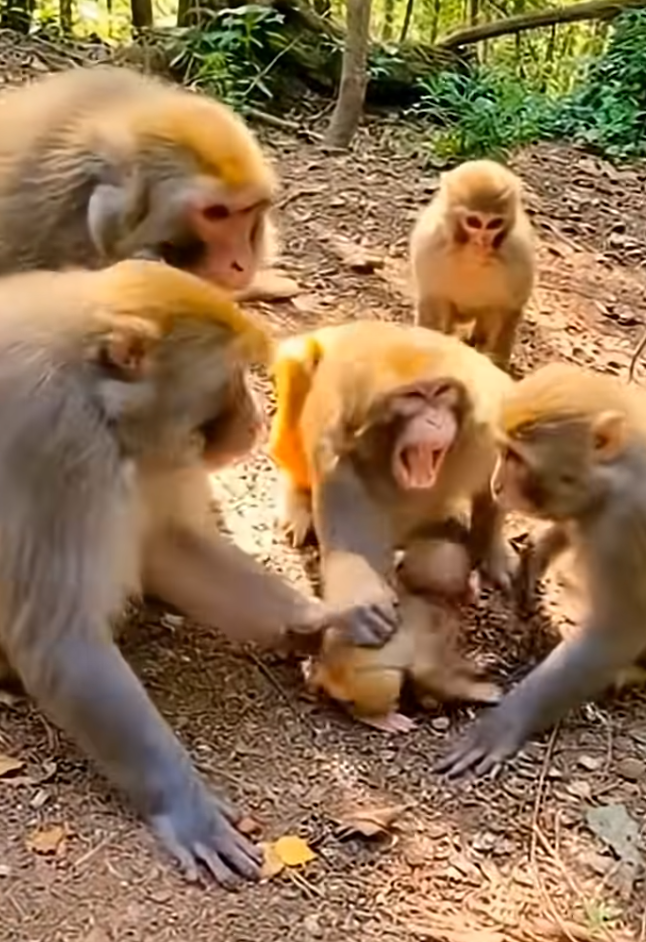
When he looked up again, the branches ahead were empty.
At first, he wasn’t worried. The troop often spread out slightly, and he assumed they were just ahead. He hurried forward, climbing clumsily down a trunk and crossing the forest floor to reach the next tree.
That was his mistake.
The ground was unfamiliar territory. It smelled different down there — damp soil, old leaves, something metallic in the air. The safety of height was gone. The forest floor felt wide and exposed.
He froze.
From the shadows between the trees, shapes began to move.
Not fast.
Not loud.
Just deliberate.
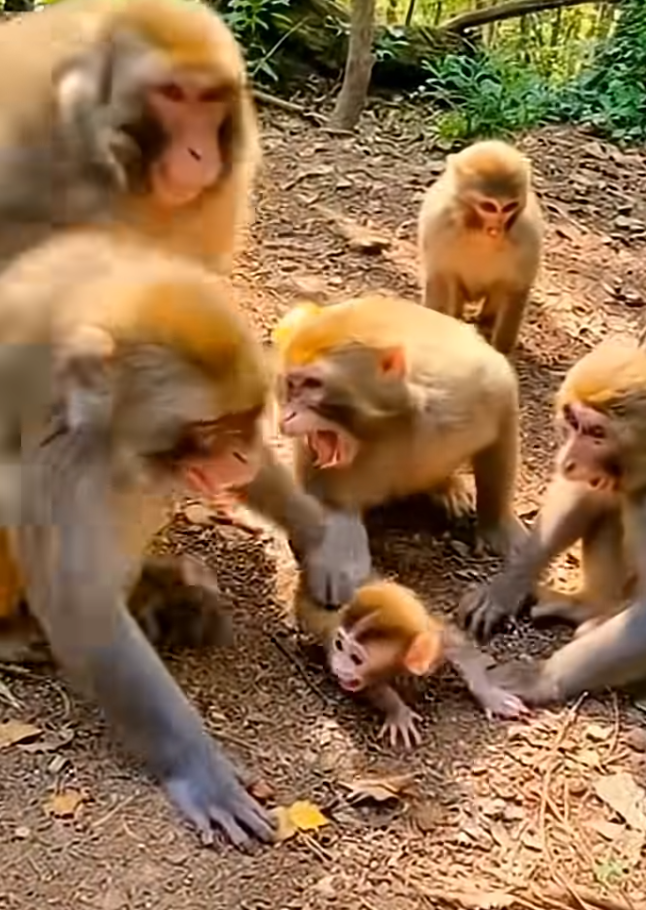
A low growl vibrated through the undergrowth. Another answered from the opposite side. Dry leaves crunched beneath slow, measured steps.
He turned in a circle, heart pounding.
They were everywhere.
Surrounded.
The young monkey’s breath came in quick, shallow bursts. His tiny hands trembled as he searched for the nearest tree trunk. It was only a few leaps away — close enough, he thought, if he was fast enough.
But the shapes in the shadows shifted closer.
Eyes caught the light. Yellow. Watching.
The forest felt smaller, tighter. Every sound was too loud — his breathing, the pounding of his heart, the rustle of his own fur brushing against leaves.
No one came.
He let out a sharp cry, high and desperate. It echoed through the trees, but the canopy swallowed it. He called again, louder this time.
Still, no answer.
Ten seconds can feel like nothing — a blink, a breath.
But in the forest, ten seconds can decide everything.
The predators edged closer, circling. Not rushing. Not wasting energy. They knew he was alone. They knew the ground favored them.
He darted toward the tree.
A sudden burst of movement exploded behind him. He stumbled, scrambling desperately, claws digging into bark as he tried to climb. His small body strained upward, slipping once, twice.
Below him, snapping jaws clashed together where his leg had been a heartbeat earlier.
Ten seconds too late.
If he had reached the tree sooner, if he hadn’t paused for the butterfly, if he had stayed higher with the troop—
A growl shook the trunk.
One of them leaped, claws scraping bark just inches beneath his feet. The impact rattled the tree, sending vibrations through his thin arms. He clung tighter, climbing higher despite the burning in his muscles.
Another predator circled the opposite side, blocking any easy descent. They were patient. Coordinated.
Caught between ground and sky.
The young monkey scrambled onto a low branch, but it wasn’t high enough. The predators paced below, eyes locked on him. One tested the trunk again, climbing slightly before slipping back down. Another sat back on its haunches, watching, calculating.
The forest had gone eerily quiet.
Even the birds seemed to hold their breath.
He cried out again — louder, raw with fear.
This time, something answered.
A distant call.
Familiar.
Strong.
The sound cut through the forest like a crack of thunder.
The troop.
Another call followed, closer now. Branches shook violently high above as shapes moved fast through the canopy. Leaves rained down.
The predators hesitated.
They glanced upward.
Too late.
The first adult monkey dropped from above with explosive force, landing on a branch overhead and shrieking in fury. Others followed, their voices merging into a wall of sound — sharp, aggressive, unrelenting.
The predators backed up slightly but didn’t retreat entirely.
Not yet.
The troop closed ranks. Larger monkeys positioned themselves above and around the young one, shaking branches, baring teeth, lunging downward in warning. Their cries echoed through the forest, layered and powerful.
The message was clear:
He is not alone.
One predator lunged upward again, testing the defense. An adult monkey struck downward with astonishing speed, claws flashing, forcing it back. Another monkey leaped to a lower branch, making itself appear bigger, louder.
The balance shifted.
Predators rely on opportunity — on weakness and isolation.
That advantage was gone.
With one final snarl, the largest of them turned away. The others followed reluctantly, melting back into the undergrowth, their shapes dissolving into shadow.
The forest exhaled.
The young monkey remained frozen on the branch, trembling violently. His chest heaved as adrenaline drained from his small body. He hadn’t realized how tightly he had been gripping the bark until his fingers began to ache.
A familiar figure climbed beside him.
His mother.
Her eyes scanned him quickly, checking for injury. Finding none, she pressed her body against his, wrapping an arm around him firmly. Not gently — firmly.
Grounded.
Safe.
He buried his face into her fur, shaking.
Below them, the troop lingered for several minutes, ensuring the predators had truly gone. Only when the forest’s natural rhythm slowly returned did they begin to move again.
This time, no one traveled alone.
The young monkey clung tightly to his mother as she leaped back into the higher canopy. The ground fell away beneath them, replaced by the woven safety of branches and leaves.
He didn’t look back.
Ten seconds too late could have meant everything.
Ten seconds earlier, and he would never have touched the forest floor.
But ten seconds later — and the troop had arrived just in time.
That is the thin line that runs through the wild: between panic and rescue, isolation and unity, danger and survival.
He had been surrounded.
Alone among them.
But in the end, he was not truly alone.
Because in the forest, even when fear closes in and shadows gather, there is always the echo of something stronger — the bond of the troop, the instinct to protect, the power of coming together when it matters most.
And sometimes, survival hangs on just ten seconds.