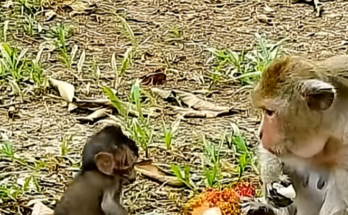
In the layered world of the forest, sound carries meaning. A snapped twig can signal danger. A sudden call can summon help—or attract the wrong kind of attention. Among monkey species, learning when to be silent is as important as learning how to climb. This lesson came sharply into focus one afternoon when a baby monkey, full of energy and curiosity, forgot the quiet rules of survival—and a male monkey stepped in to warn it.
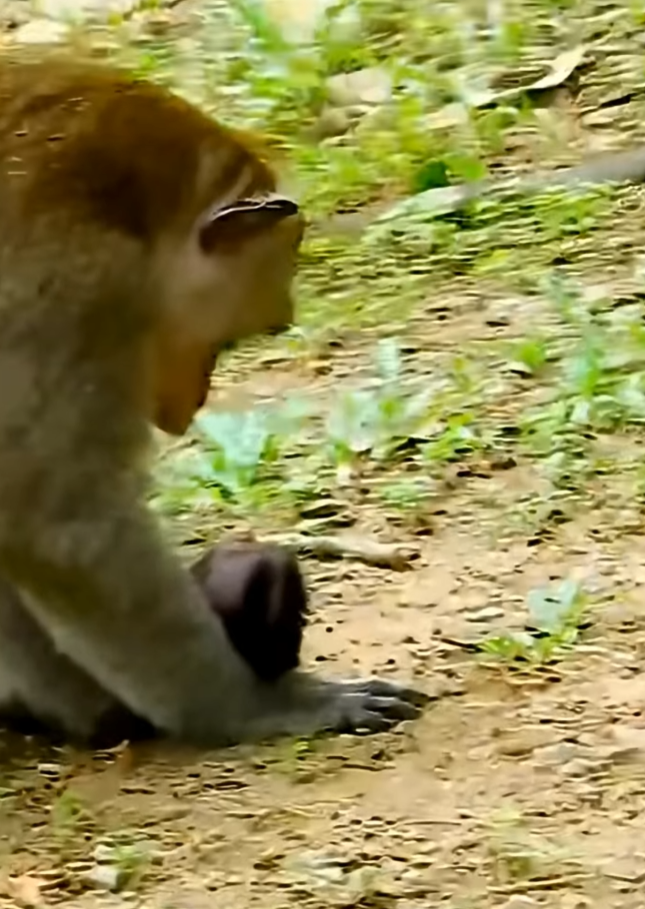
The baby monkey had only recently begun exploring beyond the constant hold of its mother. Its legs were stronger now, its grip more confident, and its voice—high, sharp, and expressive—had become one of its favorite tools. Every discovery inspired a squeak. Every frustration sparked a cry. To the baby, noise was simply a way to announce existence.
But the forest does not always welcome announcements.
The troop had paused in a shaded area, resting after a long movement through the trees. Leaves hung still, and the air felt heavy with watchfulness. Nearby, other animals moved quietly, each careful not to draw attention. This was not a place for careless sounds. Predators were known to pass through, and rival troops sometimes listened from a distance.

The baby monkey, unaware of any of this, bounced clumsily from branch to branch, chattering excitedly. Its voice cut through the calm, loud and persistent. Some adults glanced around uneasily. A few shifted their positions, scanning the surroundings.
The male monkey noticed immediately.
He was larger than the baby, with a presence shaped by experience. His body carried old scars—marks of fights survived, warnings learned the hard way. He was not the baby’s father in any clear sense, but within the troop, he held a protective role. He understood the cost of mistakes, especially loud ones.
With a sharp movement, the male turned toward the baby. He didn’t rush. He didn’t attack. Instead, he fixed the baby with a steady stare and released a low, controlled sound—not a roar, not a scream, but a warning.
The baby froze.
The sudden silence felt strange. The baby’s body stiffened, eyes wide. It had never heard that sound directed at it before. The noise it loved making suddenly felt wrong. Dangerous. The baby glanced around, confused, then looked back at the male.
The male moved closer, slowly. His posture was firm but not aggressive. He reached out and placed a hand near the baby—not touching, but close enough to make the message clear. Another low sound followed, softer this time but still serious.
Be quiet.
The baby’s chest rose and fell quickly. It wanted to cry, to call for its mother, but something in the male’s presence stopped it. This was not anger. This was instruction. The baby sensed it instinctively, even if it could not understand why.
Nearby, the mother watched closely. She did not interfere. Among monkey species, teaching does not always come from mothers alone. Other adults contribute, especially when lessons involve group safety. The mother knew that the warning, though unsettling, was necessary.
The male turned his head slightly, listening. He paused, alert. Then he relaxed just enough to signal that the danger had passed—or at least, that silence was working.
The baby stayed quiet.
For the first time, it noticed the forest differently. Without its own voice filling the space, other sounds emerged. The rustle of leaves. The distant call of birds. The subtle movements of insects. The baby felt small again, aware that it was not alone—and that being noticed was not always good.
After a moment, the male stepped back. The tension eased, but the lesson remained. The baby shifted closer to its mother, staying low, moving carefully. When it opened its mouth to make a sound, it stopped itself halfway, remembering the warning.
This moment marked a change.
Silence, the baby learned, was not emptiness. It was protection.
In monkey societies, vocalizations are powerful tools. Calls warn of predators, signal food, or maintain group bonds. But uncontrolled noise—especially from a vulnerable baby—can bring harm. The male monkey understood this deeply. His warning was not about dominance or discipline. It was about survival.
Later, as the troop moved again, the baby followed more closely than before. Its steps were quieter. Its movements more cautious. When it slipped slightly, it made no sound at all, simply clinging tighter and waiting. The mother noticed and gently groomed the baby, reinforcing calm behavior.
The male watched from a distance. He did not seek praise. His role was complete.
As the day faded into evening, the baby grew tired. It curled against its mother, eyes heavy. The forest dimmed, and sounds softened. The baby made one small noise—a quiet, barely audible hum of comfort. This time, no one reacted. The sound was safe. Appropriate.
The lesson had settled.
In the life of monkey species, growing up means learning when to call out and when to stay silent. It means understanding that sound can protect, but it can also expose. The male monkey’s warning was a brief moment, but its impact would last. The baby would remember the stillness, the watchful eyes, the feeling of being corrected without being harmed.
Tomorrow, the baby would make mistakes again. It would chatter, squeak, and forget. But each warning, each correction, would shape it—teaching not just how to survive alone, but how to survive together.
And in the quiet of the forest, where every sound matters, that lesson could mean the difference between danger and safety, between loss and life.