He waited by the roadside for a long time.
At first, he believed it was only a short stop. His owner had done this before—pulled over, stepped out, told him to stay. He was good at staying. He sat obediently, tail tucked neatly around his paws, eyes fixed on the dusty curve of the road where the car had disappeared. Every sound made his ears twitch. Every passing shadow stirred hope in his chest.
Surely, the car would come back.
The sun climbed higher. Heat pressed down on the cracked asphalt, and the air shimmered. His tongue hung dry and heavy from his mouth. Still, he did not move. He had been taught not to.
Time passed differently for him. Minutes stretched into something vast and aching. The familiar scent of his owner—oil, sweat, the faint trace of tobacco—began to fade from the air. Panic crept in quietly, like a thief. He stood, paced a small circle, then sat again, unsure which choice was the right one.
Loyalty anchored him there.
He did not understand words like useful or burden. He only knew that for years, he had followed that man everywhere. He guarded the yard at night, chased away strangers, wagged his tail when food was scarce but affection was offered. He had been there when life was good and when it was hard. He believed that meant something.
As the afternoon wore on, hunger gnawed at his belly. He nosed the ground, sniffing at discarded scraps and dry weeds. A plastic bag rattled in the wind, making him jump. His heart raced, then sank again. Not the sound he was waiting for.
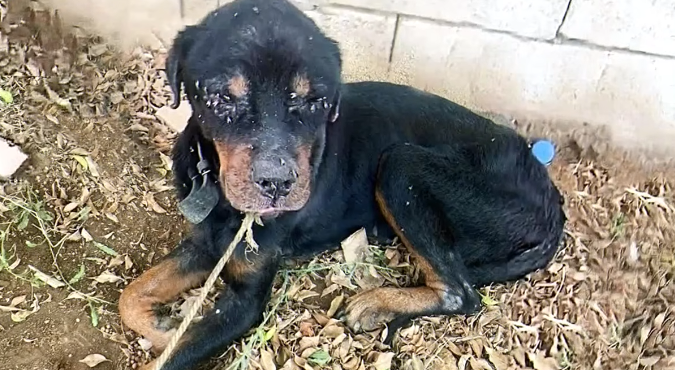
Cars passed, fast and uncaring. Some slowed. A few people looked at him—an old dog, ribs faintly visible beneath dull fur, standing alone by the road. One person shook their head. Another sped up. No one stopped.
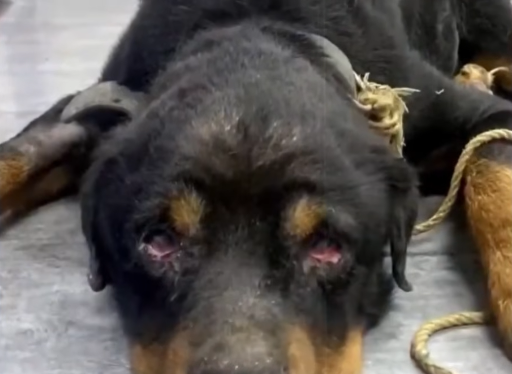
When the sun finally began to sink, cold crept in to replace the heat. The road grew quiet. Crickets sang. The sky burned orange, then purple. His legs trembled from standing too long, but he refused to lie down completely. What if the car came back and he was sleeping? What if he missed it?
Night fell.
Fear felt different in the dark. Shapes became threats. Sounds felt closer, sharper. He curled himself tight beside a bush, nose tucked under his tail, eyes still open. Hunger became pain. Thirst became a fire in his throat. He whimpered once, softly, then stopped, as if ashamed of the sound.
The second day came without mercy.
Morning light revealed the truth he had been avoiding. The car was not coming back. His owner was gone. The road smelled different now, unfamiliar, hostile. Exhaust fumes burned his nose. He wandered a few steps away from the spot where he had been left, then hurried back, confused, torn between instinct and devotion.
By noon, his strength began to fail. His gait slowed. Each step felt heavier than the last. He searched for shade and collapsed beneath a small tree, chest heaving. Flies buzzed around his face. He snapped weakly at them, then gave up.
Memories came uninvited.
A younger version of himself ran across a field, ears flapping wildly. A hand scratched behind his ears, rough but affectionate. A bowl clanged against the ground. A voice called his name. These moments replayed like a cruel joke, reminders of a life that had ended without explanation.
He did not know what he had done wrong.
Was it because he was old? Because his legs no longer moved as fast? Because his bark had grown hoarse, his eyes cloudy? He searched himself for answers, the way animals do—quietly, without bitterness, only confusion.
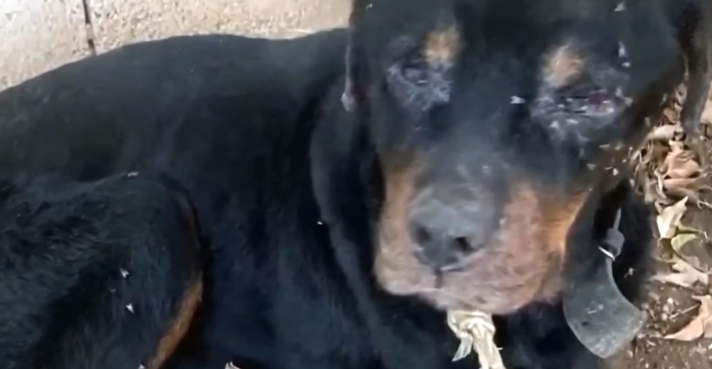
The afternoon heat returned, relentless. His breathing became shallow. He no longer lifted his head when cars passed. The world narrowed to sensation: pain, thirst, the buzzing of insects, the ache of being alone.
This was how it would end, he thought—not with danger or struggle, but with waiting.
And then, footsteps.
They were slow, hesitant. Not the rushed pace of someone passing by, but the careful approach of someone deciding whether to get closer. His ears twitched weakly. He forced one eye open.
A woman stood a few feet away.
She did not rush toward him. She crouched instead, lowering herself to his level, making herself small. Her eyes softened when she saw him—how thin he was, how his sides barely moved with each breath.
“Oh, buddy…” she whispered.
Her voice was gentle, unsure, as if afraid to startle him. He tried to lift his head, but it fell back to the ground. Embarrassment burned through him. He had once been strong. He had once greeted strangers with proud confidence.
She took a step closer.
He did not growl. He did not retreat. He simply watched her, too tired to be afraid. She noticed the worn collar around his neck, frayed and empty where a tag should have been. Her throat tightened.
Someone had owned him.
Someone had chosen to leave him.
She reached into her bag and pulled out a bottle of water, pouring a little into her palm and setting it near his mouth. At first, he did not respond. Then instinct took over. He lapped weakly, desperately, water spilling down his chin. Tears filled the woman’s eyes as she watched him drink like that—like someone who had almost forgotten what relief felt like.
“It’s okay,” she murmured. “I’ve got you.”
The words meant nothing to him, but the tone did. Warmth seeped into him, slow and unfamiliar. She stroked his head, fingers light, respectful. He leaned into the touch without thinking, a small sound escaping his throat—a sigh, half relief, half sorrow.
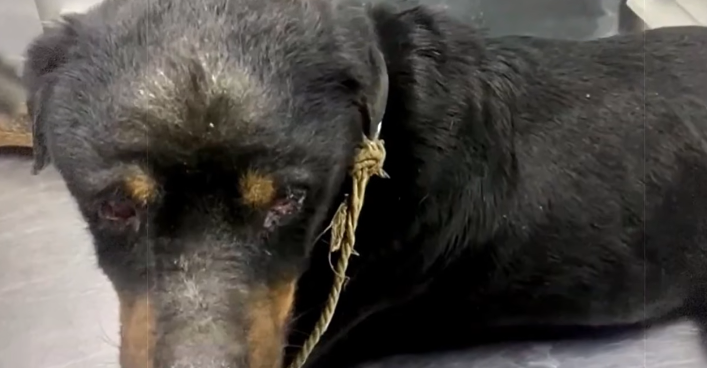
She called for help. She stayed with him while waiting, shielding him from the sun with her body. When the rescue truck arrived, she rode with him, one hand resting on his side, counting his breaths as if sheer will could keep him alive.
At the clinic, they worked quickly. Fluids. Blankets. Soft voices. He drifted in and out, floating between pain and peace. In his fading consciousness, he felt hands that did not push him away, did not abandon him. Hands that stayed.
He survived the night.
Recovery was slow. Painful. There were days he barely moved, days when he stared at walls as if still expecting someone to leave him again. But there was food now. Water. Gentle words. And every day, someone came back.
He learned, cautiously, that being left did not always mean being unwanted.
Months later, his fur grew thicker. His eyes brightened. He still walked slowly, but he walked with purpose. He slept on a soft bed instead of bare ground. Sometimes, he dreamed of the road—but when he woke, there was always someone nearby.
He had been labeled “no longer of use.”
But he was still alive. Still loving. Still worthy.
And that, he learned at last, was more than enough.