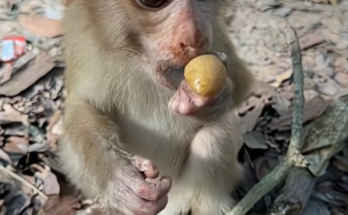
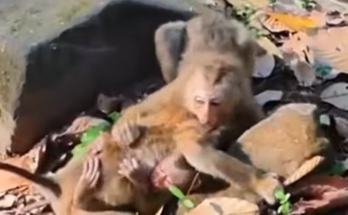
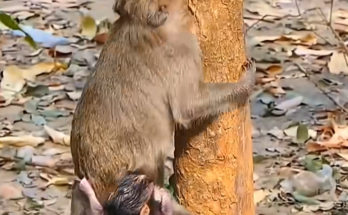
The forest had always lived by its own quiet rules. At dawn, mist curled around the trees like breath, and by midday the canopy hummed with life—birds calling, insects clicking, monkeys leaping from branch to branch with the ease of long habit. For generations, the troop had shared this place. They argued, they played, they groomed one another in the dappled light. Conflict came and went, as it always does in the wild, but balance endured.
Until one day, it didn’t.
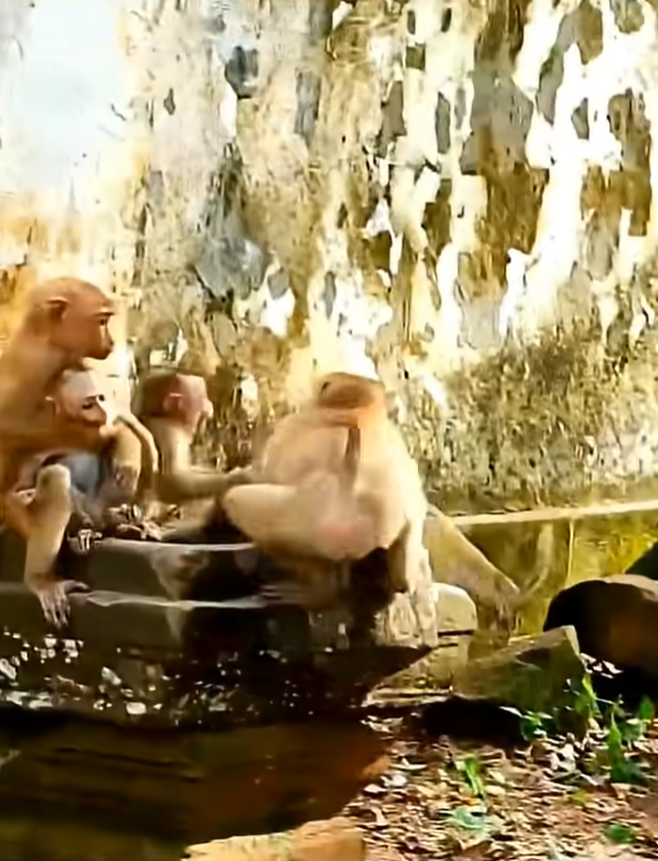
It began with a single monkey—strong, restless, and different. He was not evil, not cursed, not born wrong. He was simply out of place in a season that demanded calm. His temper flared quickly, his calls were sharper, and his challenges came too often. Where the troop sought rhythm, he brought disruption. Where there had been tension before, now there was fear.
At first, the elders tried to manage it. In the life of monkeys, disputes are common. A bite here, a scream there, a quick chase through the branches—then grooming, reconciliation, and rest. This was how order returned. But this time, order did not return. The one monkey refused to yield. He attacked younger males, harassed mothers, and drove others from feeding spots. His presence became a spark that caught on dry leaves.
The troop grew divided.
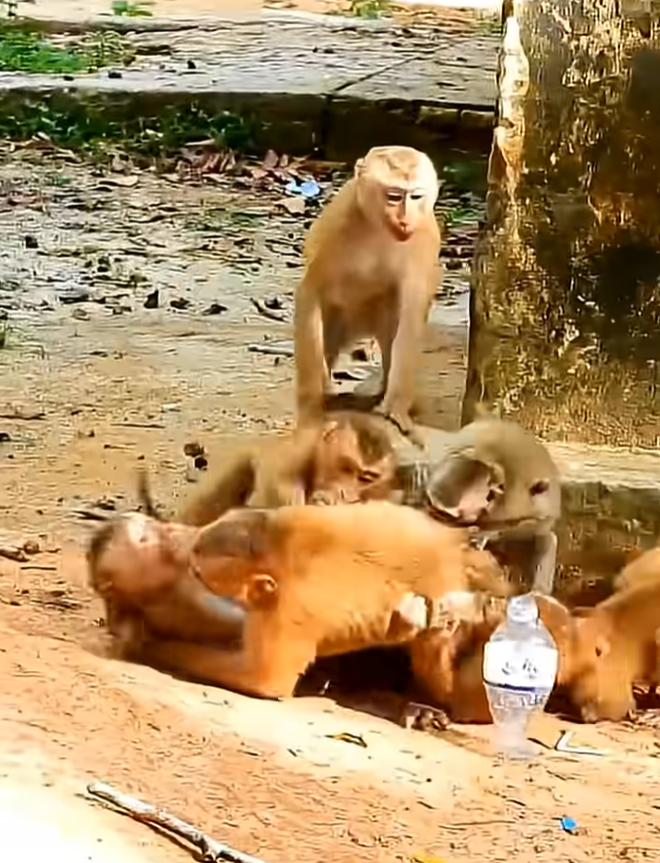
Some followed him out of fear. Others resisted, standing their ground near the old fig tree where food was plentiful and memories were long. Calls echoed through the forest—warning calls, anger calls, cries that carried panic. The air itself felt tighter, as if the forest were holding its breath.
Then came the fight.
It was sudden and overwhelming. Branches shook as bodies collided. Fur flew. Teeth flashed. The forest, once a place of routine and safety, turned into a storm of sound and motion. Mothers clutched their babies and fled. Juveniles screamed and scattered. The elders tried to break the chaos, but the force of it was too strong.
And humans noticed.
From the edge of the forest, people heard the noise and came closer. They had seen conflict before, but never like this. The fight spilled beyond the troop’s usual paths, into fields and near homes. Crops were damaged. A child was nearly caught between charging bodies. Fear spread quickly among the people, just as it had among the monkeys.
Fear changes decisions.
Authorities were called. Words like danger and control were used. Plans were made in haste, without time for understanding. The problem, they said, was the monkeys. The solution, they decided, was removal.
No one stopped to ask which monkey had started it. No one paused to see the mothers hiding with their babies, or the injured elders limping through the undergrowth. In moments of panic, nuance disappears. The forest became a problem to be solved, not a life to be protected.
And so, a terrible choice was made.
The days that followed were heavy with silence. Traps were set. Shots rang out. One by one, lives were taken—not because each monkey was dangerous, but because it was easier to erase a whole story than to read it carefully. The one monkey who had sparked the chaos disappeared into the confusion, but it did not matter anymore. Punishment fell on everyone.
When it was over, the forest felt wrong.
The fig tree stood untouched, its fruit ripening with no one to eat it. Grooming calls were gone. The playful crashes of juveniles leaping too boldly were gone. The rhythm that had shaped the place for years was broken. Even the birds seemed quieter, as if they sensed the loss.
People returned to their routines, telling themselves it had been necessary. Safety had been restored. The problem was gone.
But something else was gone too.
In the life of monkeys—and in the life of humans—conflict rarely belongs to one individual alone. It grows from pressure, from shrinking spaces, from fear that has nowhere to go. One monkey may have lit the match, but the fire was fed by a world that had grown too small for everyone sharing it.
The story spread quietly, mostly as a warning. This is what happens when things get out of control. Yet few spoke about the mothers who had tried to protect their babies, or the elders who had tried to keep peace. Fewer still spoke about the forest itself, now emptier, less alive.
Time moved on, as it always does.
New growth pushed through the soil where footsteps once passed. Leaves fell and returned. But the absence remained—a hollow where a community had lived. Balance, once broken, is not easily restored.
This story is not just about monkeys. It is about what happens when fear overrides understanding, when the actions of one are used to justify the destruction of many. It is about the cost of choosing the fastest solution instead of the wisest one.
If there is a lesson here, it is a painful one: collective punishment never tells the whole truth. In nature, as in life, every group is made of individuals—some troubled, some gentle, some simply trying to survive.
The fierce fight took place, yes. But the greater tragedy came after, when listening stopped.
And the forest, though still standing, has never quite sounded the same since.