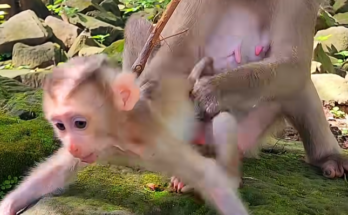
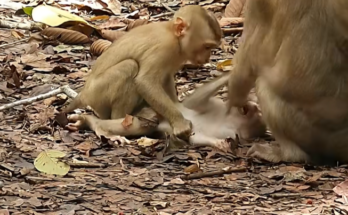
The hands moved slowly, carefully, as if the forest itself were watching and holding its breath. Fingers brushed against damp soil, slick stones, and tangled roots, following the thin, cruel line that disappeared into the earth. Fishing line—clear, almost invisible—cut through the undergrowth like a secret trap, waiting for an unlucky life to cross its path. Somewhere nearby, fear trembled in the air.
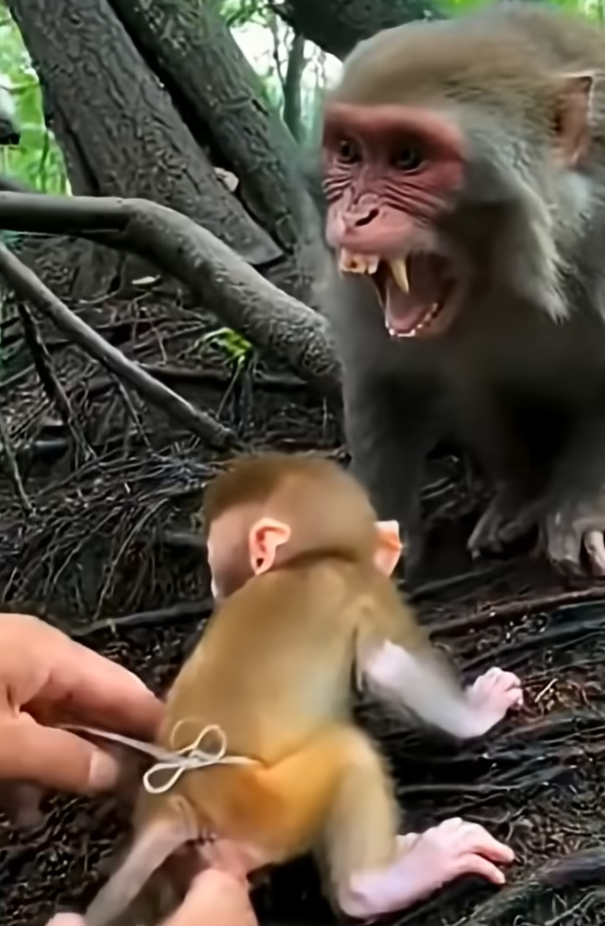
The forest floor was quiet but tense. Leaves lay flattened where something had struggled. A small body shifted just out of sight, making soft, exhausted sounds that barely carried above the rustle of wind. The line was tight, wound deep among roots and stones, pulled into a knot by panic and pain. Whoever was caught had fought hard. Too hard.
The hands paused.
This was not a moment for strength, but for patience.
Fishing line doesn’t forgive mistakes. One sharp pull can tighten it further, biting into skin, cutting circulation, stealing time. The hands adjusted, easing pressure first, tracing the path of the line instead of yanking at it. Fingertips felt the tension, measured it, respected it. The goal was simple and fragile: loosen, not pull.
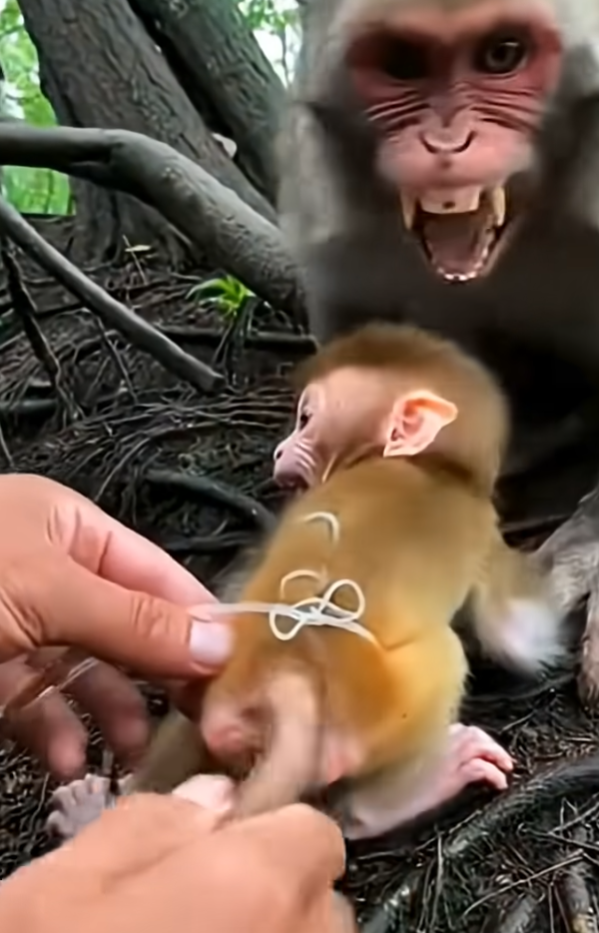
A small monkey clung to a low root nearby, eyes wide and glassy with fear. The line had wrapped around his leg, then twisted again around a stone as he tried to escape. Every movement had only made it worse. Now he hung awkwardly, muscles trembling, breath shallow, heart racing. He watched the hands with a mix of terror and hope, unsure which would come next.
The hands lowered themselves to his level.
No sudden movements. No loud sounds.
Just a soft presence, steady and calm, entering a moment that had been nothing but pain. The monkey’s fingers tightened on the root. His body shook, not from cold, but from exhaustion. He had cried until his voice thinned into silence. He had fought until his strength ran out. Now all he could do was wait.
The line disappeared beneath a rock wedged between roots. It had been there a long time—sun-bleached, roughened by dirt, abandoned by someone who never looked back. Carelessness leaves sharp edges in the world, and they often cut the smallest lives first.
The hands worked around the stone, easing it free a fraction at a time. Pebbles shifted. Soil crumbled. The line slackened just a little.
The monkey gasped.
Not a cry—just a sudden breath, as if air had finally found its way back into his lungs. His eyes flicked down to his trapped leg, then back to the hands. He didn’t move. He couldn’t afford to.
“Easy,” the silence seemed to say.
The hands pinched the line gently, lifting it away from his skin just enough to check the damage. Red grooves marked his fur. The leg was swollen, but still warm. Still alive. Time mattered now—not rushed time, but careful time. The kind that doesn’t panic.
Roots crisscrossed the ground like a maze. The line looped through them again and again, clever in its cruelty. The hands followed each loop, loosening where possible, cutting only when necessary. A small tool appeared, glinting briefly before disappearing back into a pocket. Not yet. Cutting too soon could cause recoil, snapping the line back against fragile flesh.
So the hands kept loosening.
One loop slid free of a root. Another loosened around a stone. Each small success felt enormous. The monkey’s breathing slowed. He dared to blink. He dared to hope.
At last, the line lay slack against the ground.
The hands tested it, just a whisper of movement. No tightening. No bite. Carefully, they lifted the line away from the monkey’s leg, millimeter by millimeter. When it finally came free, the monkey flinched—not from pain, but from surprise. He looked down, lifting his leg slightly, then setting it back down again, unsure if the danger was truly gone.
It was.
The line lay coiled and harmless now, cut into pieces that would never trap another life. The hands gathered it all—every fragment, every length—because rescue is not complete if the danger remains.
The monkey didn’t run.
He sat there for a long moment, trembling, watching the hands as if committing them to memory. His leg wobbled when he tried to stand, but it held. He tested it again. A little stronger. A little braver. He let out a soft sound—something between a sigh and a thank you—and shifted closer to the roots, where he felt safest.
The forest exhaled.
Birdsong returned, tentative at first, then steady. Leaves stirred. The ordinary sounds of life resumed, as if the moment had been folded carefully back into the world. But something had changed. A line had been removed. A path had been cleared.
The hands stayed a while longer, just in case.
They watched as the monkey groomed his leg, slow and deliberate, as if reassuring himself that it was still his. He climbed a little higher, then paused, looking back one last time. His eyes were still wary, but the fear had softened. He disappeared into the leaves, leaving only the faintest trace of where he had been.
Later, the hands stood and brushed dirt from their palms. They looked down at the roots and stones, at the place where the line had hidden so well. It was easy to imagine how many others might have passed here without noticing, how many dangers remain unseen until it’s too late.
Fishing line is small. It feels insignificant when tossed aside.
But in the forest, it becomes a silent net, tightening around ankles and wings and throats. It waits. It doesn’t care.
Hands that loosen it—hands that choose to kneel among roots and stones—become something else entirely. They become a pause in the cruelty. A chance. A turning point measured not in grand gestures, but in patience and care.
That day ended quietly. No applause. No witnesses.
Just a forest made slightly safer than it had been before, and a small life that would keep moving through it—climbing, playing, surviving—because someone took the time to loosen a line instead of pulling it tight.
And sometimes, that is enough.