It was late afternoon when I noticed the children gathered near the edge of the empty lot behind my house. Their laughter floated through the warm air, sharp and careless, the kind of laughter that usually meant mischief. At first, I paid no attention. Children often played there, tossing stones, chasing each other, inventing games that only made sense to them.
Then I saw it.
One of the boys picked up something small and dark from the ground and threw it hard. It landed with a dull thud, not the sharp sound of a rock. Another child ran over, nudged it with his foot, and laughed again.
A strange uneasiness settled in my chest.
“That’s not a stone,” I muttered, standing up.
I walked closer, my steps slow but deliberate. As I approached, the children noticed me and scattered, their laughter fading as quickly as it had come. The object lay still in the dirt, half-covered in dust.
When I finally stood over it, my heart stopped.
It was a puppy.
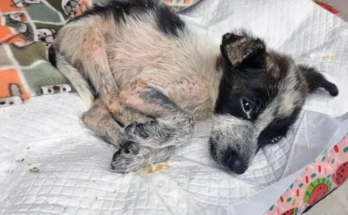
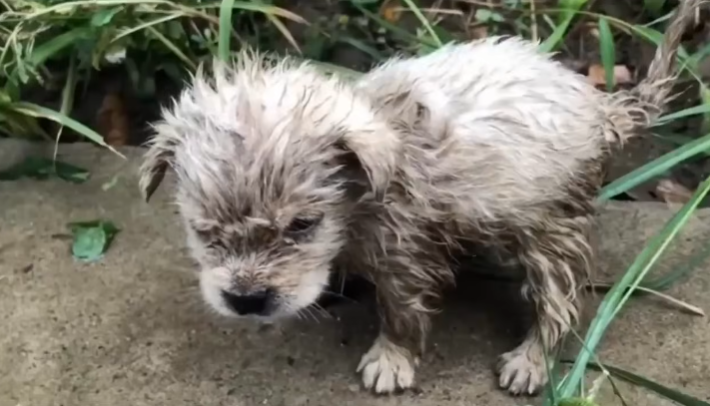
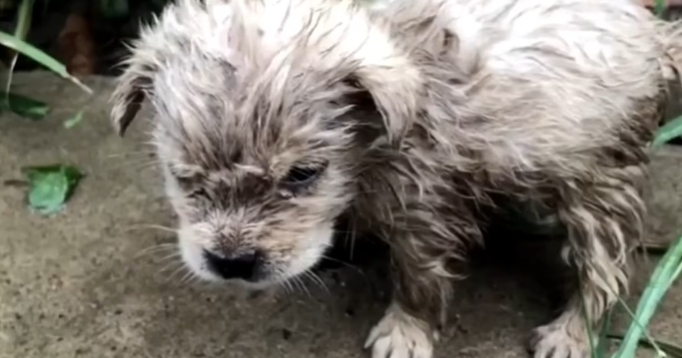
He was tiny—far too young to be alone. His fur was matted with dirt, his body limp, his breathing so faint I had to crouch down and listen carefully. One of his legs was twisted at an unnatural angle, and his small belly rose and fell unevenly, as if every breath required effort.
For a moment, I couldn’t move.
Anger surged through me, hot and uncontrollable. How could anyone—especially children—treat a living creature like this? How could something so small, so helpless, become nothing more than a toy to be thrown?
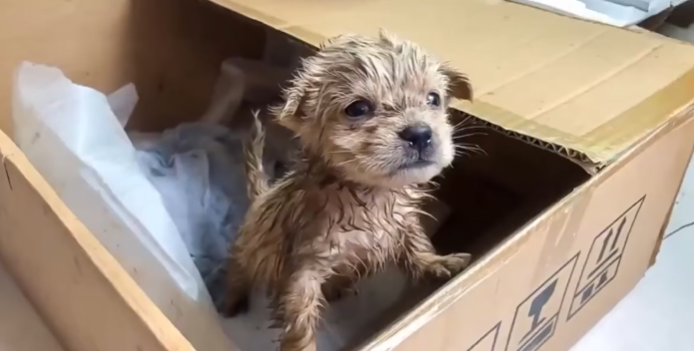
I gently scooped him up. He let out a weak whimper, barely louder than the rustling leaves around us. His body was cold. Too cold.
“Hey, hey… it’s okay,” I whispered, though I wasn’t sure he could hear me.
I rushed home, cradling him against my chest like something fragile and priceless. With every step, I feared he would stop breathing. At home, I wrapped him in a towel and tried to warm him with my hands, rubbing gently, begging him silently to hold on.
He smelled of dirt and fear.
I offered him a few drops of water with a syringe. At first, he didn’t respond. Then, miraculously, his tongue moved. He swallowed. Just a little—but enough to make my chest ache with hope.
That night, I didn’t sleep.
I kept him beside me, waking every few minutes to check his breathing. His tiny body twitched from time to time, as if reliving whatever terror he had experienced before I found him. Each twitch felt like a knife in my heart.
By morning, he was still alive.
I took him to the nearest vet as soon as they opened. The vet examined him carefully, shaking her head as she checked his leg and ribs.
“He’s been handled roughly,” she said quietly. “Very roughly.”
The leg was fractured. He was dehydrated, malnourished, and covered in small bruises. The vet explained that puppies this young often don’t survive such trauma.
“But he’s trying,” she added, glancing at the small bundle wrapped in a blanket. “That counts for something.”
I named him Milo.
I don’t know why the name came to me, but it felt right—soft, hopeful, something that belonged to a puppy who deserved a future.
The first few days were touch and go. Milo barely ate. He cried softly in his sleep, little sounds that made my throat tighten every time. I fed him slowly, cleaned his wounds, and kept him warm. When I held him, he would tense at first, then relax just enough to fall asleep against my arm.
Trust came slowly.
Very slowly.
Sometimes, when I reached out, he flinched. Other times, he froze completely, eyes wide, as if expecting pain. Those moments hurt the most—not because of what he did, but because of what he had learned.
Someone had taught him that hands were dangerous.
As weeks passed, Milo grew stronger. His leg healed with the help of a tiny cast. His appetite improved. His fur became softer, cleaner, lighter in color. He began to explore the room, dragging his cast awkwardly, determined to see everything.
One morning, something changed.
I was sitting on the floor, not paying attention, when I felt a gentle pressure against my leg. I looked down to see Milo pressing his head against me, tail wagging weakly.
It was the first time.
I laughed, tears filling my eyes, and carefully stroked his head. This time, he didn’t flinch. He leaned into my hand instead.
From that day on, his world began to open.
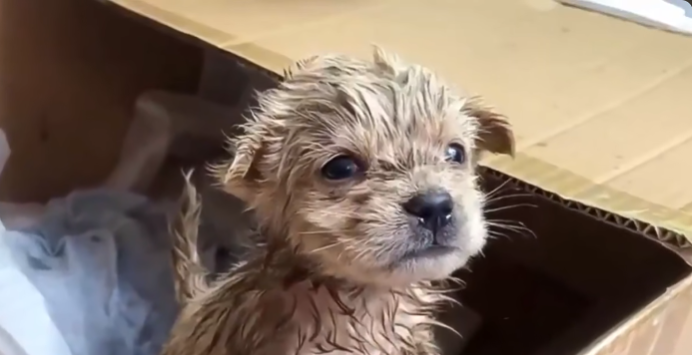
He learned what toys were—for playing, not for being thrown. He learned that voices could be kind. That laughter didn’t always mean danger. He learned that when someone approached him, it could mean food, warmth, or affection.
Sometimes, though, the past still caught up with him.
Sudden movements startled him. Loud shouts made him hide. If children ran nearby, he would freeze, trembling, eyes darting nervously. I would sit beside him, speaking softly, reminding him that he was safe.
And slowly, he believed it.
Months later, Milo became almost unrecognizable from the puppy I had found in the dirt. He grew bigger, stronger, more confident. His leg healed completely, leaving only a slight limp when he was tired. His eyes, once filled with fear, now sparkled with curiosity.
He loved the sun. He loved rolling on the grass. He loved following me everywhere, as if afraid that if he looked away, I might disappear.
One afternoon, we walked past the same empty lot.
The memory hit me like a wave.
Milo stopped, sniffing the air, tail wagging lazily. He showed no fear now—only interest. I realized then how far he had come. That place, once the site of his suffering, held no power over him anymore.
As we walked on, I glanced back once more.
I didn’t feel anger this time.
I felt relief.
Relief that I had been there that day. Relief that curiosity had pulled me closer. Relief that a strange object thrown by careless hands had turned out to be a life I could save.
Milo trotted beside me, head high, completely unaware of how close he had come to disappearing without ever knowing kindness.
Sometimes, the smallest moments change everything.
Sometimes, stopping to look—really look—can turn cruelty into compassion, and curiosity into a second chance at life. 🐾