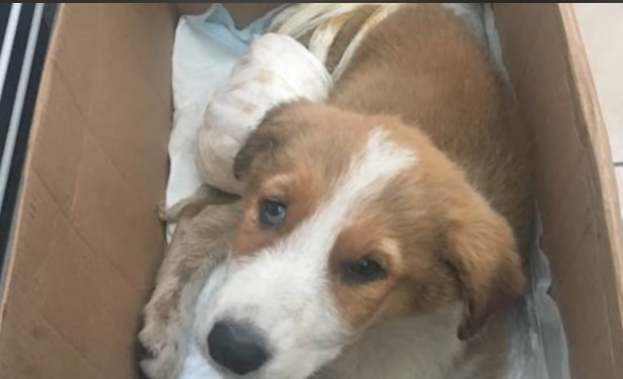
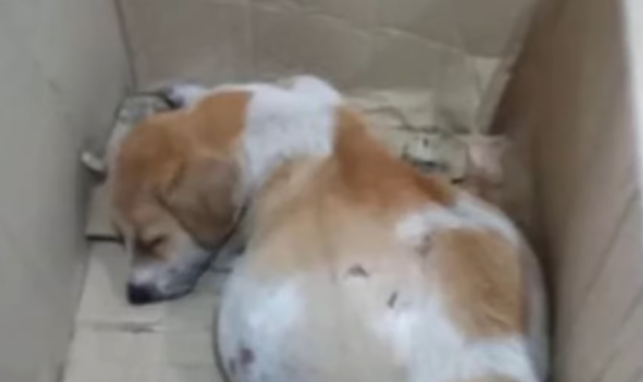
The puppy was so small that he fit entirely in my hands, light as if life itself had barely decided to stay. His fur was matted, his belly swollen in a way that didn’t match the rest of his fragile body. Every breath came shallow and fast, a quiet fight he was already losing. When I found him behind the market stalls, he didn’t run. He didn’t even lift his head. He just looked at me with eyes far too tired for something so young.
I knew then that this was bad.
We wrapped him in a jacket and rushed to the nearest veterinary clinic. The drive felt endless. The puppy whimpered once, a thin sound that cut straight through my chest, then fell silent again. I kept whispering to him, promising things I wasn’t sure I could deliver—warmth, food, a future. His belly was hard when I touched it, unnaturally firm, like something inside didn’t belong.
When we arrived, the vets moved quickly. One look at his condition and the room shifted into urgency. They placed him on the table, slid instruments into place, and gently pressed on his abdomen. The puppy cried out, and the vet immediately stopped.
“That’s not normal,” she said quietly.
An X-ray was ordered.
We waited just outside the room, staring at the floor, listening to the hum of machines. When the image appeared on the screen, the vet froze. Another staff member leaned in closer. No one spoke for several seconds.
“What… is that?” someone whispered.
The X-ray showed his tiny stomach packed tight with dark, jagged shapes. Too many. Too sharp. Too solid.
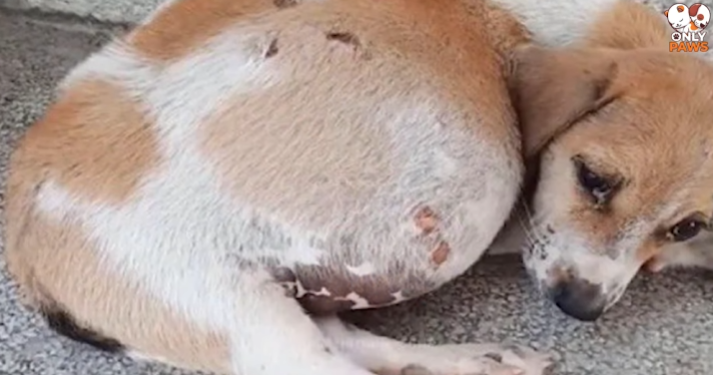
The vet turned to us, her face pale. “This puppy didn’t eat food,” she said. “He ate trash.”
Inside his stomach were pieces of plastic, rubber bands, cloth fibers, fragments of rope, and something that looked terrifyingly like metal. Bottle caps. Shards of packaging. Bits of string knotted together into a choking mass. It was as if his hunger had driven him to swallow anything that smelled even faintly edible.
The vets were horrified.
“He must have been starving for days,” another vet said. “Maybe longer.”
The puppy wasn’t sick because of a virus or parasites. He was dying because his stomach was full—full of things no living creature should ever have to eat.
They explained the danger in calm, professional voices. The objects could perforate his stomach. They could block his intestines completely. Toxins from plastics could poison his blood. Without surgery, he would not survive. Even with surgery, there were no guarantees.
The puppy lay on the table, unaware of the words being spoken over him. His tail twitched once, weakly, as if responding to a dream.
We said yes immediately.
The surgery began that night.
Hours passed. The waiting room emptied. Lights dimmed. Every time a door opened, my heart jumped. Finally, the vet emerged, her surgical cap pulled low, exhaustion etched into her face.
“We got it out,” she said.
She showed us a tray.
What lay there didn’t look real.
A tangled, filthy mass of plastic bags, chewed flip-flop pieces, string, fabric, bottle caps, and hardened food wrappers—compressed into the shape of the puppy’s stomach. It was bigger than my fist. Bigger than his head.
“He survived because he’s strong,” the vet said softly. “And because you brought him in when you did.”
But the danger wasn’t over.
The puppy was placed in intensive care. Tubes snaked from his tiny body. Machines monitored his heartbeat. His stomach had been cut open and stitched back together; now it needed time, rest, and careful feeding to heal. Infection was a constant threat.
We named him Lucky, though at the time it felt like tempting fate.
The first night was the hardest. Lucky didn’t wake up fully. He slept, unmoving, his chest rising just enough to keep hope alive. I sat beside the kennel, watching, afraid to blink.
The vet warned us gently. “If he wakes up and tries to eat too soon, it could rupture the stitches.”
So we waited.
Morning came slowly. Sunlight filtered through the clinic windows. A nurse adjusted Lucky’s blanket, and suddenly—so small it almost didn’t happen—his tail moved.
Once.
Then again.
He opened one eye, cloudy and confused, and let out the tiniest sound.
The room exhaled.
Recovery was not a straight line. Some days Lucky seemed brighter, lifting his head, sniffing the air. Other days he refused to eat even the liquid food, turning away as if afraid of what hunger had taught him. The vets explained that starvation changes animals. It teaches them that eating is pain, that swallowing is danger.
We fed him drop by drop.
Slowly, carefully, we replaced fear with safety.
As days passed, Lucky began to change. His belly softened. His fur started to shine. He discovered toys—and immediately tried to eat one, sending the entire room into panic. The vet gently took it away and laughed, a sound halfway between relief and tears.
“He still thinks everything is food,” she said.
They worked patiently, teaching him what was safe. Real meals. Real bowls. Hands that didn’t disappear.
When Lucky was finally strong enough to leave the clinic, the vet knelt beside him.
“Most puppies don’t survive this,” she said. “You should know that.”
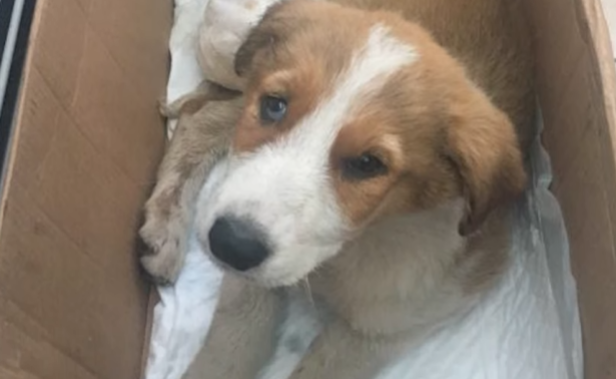
We did know.
Outside, Lucky hesitated on the pavement, overwhelmed by space and sound. Then he stepped forward, nose low, tail wagging uncertainly. For the first time, he wasn’t searching for scraps. He was just… exploring.
At home, he slept for hours, curled into a tight ball, his stomach rising and falling peacefully. Sometimes he whimpered in his sleep, paws twitching, reliving a world where hunger screamed louder than instinct.
Weeks went by.
Lucky grew.
His legs lengthened. His ears perked. His eyes sparkled with mischief. The scar on his belly faded from angry red to pale pink—a quiet reminder of what he survived.
One evening, as he ate his dinner calmly from a bowl, I realized something that made my chest ache.
He was leaving food behind.
Not gobbling. Not panicking. Just… stopping when he was full.
That was the moment I knew he was truly healing.
Sometimes, when people meet Lucky, they laugh at his name and say how cute he is. They have no idea what once lived inside him. They don’t know that hunger drove him to eat the world because the world gave him nothing else.
The vets were horrified by what they found in his stomach.
I can still see their faces when they showed us that tray.
But every time Lucky runs across the yard, belly full, tail high, eyes bright with trust, I remember something else too.
Horror can turn into hope.
And even the smallest life, once starved of everything, can still choose to live.