They said he was a monster.
That single word followed him everywhere, whispered by fearful voices and shouted by angry ones. People crossed the street when they saw him coming. Children hid behind their parents. Even adults looked at him with a mixture of disgust and dread. No one stopped to understand him. No one tried to see past his appearance.
So one day, they abandoned him.
He was left at the edge of a deserted road, surrounded by weeds, broken bottles, and silence. The car that brought him there drove away without looking back. Dust settled slowly, and the sound of the engine faded into nothing. He stood there for a long time, confused, waiting for someone to return.
But no one did.
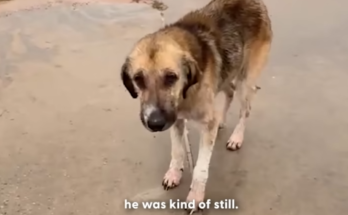
The “monster” was actually a dog—a large one, with a twisted jaw and scarred face. An old injury had healed badly, leaving his mouth uneven and his expression permanently grim. One eye drooped slightly, giving him a look many found terrifying. But behind that face was a gentle soul who had only ever wanted love.
He didn’t understand why he was alone.
For hours, he stayed near the road, ears perked, hoping the familiar scent of his humans would return. When night fell and the air grew cold, he curled up under a tree, shaking—not from fear of the dark, but from the sudden emptiness of being unwanted.
The next days were cruel.
Hungry and thirsty, he wandered cautiously into nearby streets. People screamed when they saw him. Some threw stones. Others shouted for him to go away. Every rejection cut deeper than the last. He began to believe what they saw—that he really was a monster.
Eventually, he stopped approaching people at all.

He slept behind dumpsters and scavenged for scraps at night. When he heard footsteps, he hid. When he saw lights, he ran. His body survived, but his spirit slowly broke. His tail never wagged. His head stayed low. His eyes, once hopeful, now avoided every gaze.
Until one person didn’t look away.
Her name was Sarah.
She worked at a small animal clinic and often took a shortcut through the industrial area after her shifts. One evening, she noticed a large shape huddled near a fence. At first glance, even she felt a flicker of fear. The dog looked intimidating—scarred, dirty, and tense.
But then she saw his eyes.
They weren’t aggressive. They were tired. Lonely. Sad.
Sarah stopped.
She didn’t rush toward him or call out loudly. She simply sat down on the curb, a few meters away, and spoke softly. “Hey there,” she said. “You don’t look like a monster to me.”
The dog froze.
No one had ever spoken to him like that before. He expected shouting. Pain. Rejection. Instead, he heard calm. Kindness. Patience.
He didn’t move.
Sarah returned the next day. And the day after that. Each time, she brought food and sat quietly nearby. She never forced contact. She let him decide. Slowly, the dog inched closer, drawn by the food—and something far stronger.
Trust.
The first time he let her touch him, he trembled from head to paw. Sarah gently rested her hand on his back, expecting him to pull away. He didn’t. Instead, he let out a deep sigh, as if releasing years of pain in a single breath.
That moment changed everything.
Sarah took him to the clinic. The staff stared at first, uncertain. But after examining him, they realized the truth. His scars were old. His jaw injury had never been treated. The drooping eye was harmless. He wasn’t dangerous. He wasn’t aggressive.

He had just been misunderstood.
They named him Bruno.
Recovery wasn’t easy. Bruno was scared of sudden movements and loud noises. He flinched when people raised their hands too quickly. But he never growled. Never snapped. All he wanted was reassurance.
As weeks passed, something incredible happened.
Bruno began to smile.
Not the crooked, frightening grin people once feared—but a real smile, with a gently wagging tail and soft eyes. He learned what toys were. He learned that hands could bring comfort instead of pain. He learned that he didn’t have to hide anymore.
When visitors came to the clinic, they were shocked.
“That’s the scary dog?” they asked, watching Bruno lean lovingly against Sarah’s legs.
Children who once would have screamed now knelt to pet him. Bruno remained calm and patient, as if he understood that his job was to show the world he was not a monster after all.
Then came the moment that stunned everyone.
One afternoon, a frightened rescue puppy arrived at the clinic, shaking uncontrollably. None of the other dogs could calm him. Bruno was brought in as a last attempt.
He walked slowly toward the puppy, lay down beside him, and gently nudged him closer. The puppy stopped crying almost instantly, curling up against Bruno’s chest.
The room fell silent.
The dog once abandoned for being “too scary” had become a source of comfort.
News of Bruno spread. People came just to meet him. His story touched hearts far beyond the clinic. Eventually, Sarah made the decision official—Bruno came home with her, not as a rescue case, but as family.
Today, Bruno sleeps on a soft bed, goes on long walks, and greets each morning with joy. He is protective but gentle, strong but kind. His scars are still there, but they are no longer seen as something ugly.
They are proof of survival.
Bruno was never a monster.
He was a victim of fear, of ignorance, of judging by appearance alone. All it took was one person brave enough to look closer, to choose compassion over fear.
He was abandoned because of how he looked.
But what happened next showed the world who he truly was—and reminded everyone that sometimes, the real monsters are not the ones with scars, but the ones who refuse to see the heart beneath them.