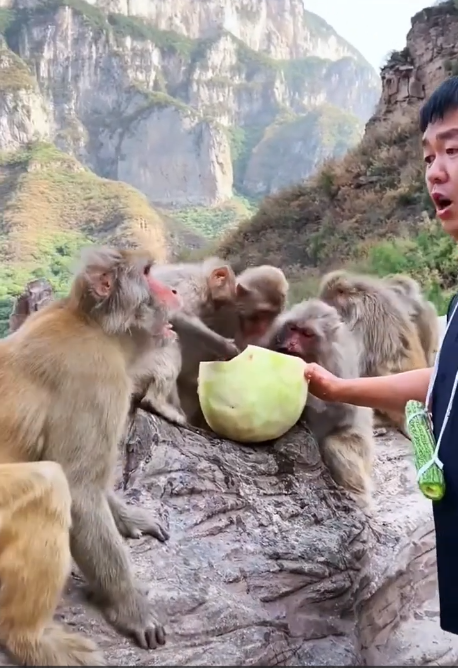
At the edge of a dense bamboo grove in southern China lies a park famous for its playful primates and scenic beauty. Tourists flock to witness the antics of the monkeys, hoping for that perfect selfie or an entertaining moment. Yet, behind the cheerful laughter and camera flashes, the monkeys themselves are growing increasingly weary—tired of a little trick humans love to play: the mirror.
The park, designed as a haven for wildlife and a popular tourist attraction, is filled with clever primates who have long learned to adapt to human presence. Visitors are often greeted with curious faces peeking from trees, nimble hands reaching for fruit, or cheeky monkeys that snatch hats and sunglasses. Among these creatures, there’s a certain species—Cynomolgus macaques—that has become particularly famous for their interactions with mirrors installed throughout the park.
Initially, the mirror experiment was supposed to be a fascinating study in animal behavior. Researchers and park staff placed mirrors in various locations to observe how monkeys react to their reflections. At first, the results were amusing. A lone monkey, discovering a mirror for the first time, would leap back in fright, then cautiously approach, tilting its head to inspect the stranger mimicking its every move. Other monkeys, drawn by curiosity, would gather around, chatter, and even make gestures, attempting to communicate with the reflection. Tourists were delighted. Social media exploded with videos of monkeys staring, grimacing, or seemingly “posing” for their own reflections.
But the novelty wore off—for the monkeys. What had begun as an intriguing puzzle gradually became a daily frustration. They learned quickly that no matter how aggressively they gestured, the mirror never responded with proper social cues. Unlike their usual interactions, which are dynamic and involve negotiation, grooming, and playful roughhousing, the mirror’s reflection was static—it merely copied without understanding. Soon, the monkeys began to show signs of irritation.
A young male named Bai, known for his mischievous streak, once spent hours trying to intimidate the “other monkey” in the mirror. He bared his teeth, thumped the ground, and even attempted to lunge forward, only to bounce off the unyielding surface of glass. At first, the park staff found it hilarious, watching Bai’s expressions shift from curiosity to frustration to bewilderment. But the repeated exposure to these mirrors started affecting the monkeys’ mental state. Bai, and many others like him, began avoiding the mirrored areas, moving to shaded groves or climbing higher into the bamboo to escape the relentless gaze of their reflection.
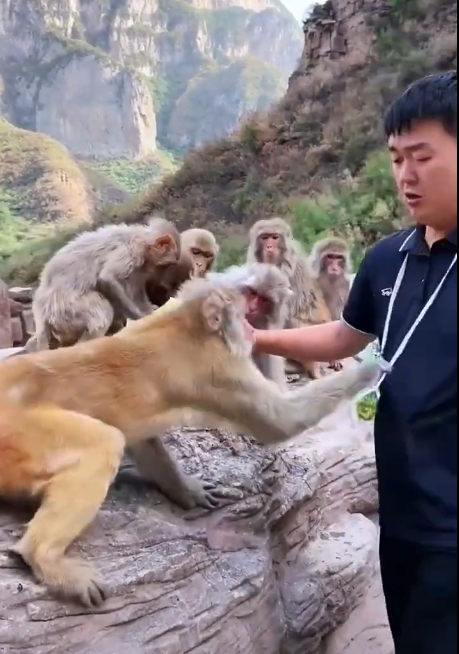
The park staff noticed other changes as well. Grooming habits among the monkeys declined slightly, as they spent more time glancing at the mirrors than tending to one another. Social cohesion, while not entirely disrupted, became tense in the mirror zones. Fights occasionally broke out, triggered not by competition over food or mates, but by the simple fact that a monkey misread another’s reflection as a rival. Mothers were observed scolding their babies more frequently near mirrored walls, as if to warn them of the strange “phantom monkeys” lurking in the glass.
Researchers began documenting the phenomenon, realizing that monkeys, like humans, are sensitive to repetitive, unnatural stimuli. Mirrors, they discovered, could cause confusion and mild stress when used excessively. While mirrors might provide mental stimulation for short periods, the constant presence of reflections disrupted the monkeys’ natural routines. Some monkeys even began to act out deliberately, testing whether the mirror could be “tricked” by unusual postures or by throwing small objects in front of it. The mirror, of course, remained indifferent, reflecting every gesture with perfect accuracy yet offering no reward or recognition.
The tourists, oblivious to the growing discontent of the monkeys, continued to line up for the best angles. Smartphones captured every grimace, pout, and exaggerated pose. Guides encouraged visitors to tempt the monkeys closer to mirrors, hoping for viral moments. But the primates, increasingly aware of the human gaze and the predictable outcome of the mirror, started showing clever avoidance behavior. Older monkeys, in particular, taught the younger ones to be wary. They would dart past mirrors without even a glance, a silent rebellion against the persistent trickery of the park’s human caretakers.
One afternoon, a group of tourists noticed a mother monkey sitting quietly by a mirrored wall, her infant clinging to her back. The mother glanced at the reflection with a faint look of suspicion, then nudged her baby away. The baby, naive and curious, reached out toward the mirrored face, only for the mother to gently pull it back. Observers later recounted that it was as if the mother was teaching the child about the futility of the reflection, warning it against wasting time on a “false companion.” The scene resonated deeply with the researchers, illustrating the monkeys’ growing collective understanding of the mirror phenomenon.
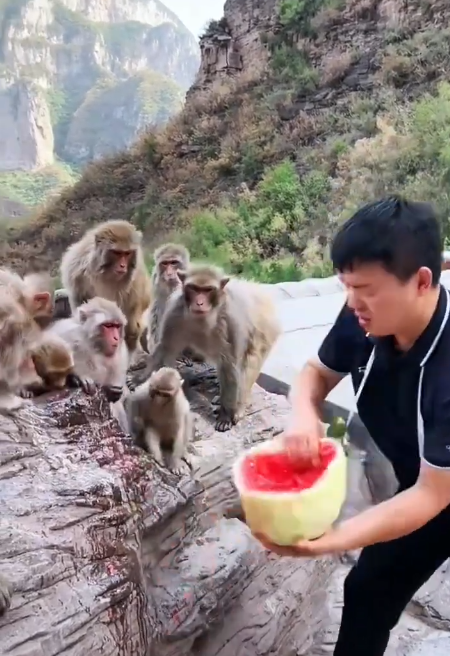
As weeks turned into months, the park began adjusting the use of mirrors. Some were removed entirely, while others were placed in areas where monkeys had little reason to congregate. Staff introduced more natural enrichment activities—puzzle feeders, climbing structures, and scattered fruit trails—to engage the monkeys without relying on artificial stimuli. Visitors were subtly educated about the ethical treatment of animals and the importance of respecting their intelligence. Signs were posted: “Monkeys are smart. Please do not disturb them with tricks.”
Interestingly, some monkeys adapted in unexpected ways. Bai, the previously aggressive young male, learned to use a mirror strategically. Instead of confronting the reflection with anger, he began using it to practice facial expressions and gestures he had observed in other monkeys. It became a private rehearsal space, a mirror of skill rather than conflict. In a sense, the mirror had evolved from a source of frustration into a tool—but only after the monkeys asserted control over how and when they interacted with it.
By the end of the year, a delicate balance was restored. Mirrors remained in the park, but they were no longer a dominant feature of the monkeys’ environment. The animals regained their confidence and freedom to interact naturally. Observers could still enjoy the sight of monkeys discovering their reflections, but now it was brief, harmless, and fully under the monkeys’ own terms. The humans had learned a lesson too: intelligence and awareness are not limited to their own species, and even something as simple as a mirror can become a source of stress if imposed without consideration.
Visitors left with memories of playful primates, but those who watched closely could sense the subtle undercurrent of wisdom in the monkeys’ eyes. They weren’t just entertaining animals; they were beings capable of recognizing repetition, testing boundaries, and asserting autonomy. The mirror trick, once a source of amusement for humans, had become a quiet story of resistance and learning for the monkeys. They were no longer mere reflections of curiosity—they were actors in their own right, demanding respect and space in a world that too often treats them as objects of amusement.
In the end, the monkeys at that Chinese park learned to navigate the mirrors with a mix of wariness and ingenuity. They taught humans an invaluable lesson: intelligence, patience, and adaptability are often hidden beneath playful facades. And sometimes, the most profound message comes not from the humans watching, but from the animals who quietly say, “We are more than your reflection.”