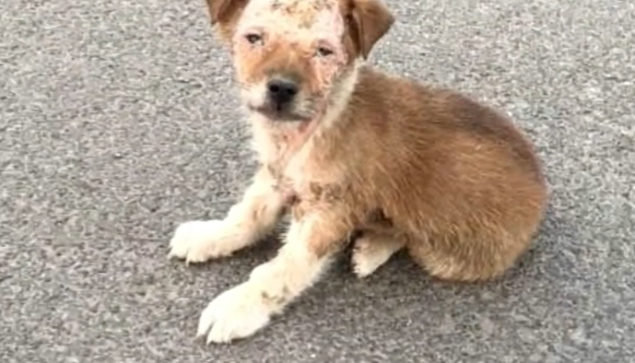
On a dusty roadside at the edge of a busy town, where motorbikes roared past and vendors called out over the hum of traffic, a small, scruffy puppy wandered alone.
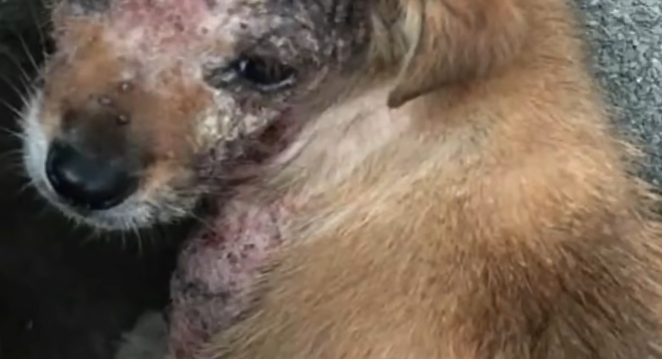
His fur stuck out in uneven patches, matted with dirt and burrs. One ear flopped forward while the other stood stubbornly upright, giving him a permanently confused expression. His ribs showed faintly beneath his thin coat, and his tail—though wagging whenever he saw someone—was often tucked low with uncertainty.
People noticed him, but not in the way he hoped.
“Shoo!” a shopkeeper would shout, waving a broom as the puppy crept near the doorway, drawn by the smell of fried noodles.
A group of children laughed as he followed them for a few steps, hopeful for a pat or a crumb, but they ran off quickly, leaving him standing in a cloud of dust.
He didn’t understand why.
All he knew was that he was hungry, tired, and longing for kindness.
Each day, he searched for scraps behind food stalls, careful to stay out of sight. Sometimes he found a piece of stale bread or a few grains of rice scattered on the ground. Other times, he went to sleep with his belly aching and empty.
At night, he curled up beneath an old wooden cart, listening to the distant sounds of laughter and music drifting through the streets. He dreamed of warm places and gentle hands—though he had never truly known either.
One afternoon, under the blazing sun, he wandered toward a small café where customers sat chatting over iced drinks. The puppy approached cautiously, tail wagging in slow hopeful sweeps.
A woman noticed him and wrinkled her nose. “He looks filthy,” she said. “Someone should take him away.”
The café owner clapped his hands sharply. “Go! Go!” he shouted.
Startled, the puppy backed away, ears flattening. He paused at the edge of the road, looking back once before trotting off.
Despite everything, he never stopped hoping.
A few streets away lived an elderly man named Dara, who sold fruit from a wooden stall. He had seen many strays over the years, but this little puppy caught his attention one morning as he sniffed cautiously near a pile of discarded banana peels.
“Hello there,” Dara said softly.
The puppy froze, unsure.
Dara crouched slowly and tossed a small piece of ripe banana toward him. The puppy sniffed it, then gobbled it up in seconds, tail wagging faster now.
“Well, you must be hungry,” Dara murmured.
From that day on, whenever the puppy passed by, Dara would leave a little food near the stall. Sometimes it was fruit scraps; sometimes a bit of leftover rice wrapped in paper.
The puppy began to linger nearby, sitting at a respectful distance as if afraid that coming too close might make the kindness disappear.
Still, not everyone was welcoming.
One morning, a customer complained loudly. “Why is that dirty dog here? He’ll scare people away!”
Dara sighed but said nothing. After the customer left, he scratched the puppy gently behind the ear. “Don’t worry,” he whispered. “You’re not bothering me.”
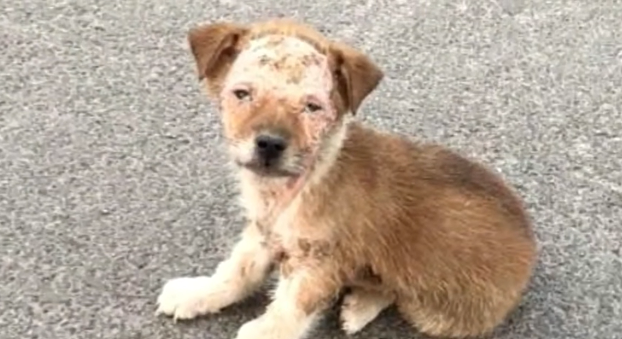
The puppy leaned into the touch, eyes closing briefly in contentment.
Days turned into weeks.
Though he remained scruffy, his spirit grew brighter. He learned the rhythm of the market—the times when food was plentiful, the quiet hours when he could nap safely in the shade.
Yet life on the streets was never easy.
During a sudden storm, rain poured down in sheets, turning the roads into rivers of muddy water. The puppy shivered beneath a parked truck, soaked to the bone, whimpering softly as thunder cracked overhead.
Across the street, a young woman named Lina watched from her apartment window. She had noticed the little dog before—the way he hovered at the edges of crowds, the way he wagged his tail even when people shooed him away.
Seeing him now, trembling in the rain, stirred something deep within her.
She grabbed an umbrella and hurried downstairs.
Approaching slowly, she knelt a few steps away. “Hey, little one,” she said gently.
The puppy looked up, unsure but curious.
“It’s okay,” she murmured, extending her hand.
After a moment’s hesitation, he crept forward and sniffed her fingers. She smiled softly and stroked his muddy fur.
“You’re so scruffy,” she said, not unkindly. “But you’re very brave.”
She coaxed him under her umbrella and led him to a dry corner near her building. Returning moments later with a bowl of water and some leftover chicken, she watched as he ate eagerly, tail wagging nonstop.
From then on, Lina began leaving food for him daily.
One evening, as she sat on the steps, the puppy curled beside her, resting his head on her foot. She laughed quietly. “I think you’ve adopted me,” she said.
But she knew the streets were dangerous.
Cars sped through the narrow roads without slowing. Stray dogs sometimes fought over territory. Illness lurked in puddles and trash heaps.
After discussing it with her family, Lina made a decision.
The next morning, she gently lifted the puppy into a carrier—he whimpered at first, unsure of what was happening, but her soothing voice calmed him.
They went to a small animal clinic.
The veterinarian examined him carefully. “He’s underweight and has some skin infections,” she said. “But with care, he’ll recover.”
Over the next few weeks, the puppy received baths, medication, and proper meals. His fur began to grow softer, filling in the patchy spots. The constant itchiness faded, replaced by playful energy.
At Lina’s home, he discovered toys, cozy blankets, and the joy of a full belly. He chased shadows across the floor, wagging his tail with boundless enthusiasm.
They named him Lucky.
Sometimes, Lina would sit with Lucky on the balcony, watching the world below.
“Do you remember the market?” she asked one evening.
Lucky tilted his head, ears perked.
“We should visit,” she said.
When they returned, Dara’s face lit up. “Look at you!” he exclaimed, kneeling to greet Lucky, whose tail wagged furiously.
“He’s doing so well,” Lina said, smiling.
Dara nodded, eyes warm. “He just needed someone to see him.”
Word spread quickly through the market. People who once drove the scruffy puppy away now bent down to pet him, surprised by his transformation.
“He’s beautiful,” someone remarked.
Lucky accepted the attention happily, though he stayed close to Lina, as if knowing she was his safe place.
As months passed, Lucky grew stronger and more confident. His once-scruffy coat shone in the sunlight, and his eyes sparkled with curiosity.
Yet Lina never forgot how he had once wandered, unwanted.
She began volunteering with a local animal rescue group, helping feed strays and raise awareness about adoption. Lucky often accompanied her, greeting other dogs gently, as if offering silent reassurance.
One day, while distributing food near a construction site, Lina noticed another small dog hiding behind a pile of bricks—thin, frightened, and alone.
Lucky approached slowly, tail wagging in a friendly arc.
The little dog peeked out cautiously.
Lina smiled. “Looks like you’re paying it forward,” she said softly.
As the sun dipped below the horizon, casting golden light across the dusty ground, Lucky sat beside Lina, content.
He no longer wandered in search of kindness—he had found it, and now he helped share it.
And though once he had been the scruffy puppy people drove away, he had become something else entirely: a reminder that beneath tangled fur and timid eyes, there can be a heart waiting patiently for someone to care.