The first time I saw her, she didn’t even look up.
She was curled tightly in the corner of her kennel, nose tucked beneath her tail, as if she could disappear into herself. Around her, the shelter buzzed with hopeful energy — families walking past, children pressing their faces against the glass, volunteers smiling and pointing at wagging tails. Dogs barked excitedly, jumping against their gates as people approached.
But not her.
Her name on the card read: Luna. Age: 3 years. Breed: Mixed. Notes: “Gentle. Quiet. Needs patience.”
I crouched down slowly. “Hi, Luna,” I whispered.
No tail wag. No curious glance. Just stillness.
A volunteer approached me softly. “She used to greet everyone,” she said. “But after being returned twice… she just stopped trying.”
Returned.
The word hit harder than I expected.
Apparently, Luna had been adopted once by a young couple who decided she was “too shy.” Then again by a family who said she “wasn’t playful enough.” Each time, she came back quieter.
Eventually, she stopped walking to the front of the kennel. Stopped wagging. Stopped hoping.
“She doesn’t even look at potential adopters anymore,” the volunteer added gently. “It’s like she doesn’t want to be chosen.”
I sat there for a long time.
While other dogs barked and danced for attention, Luna remained curled in the corner. And something inside me broke a little.
It wasn’t that she didn’t want a home.
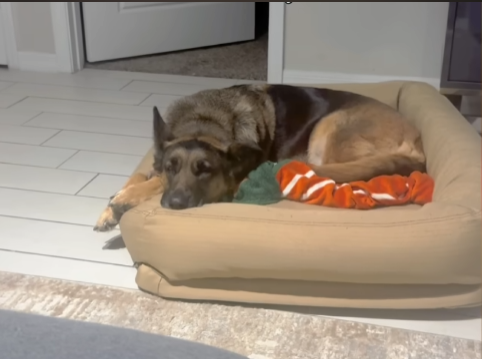
She just didn’t want to be disappointed again.
I asked if I could meet her outside.
The volunteer clipped on a leash, and Luna stood slowly, almost mechanically. She followed without pulling, without resistance — just quiet acceptance.
In the small yard behind the shelter, she sat down a few feet away from me.
Not too close.
Not too far.
Just… guarded.
I didn’t try to touch her immediately. I just sat in the grass.
Minutes passed.
Birds chirped overhead. A car drove by. Somewhere inside, another dog barked loudly.
Luna glanced at me once.
Just once.
And in that split second, I saw it — exhaustion. Not physical exhaustion. Emotional exhaustion.
The kind that comes from trying too many times.
The kind that says, “I won’t get my hopes up again.”
I swallowed hard.
“I’m not going to return you,” I said quietly.
She blinked.
I didn’t know then if I was saying it for her… or for me.
The decision wasn’t dramatic.
There was no grand moment of fireworks.
I simply walked back inside and told the volunteer, “I’ll take her.”
The volunteer’s eyes softened. “Are you sure? She may take time to adjust.”
“I have time,” I replied.
And I meant it.
The ride home was silent.
Luna sat in the back seat, not pacing, not whining — just watching out the window.
When we arrived, she hesitated at the doorway.
New place. New smells. New unknowns.
I knelt down beside her.
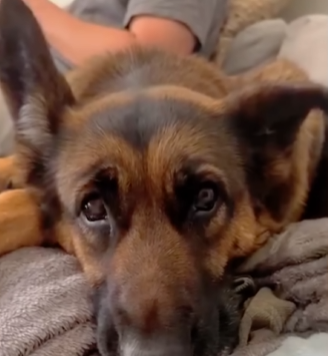
“It’s okay,” I whispered.
She stepped inside.
The first few days were quiet.
She followed me from room to room but never got too close. If I sat on the couch, she chose the floor nearby. If I entered a room, she watched carefully before moving.
At night, I set up a soft bed beside mine.
She didn’t use it.
Instead, she slept near the door.
As if she needed to keep an exit in sight.
I didn’t force affection. I didn’t overwhelm her with excitement. I kept my voice soft. My movements slow. My expectations gentle.
Trust isn’t something you demand.
It’s something you earn.
One evening, about a week later, I was sitting on the floor reading.
Luna approached.
Not fully confident. Not fully hesitant.
Just… curious.
She sniffed my hand.
I held still.
Her nose brushed my fingers.
Then — almost imperceptibly — her tail moved.
A small wag.
Not wild. Not joyful.
But real.
It felt like watching a flower bloom in slow motion.
I smiled, but didn’t react too strongly. I didn’t want to scare the moment away.
“Hi, Luna,” I whispered again.
This time, she didn’t look away.
Progress came in tiny pieces.
She began sleeping closer to the bed.
She started eating more confidently.
She followed me into the backyard and even trotted a little when I called her name.
The first time she brought me a toy, I nearly cried.
It wasn’t dramatic.
She simply picked it up… walked halfway toward me… and dropped it.
Then stepped back, unsure.
As if asking, “Is this what you want?”
I picked it up and gently rolled it toward her.
She startled slightly.
Then… she nudged it back.
That was the first time I heard her bark at home.
A soft, surprised sound.
It was the sound of something waking up inside her.
Weeks turned into months.
Luna transformed — not into a different dog, but into the dog she always was beneath the fear.
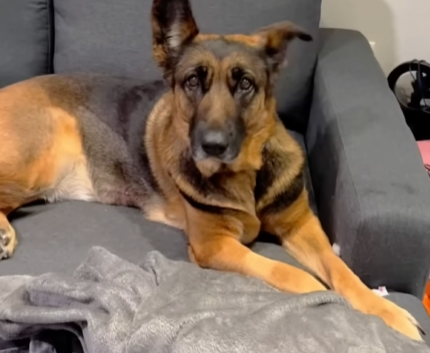
She loved slow morning walks. She enjoyed sitting by the window in the afternoon sun. She learned that the couch was allowed — and eventually claimed her corner like royalty.
But the biggest change wasn’t in her behavior.
It was in her eyes.
The guarded, distant look slowly faded.
In its place: softness.
Security.
Belonging.
She no longer flinched when I reached out to pet her. She leaned into it.
She no longer slept near the door.
She slept curled against my legs.
As if afraid not of being returned…
But of being too far away.
People often ask me why I chose her.
There were younger dogs at the shelter.
More energetic dogs.
Dogs who would have run straight into my arms.
But Luna didn’t need someone to be impressed by her.
She needed someone to stay.
There’s a difference.
Some dogs try hard to be adopted.
Luna had tried.
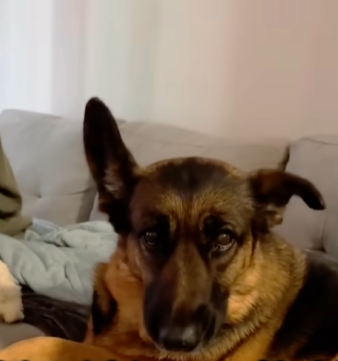
And after being sent back twice, she simply stopped performing.
Stopped begging.
Stopped auditioning.
She wasn’t giving up on love.
She was protecting herself from more rejection.
And maybe, in a way, I understood that feeling too.
Taking her home didn’t feel like rescuing her.
It felt like we rescued each other.
She taught me patience in ways I never expected.
She taught me that healing doesn’t happen loudly.
Sometimes it happens quietly — in shared spaces, in soft glances, in slow tail wags.
Sometimes love isn’t fireworks.
It’s consistency.
It’s showing up every day.
It’s not leaving.
One afternoon, about a year later, we visited the same shelter — this time to donate blankets.
As we walked past the kennels, Luna paused.
She looked inside, watching the other dogs bark and jump.
Then she looked up at me.
Her tail wagged — steady, confident.
Not the hesitant flicker from before.
A full, secure wag.
And in that moment, I realized something.
She didn’t stop wanting to be adopted.
She stopped wanting to be chosen by people who weren’t ready for her.
There’s a difference.
Luna doesn’t live in the corner anymore.
She doesn’t hide her face.
She doesn’t brace for disappointment.
She runs in the backyard.
She greets me at the door.
She curls beside me every night.
And sometimes, when I look at her sleeping peacefully, I think about the girl who once sat in the corner of a kennel, trying not to hope.
I’m so glad she stopped trying to impress the world.
Because when she stopped auditioning…
That’s when I found her.
And that’s when I took her home.