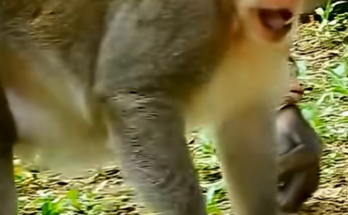
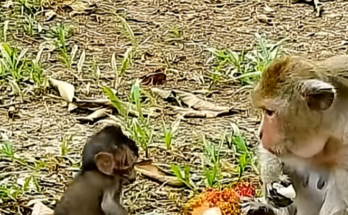
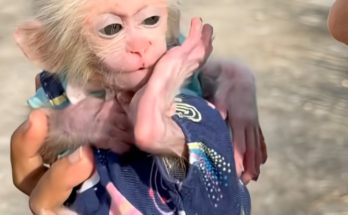
In the early morning light, when the forest was still wrapped in a soft hush, a baby monkey sat alone on a low branch, its tiny fingers gripping the bark with desperate strength. The world felt enormous from that height—not because it was far from the ground, but because its mother was nowhere in sight. For a baby monkey, distance is not measured in meters or steps. It is measured in heartbeats without warmth, in seconds without the familiar sound of breathing, in moments without the steady reassurance of a mother’s touch.
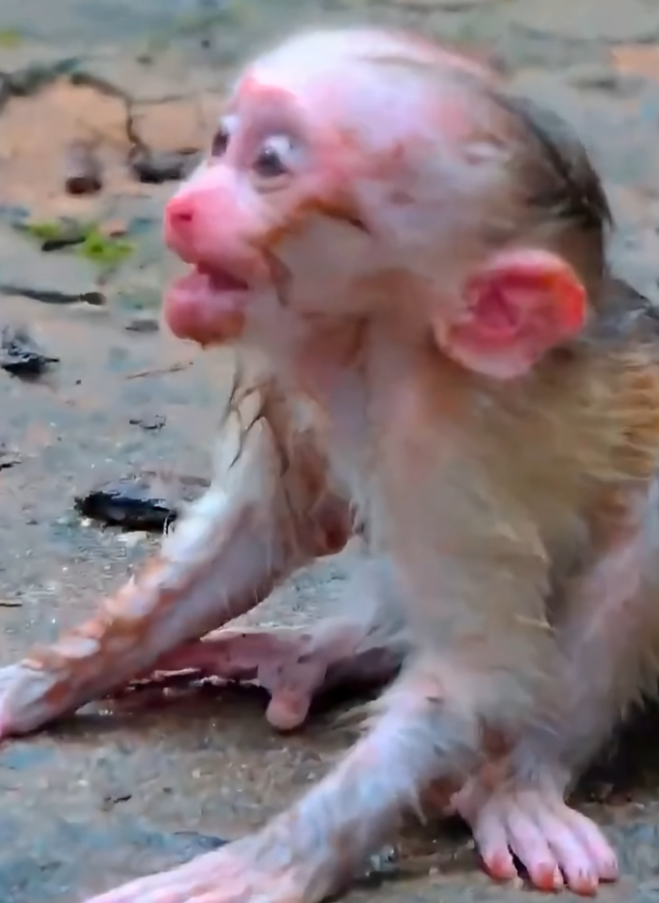
The baby had only been born a short time ago. Its eyes were still learning how to focus, its ears still learning how to separate danger from background noise. Everything felt loud, bright, and unpredictable. Normally, it would be pressed tightly against its mother’s chest, tucked into the curve of her arm, feeling the rhythm of her movements as she climbed, rested, or fed. That closeness was not just comfort—it was survival. Warmth, milk, protection, and learning all came from staying close.
But now, the mother was gone.
Perhaps she had moved quickly to chase away another monkey. Perhaps she had climbed higher in search of food, assuming the baby would follow. Or perhaps the baby had loosened its grip at the wrong moment, slipping onto a branch below while the mother leapt ahead. In the wild, separation does not need a dramatic cause. It happens in a blink.
The baby froze.
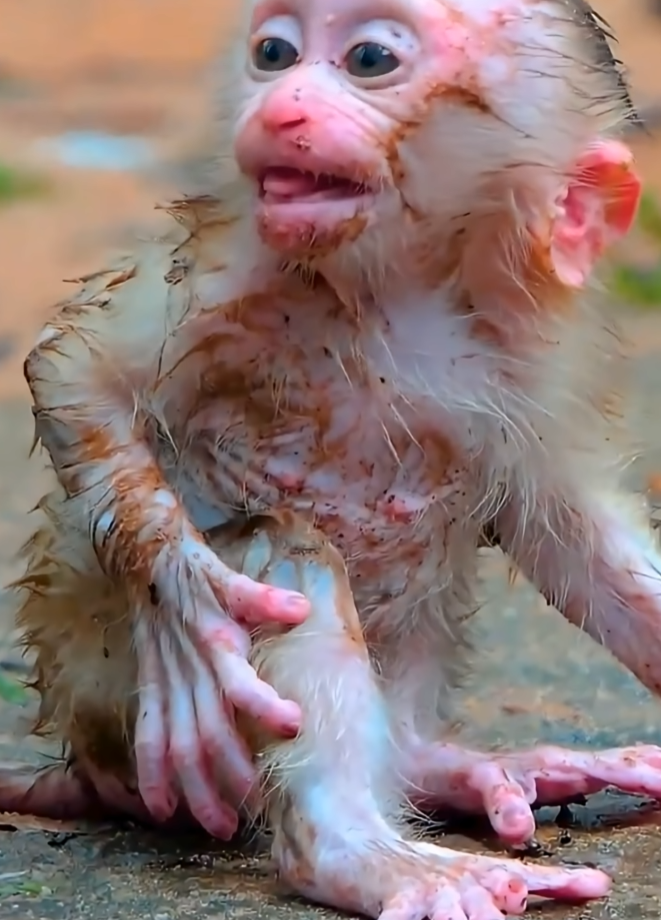
Its small chest rose and fell faster than before. The forest, once a blur of safety behind its mother’s fur, now appeared full of threats. Leaves rustled—was that the wind or something moving closer? A bird cried overhead, sharp and sudden, making the baby flinch. Even the sunlight felt unfamiliar without the shadow of its mother blocking the harshest rays.
Fear settled in quickly, deep and instinctive.
Baby monkeys are born with a powerful attachment instinct. From the moment they enter the world, their brains are wired to cling—to fur, to warmth, to the one body that means safety. Being alone triggers an alarm that has echoed through generations: alone means vulnerable. Alone means danger.
The baby let out a thin, trembling cry.
It was not loud, but it was urgent. A sound shaped by panic rather than hunger. The cry echoed through the trees, bouncing off trunks and branches, carrying a simple message: I am here. I am small. I need you.
For a moment, nothing answered.
The baby’s grip tightened until its fingers ached. Its tail curled inward, not for balance but for comfort. Tears pooled at the corners of its eyes, though it did not understand why its face felt wet. All it knew was that the world felt wrong without its mother close.
In monkey societies, mothers are the center of a baby’s universe. They teach without words—how to climb, how to groom, how to recognize danger. A baby learns by being carried, by watching from the safest seat possible: its mother’s body. Away from her, the baby does not just lose protection; it loses its guide to reality.
The baby cried again, louder this time.
Somewhere above, a movement paused. The mother had heard it.
A mother monkey’s ears are finely tuned to her infant’s voice. Among hundreds of sounds—the chatter of other monkeys, birds, insects—her baby’s cry cuts through everything. It carries a unique rhythm, a familiar urgency that pulls at her instincts before thought has time to form.
She turned back.
From branch to branch, she moved quickly, her body tense, scanning below. When she saw the baby clinging alone, fear flashed across her face—not fear for herself, but for the fragile life she had momentarily lost track of. She clicked softly, a low sound meant only for her infant.
The baby froze again, then lifted its head.
The sound was unmistakable. Relief flooded through its tiny body so fast it nearly lost its grip. The crying turned into short, broken noises—half sobs, half gasps—as it searched wildly for the source. When its eyes finally locked onto its mother’s shape above, something inside it loosened.
She was coming back.
The mother reached the baby in seconds, pulling it against her chest with firm, practiced movements. Her arms wrapped around it, not gently but securely. The baby buried its face into her fur, breathing in the familiar scent, its shaking slowly easing. The fear did not vanish instantly—it faded gradually, like a storm passing but leaving wet ground behind.
Held once more, the baby’s world made sense again.
Its breathing slowed. Its fingers unclenched. The forest sounds softened into background noise instead of threats. Even the sunlight felt warmer now, filtered through the safety of its mother’s presence. The baby whimpered once more, but this time the sound was not panic—it was release.
For the mother, the moment served as a reminder written deep into instinct. Babies are fragile. They slip. They lag behind. They get scared. Vigilance is never-ending. She groomed the baby briefly, small, reassuring touches meant to calm and reconnect. Grooming, in monkey species, is more than cleaning—it is communication, comfort, and bonding all at once.
The baby clung tightly, unwilling to loosen its hold again anytime soon.
Moments like this happen often in the lives of monkeys, though they are rarely seen. Separation, fear, reunion—these cycles shape a baby’s early understanding of the world. Each time the baby is scared and then comforted, it learns something vital: fear can be survived, and safety can return.
But the lesson is not gentle.
Being away from its mother had shown the baby the truth of its vulnerability. It was small in a big world. It depended on others. Independence would come later—much later—after strength, coordination, and confidence had grown. For now, closeness was not weakness. It was life.
As the mother moved off again, this time with the baby held securely against her chest, the forest resumed its rhythm. The danger had not disappeared. The world was still unpredictable. But the baby was no longer alone.
And for a baby monkey, scared and trembling just moments before, that made all the difference.
In the wild, courage is not born from fearlessness. It is born from surviving fear—and learning that even when the world pulls you away, the bond with your mother can bring you back to safety.