The snow had been falling since dawn, quiet and relentless, turning the city into a pale, muffled version of itself. Streets lost their edges. Sounds softened. Even anger seemed to sink beneath the white. It was the kind of cold that crept through gloves and boots, that made people walk faster and look at the ground instead of at one another.
No one noticed the puppy at first.
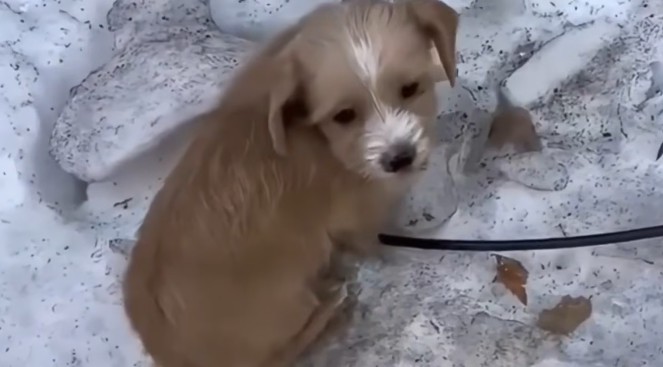
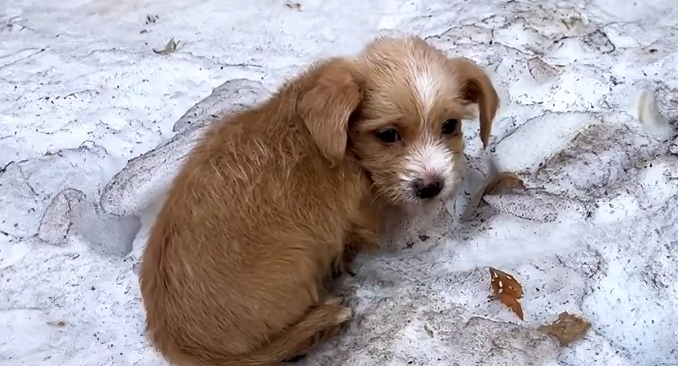
He lay where he had landed, a small, shivering shape half-buried beside a trash-strewn alley, his fur already dusted white. He didn’t understand what had happened—only that one moment there were hands, rough and impatient, and the next there was air, then pain, then cold so sharp it stole his breath. He tried to stand, but his legs slipped uselessly beneath him. Snow filled his nose. He sneezed weakly and whimpered, the sound thin as a cracked bell.
The cold wrapped him fast.
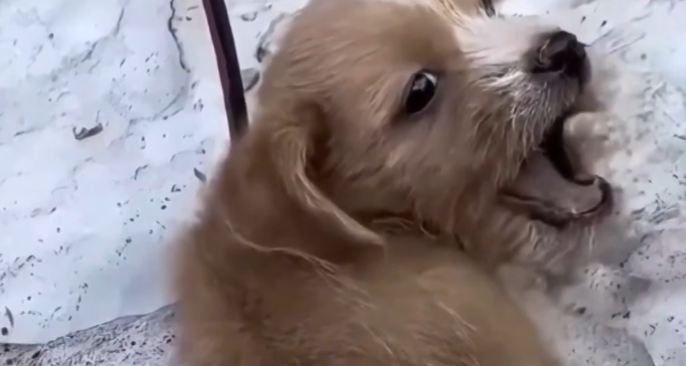
He tucked his paws beneath his belly the way instinct told him to, curling into the smallest shape he could manage. His heart raced, trying to keep warmth where there was none. Somewhere in his tiny chest, hope flickered—not a thought, not a plan, just the animal certainty that crying might bring something back. He cried until his throat hurt, until the sound faded into a whisper the wind carried away.
People passed.
Boots crunched. A door slammed. A bus hissed to a stop and moved on. No one looked down long enough to see him. Snow fell harder, softening his outline, making him easier to miss. His eyelids grew heavy, lashes frosting over. The world narrowed to cold and ache and the slow, frightening pull of sleep.
That was when the woman came.
She was walking slower than most, shoulders hunched against the weather, scarf pulled up to her nose. Her name was Mira, and she hated winter—not because of the cold, but because of what it did to people. It made them hurried, sealed away, blind to anything that wasn’t already on their path. She told herself she was only going to the store for bread and milk, that she wouldn’t linger in the snow.
She almost walked past him.
Almost.
A sound—so small she wasn’t sure she’d heard it at all—caught at her attention. She stopped, frowning, breath fogging the air. The alley looked empty. Then she saw the shape by the curb, wrong in a way her brain resisted naming.
“Oh no,” she whispered.
She crouched instantly, forgetting the cold seeping through her coat. The puppy’s sides barely moved. His ears were flattened, rimmed with ice. When she touched him, gently, his body jerked in reflex, a faint tremor of life still there.
He was freezing.
Every sensible voice in her head began listing reasons to step back. He might be sick. You don’t know where he came from. You can’t take responsibility for this. She had bills. A small apartment. A life already packed tight with obligations.
She did something unexpected.
She took off her scarf.
It was thick, woolen, the kind her grandmother used to knit, and she wrapped it around the puppy with careful hands, tucking it beneath his chin, around his belly. She scooped him up against her chest, shielding him from the wind with her body. He was so light it scared her. She could feel his heart fluttering, fast and fragile, like a trapped bird.
“It’s okay,” she murmured, though she didn’t know if it was true. “I’ve got you.”
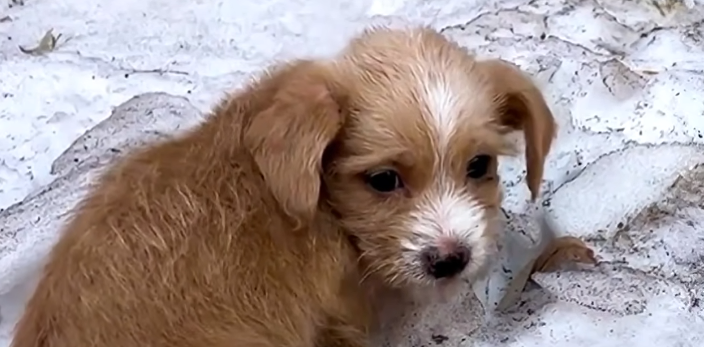
The puppy didn’t understand the words, but he felt the warmth. He pressed his face into the softness, releasing a sound that was half sob, half breath. The world shifted. The snow still fell, but it no longer touched him. There was a heartbeat beneath his cheek, steady and strong.
Mira turned and ran.
Her boots slipped. Her lungs burned. Snow stung her eyes, but she didn’t slow. She cradled the puppy with one arm and held her phone with the other, fingers numb as she called the nearest veterinary clinic. Her voice shook as she explained, as if urgency itself might hurry the line.
They told her to come immediately.
At the clinic, the doors flew open to warmth and light. Hands reached out. The puppy disappeared into towels, into practiced movements and quiet commands. Mira stood there, snow melting into a puddle at her feet, heart hammering as if she were the one on the table.
“He’s hypothermic,” the vet said gently. “But you got him here in time.”
Time. The word echoed.
She sat in the waiting room, staring at her scarf now hanging to dry by a heater, feeling oddly hollow without it. Minutes stretched. She replayed the image of the puppy in the snow again and again, a loop she couldn’t stop.
What kind of person throws a living thing away like that?
When the vet returned, there was a small smile on her face. “He’s stable,” she said. “He’ll need care, but he’s a fighter.”
Relief hit Mira so hard her knees weakened. She laughed once, breathless, then covered her mouth as tears came without warning.
She went home that night without bread or milk.
She couldn’t sleep. The quiet felt too loud, the apartment too empty. Every time she closed her eyes, she saw snow piling up around a tiny body. By morning, her decision felt less like a choice and more like something that had already been made.
She went back.
The puppy was awake when she arrived, wrapped in a blanket far too big for him. His eyes—dark, curious despite everything—found her immediately. His tail gave a tentative wag, as if unsure he was allowed to hope.
The vet watched them. “If you don’t have someone else in mind,” she said, “he’s going to need a home.”
Mira looked at the puppy, at the way his ears perked when she spoke, at how he leaned toward her without hesitation.
“I think,” she said slowly, “I might.”
Recovery was not simple. There were medicines, sleepless nights, moments when the puppy—she named him Snow, for reasons that felt both sad and defiant—shook with memories she couldn’t see. He startled at loud noises. He hated the cold. But he learned, day by day, that the floor was warm, that food came regularly, that hands could lift without throwing.
Mira learned too.
She learned how quickly love rearranges a life. How responsibility can feel less like weight and more like purpose. How stopping for something small and fragile can change the direction of a day—or a future.
Winter loosened its grip eventually. Snow melted. Streets reappeared. People walked slower again, faces lifting. Snow grew stronger, his fur thicker, his steps surer. He chased falling leaves with the same enthusiasm he once spent shivering.
Sometimes, when Mira wrapped her scarf around her neck, Snow would paw at it, tail wagging wildly. She would laugh and kneel, pressing her forehead to his.
He had been thrown away.
She had stopped.
And in that unexpected moment—on a street everyone else hurried past—they had saved each other.