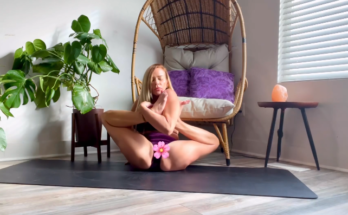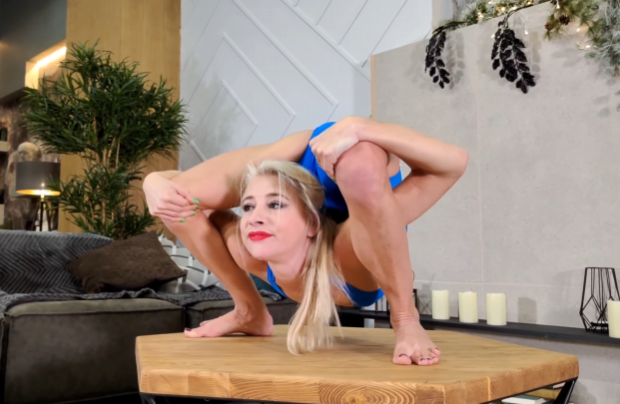
Backbend stretching is where strength and surrender meet. It is often mistaken for pure flexibility, something reserved for the naturally bendy or the fearless. But true backbend work—especially when it leads into contortion and advanced triple fold training—is built on patience, control, and deep respect for the body. It is not about forcing shapes. It is about preparing the body so thoroughly that the shape becomes possible on its own.
At its core, a backbend is an act of opening. The front body lengthens, the spine arcs, the chest lifts, and the breath expands. For many people, this feels unfamiliar or even uncomfortable. Modern life pulls us forward—phones, desks, steering wheels—compressing the chest and stiffening the spine. Backbend stretching reverses that pattern, asking the body to remember a fuller range of motion.
But contortion-level backbends go far beyond basic mobility. They require not only flexible joints but also powerful muscles that can support the spine in extreme ranges. This is where most beginners misunderstand contortion. The deeper the bend, the stronger the body must be.
Before triple fold training ever begins, the foundation must be solid.
A safe backbend practice starts with warming the entire body. Shoulders, hips, spine, and even ankles play critical roles. Gentle spinal waves, cat-cow movements, and controlled shoulder rotations prepare the nervous system as much as the muscles. Heat is essential—not just physical warmth, but internal readiness. Rushing into deep backbends without preparation is the fastest way to injury.
Once warm, basic backbend shapes begin to build structure. Cobra, sphinx, bridge, and wheel pose are not “easy” versions of contortion—they are the language through which the spine learns extension. In these shapes, alignment matters more than depth. A clean, supported bridge with active legs and open shoulders is far more valuable than a collapsed deep bend.
Breath is the silent teacher in this process. In backbend stretching, breath guides movement and reveals tension. Shallow or held breath often signals fear or over-effort. Slow, even breathing tells the body it is safe to open. Over time, the breath becomes a tool for accessing deeper ranges without panic.
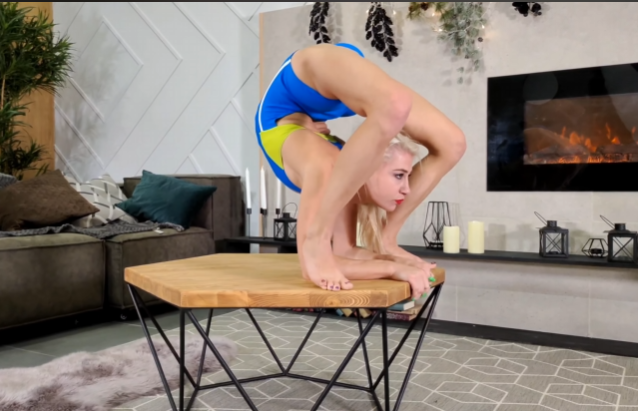
Contortion training begins where ordinary stretching ends.
This transition is not marked by a single pose, but by a shift in awareness. The practitioner stops asking, “How far can I go?” and starts asking, “How well can I control this range?” Active flexibility replaces passive hanging. Muscles engage to lift, support, and stabilize joints as the spine curves further.
In advanced backbends, the spine does not bend evenly by accident—it is guided. Thoracic mobility becomes a priority, as this mid-back area is often the stiffest yet safest place to generate curve. When thoracic extension is limited, the lower back is forced to compensate, increasing injury risk. Smart contortionists train thoracic opening deliberately, using props, wall drills, and slow resistance work.
Triple fold training takes this concept even further.
The term “triple fold” refers to the ability to move seamlessly through three directions of spinal folding—backward extension, forward compression, and inward folding—within one continuous sequence. It is not three separate tricks, but one integrated expression of spinal intelligence.
To train for triple fold capacity, the body must be equally comfortable opening and closing. This means backbend stretching must be balanced with deep forward folds and compression drills. Pancake stretches, pike holds, and active core compression are just as important as bridges and chest stands.
The spine must learn to articulate—not just bend.
Articulation is the ability to move one vertebra at a time with awareness and control. In triple fold training, articulation prevents “dumping” into joints and distributes movement evenly. Slow roll-downs, controlled backbends against a wall, and segmented spinal drills are essential tools for developing this skill.
Strength is the hidden backbone of contortion.

In triple fold work, muscles are not relaxed passengers—they are active drivers. Glutes stabilize the pelvis in backbends. Hamstrings protect the knees and support forward folds. Deep core muscles manage compression and prevent spinal collapse. Even the feet play a role, grounding and distributing force.
This is why advanced contortion training often looks deceptively slow. Holds are longer. Transitions are controlled. Shaking muscles are welcomed as signs of engagement, not weakness. Progress comes not from pushing deeper, but from holding steady longer.
Mental training is just as critical.
Backbend stretching and contortion can trigger vulnerability. Opening the front body exposes vital areas—the throat, heart, and abdomen. For many, this creates emotional resistance long before physical limits are reached. Triple fold training demands calm under intensity. The practitioner must remain present while the body is in unfamiliar territory.
Fear, when acknowledged and respected, becomes information rather than an obstacle.
Rest and recovery shape progress more than effort alone. The spine and connective tissues adapt slowly. Deep backbend work should be spaced thoughtfully, allowing time for repair and integration. Gentle movement on rest days—walking, swimming, light mobility—helps maintain circulation without overload.
Consistency matters more than intensity.

Ten minutes of mindful backbend preparation done regularly will yield more lasting results than occasional extreme sessions. Triple fold capacity is built layer by layer, often invisibly, until one day the body simply moves differently—more fluid, more responsive, more confident.
One of the most overlooked aspects of triple fold training is the exit.
Coming out of extreme shapes safely is as important as entering them. Controlled exits train strength in reverse ranges and protect vulnerable joints. A true contortionist never collapses out of a pose. They unwind with the same care they used to enter.
This discipline is what allows longevity in the practice.
Over time, backbend stretching evolves from something dramatic into something meditative. The practitioner learns the subtle language of their spine—the difference between productive discomfort and warning signals, between stretching sensation and compression stress.
Triple fold training becomes less about the shape and more about flow.
In its highest form, contortion is not performance—it is conversation. A dialogue between breath, muscle, bone, and intention. The body is not conquered or forced. It is listened to, negotiated with, and gradually invited into greater freedom.
Backbend stretching opens the door.
Contortion teaches control.
Triple fold training unites both into one continuous, intelligent movement.
And in that union, the body discovers not just how far it can bend—but how deeply it can trust itself.