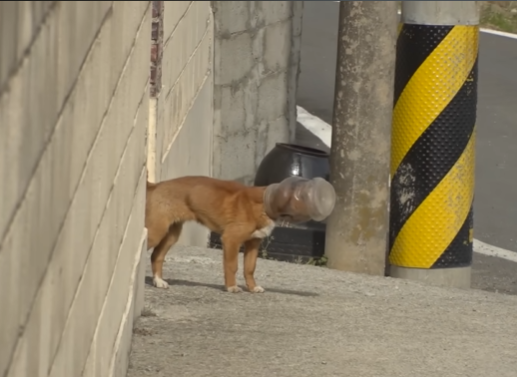
The dog’s head was stuck in a plastic jar, and he was starving. At first glance, it looked almost unreal—like a cruel joke frozen in time—but one look into his eyes erased any doubt. Panic, exhaustion, and desperation stared back through the cloudy plastic. Each breath echoed hollowly inside the container, fogging it with short, uneven puffs of air.
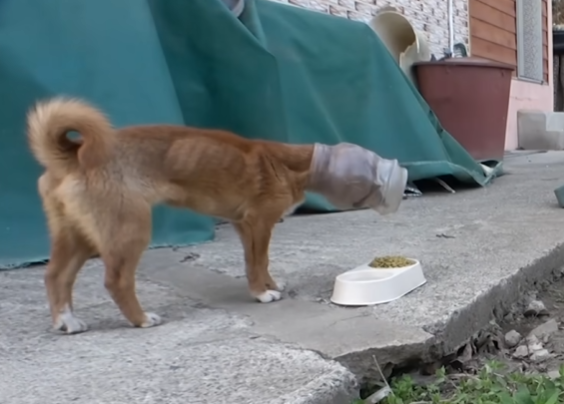
He wandered near the edge of a marketplace, bumping into crates and walls because he couldn’t see clearly. The jar was scratched and yellowed, once used for storing snacks or cooking oil, now turned into a prison. It was wedged tightly around his neck, cutting into his skin. Dried blood stained the fur beneath it. Every step he took was careful and slow, his body thin from days—maybe weeks—without proper food or water.
People noticed him, but most didn’t understand what they were seeing at first. Some laughed nervously, thinking it was strange or even funny. Others recoiled, uncomfortable with the sight, unsure of what to do. A few tried to chase him away, afraid he might panic and bite. The dog only staggered farther, frightened and confused, the jar clacking against the ground with each step.
Inside the plastic container, the smell was unbearable. Old food residue mixed with saliva and dirt. The dog’s tongue hung out, dry and swollen. He tried to lick the inside walls of the jar, hoping for moisture, but there was nothing left. Hunger clawed at his stomach, sharp and relentless. The jar prevented him from eating, drinking, even panting properly. Slowly, it was killing him.
He hadn’t always been like this. No dog is born into suffering. Somewhere along the way, hunger had driven him to desperation. He must have smelled food inside the jar, pushed his head in too far, and then—panic. He probably struggled at first, pawing at the container, slamming it against walls, trying to pull free. But plastic doesn’t give easily. Exhaustion eventually won.
Now he barely had the strength to fight.
By the time a small group of animal rescuers arrived, the dog was lying on his side near a pile of cardboard boxes. The jar rested awkwardly against the ground, tilting his head at an unnatural angle. His chest rose and fell too fast, too shallow. One of the rescuers knelt down slowly, speaking in a calm, steady voice.
“It’s okay, boy… we’re here.”
The dog flinched at the sound, his body tensing, ready for pain. Humans had not been kind to him. Some had thrown stones. Others had shouted. No one had helped. Why would this be any different?
As they approached, he tried to stand, but his legs buckled. The jar scraped loudly against the pavement, sending a jolt through his neck. He whimpered—a weak, broken sound that silenced everyone around him. That sound alone made tears well up in the rescuers’ eyes.
They knew time was critical. The longer the jar stayed on, the greater the risk of suffocation, infection, and organ failure. But removing it was dangerous too. If he panicked, he could injure himself—or them.
They gently wrapped a blanket around his body to calm him and prevent sudden movements. One rescuer carefully held his head steady while another examined the jar. It was thick plastic, tightly sealed, with no easy way to slide it off. His neck was swollen from prolonged pressure. Pulling it off wasn’t an option.
They would have to cut it.
The sound of scissors clicking made the dog tremble. His breathing became frantic, echoing inside the jar. One rescuer pressed their forehead against his body, grounding him with gentle pressure. “Easy… easy… just breathe,” they whispered, even though they knew he barely could.
Slowly, carefully, they began to cut. Each snip was deliberate. The plastic resisted at first, but then gave way inch by inch. The dog flinched, then froze, as if he sensed that something important was happening.
When the jar finally cracked open, fresh air rushed in.
The dog gasped—deep, desperate breaths filling his lungs for the first time in days. The jar fell away, hitting the ground with a dull thud. For a moment, everyone just stared.
His neck was raw and bleeding. Fur was missing in patches. The skin underneath was inflamed and infected. But his head was free.
He lay still, stunned, then slowly lifted his head. His eyes—no longer distorted by plastic—were large and dark, filled with confusion and disbelief. He sniffed the air, again and again, as if he couldn’t believe it was real.
Then his body relaxed.
He collapsed into the blanket, exhausted beyond words, but alive.
Water was offered carefully, drop by drop. He drank weakly at first, then more eagerly, spilling some down his chin because he couldn’t stop. Soft food followed—tiny portions to avoid shock. He ate slowly, shakily, every bite a small victory against starvation.
At the veterinary clinic, the full extent of his condition became clear. Severe dehydration. Malnutrition. Deep wounds around the neck. Infection that had been spreading unchecked. The vet shook their head sadly. “If he’d gone another day like this,” they said quietly, “he wouldn’t have survived.”
Treatment began immediately. Fluids flowed into his veins. Antibiotics fought the infection. His wounds were cleaned and treated with care. Through it all, the dog remained strangely calm, as if the fight had finally left his body.
The first night was critical. He drifted in and out of sleep, his body struggling to recover from prolonged stress and starvation. A volunteer stayed nearby, sleeping on a chair, waking every time he stirred. No one wanted him to be alone again.
By morning, he was still breathing.
That alone felt like a miracle.
Over the next days, small changes appeared. His appetite returned slowly. His eyes became brighter. He began to lift his head when someone entered the room. When a hand reached out gently, he didn’t flinch as much.
They gave him a name—one that meant “freedom.”
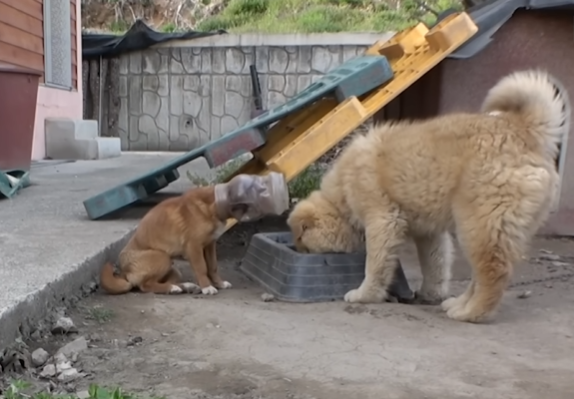
As weeks passed, the scars around his neck began to heal, though they would never disappear completely. They served as a reminder of how close he had come to dying because of something so small, so ordinary, and so cruelly overlooked: a piece of plastic trash.
The dog learned how it felt to eat without fear, to drink until satisfied, to sleep without choking for air. He discovered toys, soft blankets, and the simple joy of sunlight warming his fur. His tail wagged cautiously at first, then more confidently.
One afternoon, he stood at the door of the shelter, watching the world outside. Cars passed. People walked by. Life went on. But he was no longer invisible. No longer trapped.
His story spread quickly, touching hearts far beyond the place where he had been found. People cried when they saw the photos of the jar stuck around his head. They were reminded of how human carelessness—discarded plastic, ignored suffering—can turn deadly for animals who have no voice.
But they were also reminded of something else: that compassion matters. That stopping, noticing, and choosing to help can mean the difference between life and death.
The dog who once starved with his head trapped in a plastic jar now slept peacefully, belly full, breathing freely. His body still bore the marks of his ordeal, but his spirit had survived.
He was no longer an animal in crisis.
He was a survivor.
And every time he lifted his head to breathe the open air, it felt like a quiet victory—not just for him, but for everyone who believes that even the most helpless lives are worth saving.