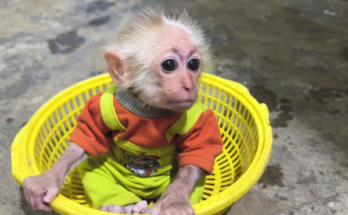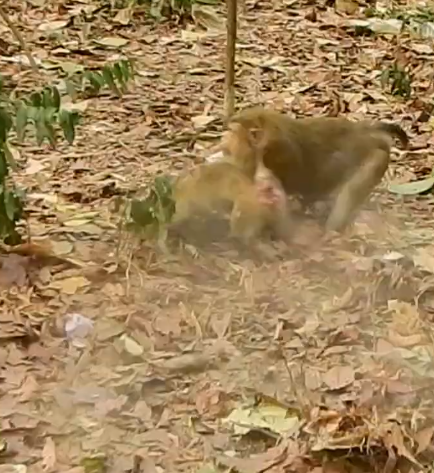
In the heart of a lush, tropical forest, a troop of monkeys swung effortlessly through the dense canopy. The morning sun filtered through the leaves, creating patches of light and shadow on the forest floor below. The air was filled with the sounds of chirping birds, rustling leaves, and the occasional high-pitched chatter of monkeys communicating with one another. Life in the forest was busy and dynamic, and among the troop, social interactions were the lifeblood of daily life.
This particular morning, however, was different. The troop had gathered around a cluster of fruit-laden trees, and an unusual tension hung in the air. Something had sparked a disagreement among the monkeys—a minor issue, perhaps, but one that revealed the subtle complexities of their social structure.
At the center of the conflict was a pile of ripe, juicy mangoes that had fallen from the highest branches. The fruit was a rare treat, and every monkey in the troop wanted a share. The youngest members scampered eagerly toward the pile, squealing in excitement. Older monkeys, larger and more dominant, moved deliberately, sizing up both the fruit and each other.
The disagreement began subtly. One of the older females, known for her assertiveness, claimed a cluster of mangoes for herself and her young offspring. Another female, equally strong and determined, argued that she had spotted the same fruit first and deserved a share. Their chatter escalated into loud vocalizations, sharp cries, and occasional flashes of teeth—a language both threatening and negotiating.
The adult males observed from nearby branches, assessing the situation carefully. Among them was the dominant male, whose presence usually settled disputes before they escalated. He sat tall, eyes scanning, ears twitching, ready to intervene if necessary. Yet, at this moment, he chose to watch, understanding that some lessons were best learned through experience.
The younger monkeys, oblivious to the complexities of hierarchy, attempted to snatch fruit while the adults argued. One particularly daring juvenile tried to grab a mango from the pile, only to be chased away by a protective female. The juvenile yelped and retreated, but its curiosity and eagerness remained undiminished. This small act added to the tension, as the older monkeys interpreted the behavior as a challenge to their authority.
As the disagreement continued, subtle alliances formed. The troop is structured around relationships, trust, and past interactions. Monkeys who had previously groomed one another or shared resources tended to support each other during conflicts. In this case, the assertive females rallied nearby allies, creating a temporary division within the group. Vocalizations became louder, and branches creaked under the weight of pacing monkeys.
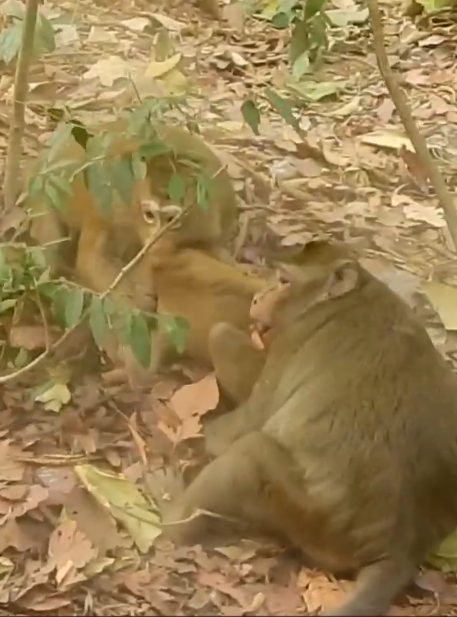
The disagreement, though seemingly over something as simple as mangoes, highlighted deeper issues. Access to food is a critical concern for survival, but it also carries social implications. How a monkey asserts its claim, responds to challenges, and navigates the reactions of others reveals status, strength, and intelligence. In essence, the dispute was a microcosm of the troop’s social dynamics.
At one point, the dominant male intervened subtly. He leapt from his branch with a powerful swing, landing in the center of the group. His presence immediately silenced the louder voices, though not entirely. Monkeys glanced at him, evaluating his mood and intent. In the world of monkeys, the dominant male does not always need to fight to assert authority; a mere display of confidence, size, and composure often suffices.
The disagreement shifted from aggression to negotiation. The dominant male began a series of vocalizations, low chattering sounds interspersed with hoots and grunts. These were signals of authority, but they also contained information: cues to respect hierarchy, to wait one’s turn, and to share resources. The female monkeys adjusted their postures, lowering their bodies slightly, acknowledging the dominant male’s presence without completely relinquishing their claims.
Interestingly, the younger monkeys observed everything attentively. They were learning—not just about mangoes, but about social rules, power dynamics, and strategies for conflict resolution. Every gesture, every vocalization, every glance was a lesson in survival and social intelligence. The young monkeys mimicked small movements, tested boundaries with cautious touches, and practiced the vocalizations they had heard.
After several minutes, the situation began to de-escalate. The dominant male allowed each female to take a small share of the mangoes in turn. He supervised closely, ensuring that no monkey overstepped or became aggressive. The resolution was peaceful, though firm. Every member of the troop had learned something: the value of patience, the importance of hierarchy, and the subtle art of negotiation.
Once the disagreement settled, the monkeys resumed their daily activities. Some climbed higher into the trees to forage, others rested in the shade, and the juveniles continued their playful antics with newfound awareness. The forest returned to its usual rhythm, but the memory of the morning’s tension lingered subtly among the troop members.
This seemingly small disagreement had larger implications for the troop’s cohesion. Social conflicts are inevitable in monkey communities, but how they are managed determines group stability. Monkeys rely on cooperation to forage, protect territory, and raise young. Conflicts that escalate into aggression without resolution can fracture relationships and jeopardize survival. In this case, the dominant male’s intervention ensured harmony, preserving both order and cooperation.
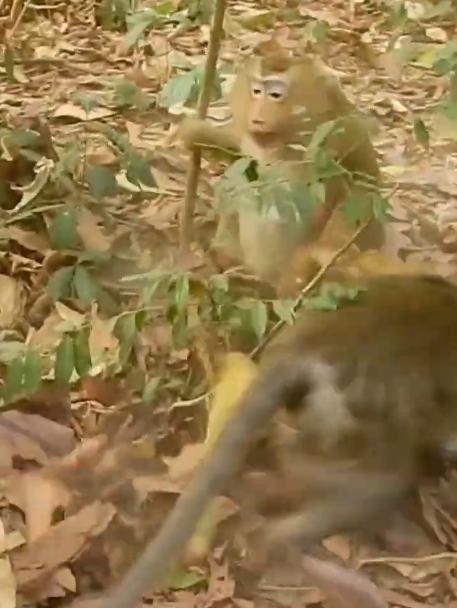
Moreover, the disagreement illustrated the role of learning in monkey societies. Social intelligence is as important as physical strength. Young monkeys learn not only by observing but by participating in these conflicts in minor ways—testing rules, gauging responses, and adjusting behavior accordingly. Over time, they internalize social norms that will guide their interactions for life.
Another key aspect of the incident was communication. Monkeys rely heavily on vocalizations, gestures, and postures to convey intent. The dispute over the mangoes demonstrated how nuanced these signals can be. Aggressive gestures, submissive postures, and playful interruptions all conveyed layers of meaning, allowing the troop to negotiate conflict without escalating into serious violence.
By the afternoon, the forest was calm again. The mangoes had been eaten, disputes resolved, and the troop moved as a cohesive unit. The little monkeys played among the branches, the adult females groomed one another, and the dominant male watched over them with quiet authority. Lessons had been learned, tensions had been addressed, and life continued in the forest—a delicate balance maintained through instinct, intelligence, and cooperation.
In the life of monkeys, disagreements are inevitable. Resources are finite, personalities clash, and curiosity often leads to missteps. Yet these moments are essential for growth, social learning, and the reinforcement of community norms. Every conflict, from the smallest spat over fruit to more serious challenges to hierarchy, serves as both a test and a teaching moment.
Even the seemingly trivial disagreements have profound impacts. They build resilience, teach patience, and reinforce relationships. The troop, while vocal and animated, operates under a system of subtle rules that maintain balance. Understanding these rules is crucial for survival, and young monkeys must navigate them carefully.
By observing the outcome of disputes, juveniles learn valuable strategies: when to assert themselves, when to wait, and when to seek alliances. Adult monkeys reinforce these behaviors, providing guidance, boundaries, and occasional intervention. Over time, these interactions foster a cohesive, cooperative, and adaptable troop capable of thriving in the unpredictable forest environment.
As night fell, the monkeys settled into their nests among the branches. Leaves rustled gently in the evening breeze, and the sounds of the forest softened. The day’s disagreement became just another memory, a story woven into the complex tapestry of monkey life. Yet for those who observed closely—the younger monkeys, the attentive females, and even the dominant male—it was also a story of learning, growth, and the intricate dance of social life.
In conclusion, the morning’s disagreement over mangoes was more than a simple quarrel. It was a window into the complexities of monkey society: hierarchy, communication, negotiation, and learning. Through conflict and resolution, the troop reinforced social bonds, clarified rules, and taught the next generation the essential skills for survival. The forest, alive with movement, chatter, and life, continued its rhythm, a reminder that even in disagreement, there is order, purpose, and opportunity for growth.
Life in the forest is never without challenges. But through every dispute, playful interaction, and carefully mediated conflict, monkeys navigate a world that is both dynamic and demanding. They teach us, in their subtle and instinctive ways, that even disagreements have meaning, that lessons can emerge from tension, and that cooperation is the foundation of thriving communities.