The dog appeared at the edge of the road just before sunset, when the sky burned orange and red and the traffic was at its loudest. Cars rushed past in endless streams, engines roaring, horns blaring, tires screeching against hot asphalt. To most drivers, it was just another noisy evening commute. To the dog, it was terror.
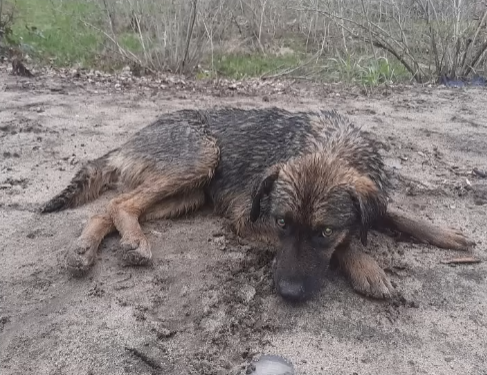
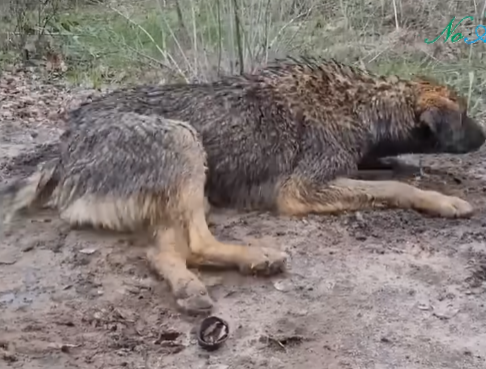
He crawled out slowly from behind a pile of broken concrete near the roadside. His movements were painfully slow, his body pressed low to the ground as if he were afraid even to be seen. One of his back legs dragged uselessly behind him, leaving a faint line in the dust. His fur was matted and gray with dirt, and his ribs showed clearly beneath his skin. Every breath looked like an effort.
For a moment, he paused at the edge of the road. The wind from passing vehicles whipped around him, carrying the smell of fuel and burning rubber. The noise was overwhelming, a wall of sound that made him flinch and flatten himself even more. Still, he moved forward. Hunger, pain, and desperation pushed him onward. Somewhere inside him, a fragile hope told him that humans meant help.
He tried to stand, but his legs failed him. Instead, he crawled. His front paws pulled his body forward inch by inch, scraping against the rough ground. Each movement seemed to cost him everything he had left. When he reached the asphalt, a car sped by just a few feet away, the sudden roar making him cry out in fear.
Drivers noticed him then. Some slowed, shocked by the sight of a dog crawling into traffic. Others swerved slightly, hearts racing, afraid of causing an accident. A few horns blared—not in anger, but in panic. The dog froze, his body shaking violently. The noise was unbearable. His ears flattened against his head, his eyes wide with terror.
He had not expected this.
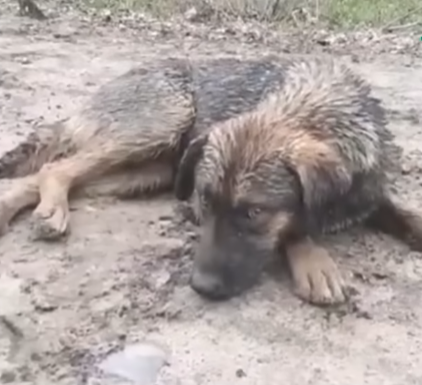
The road was not the place of safety he had imagined. The deafening traffic felt like an attack, crashing over him from all sides. His instincts screamed at him to flee, to get away from the noise and danger. Panic surged through his weakened body, and somehow, he found the strength to turn around.
Dragging himself back toward the roadside, he moved faster now—not because he was less injured, but because fear had taken over. A truck thundered past, its horn blasting loudly, and the vibration shook the ground beneath him. That was the final blow. With a frightened yelp, the dog scrambled off the road and disappeared into the weeds, vanishing from sight.
For a moment, the traffic continued as if nothing had happened. Then someone stopped.
A young man pulled his car over and got out, his heart pounding. He had seen the dog clearly—the way he crawled, the way he ran when the noise overwhelmed him. He scanned the roadside, calling softly, but there was no sign of the dog. Only flattened grass and a faint trail in the dirt showed where he had gone.
The man made a decision. He called a local animal rescue group and described what he had seen. His voice was urgent. “He’s badly hurt,” he said. “And he’s terrified. He ran into the bushes, but he can’t go far.”
Within the hour, volunteers arrived. They searched carefully, spreading out along the roadside and nearby fields. They called gently, avoiding sudden movements or loud noises. The sun was setting fast, and shadows stretched long across the ground. Somewhere nearby, the dog lay hidden, trembling.
They found him under a cluster of thick bushes not far from the road. He was curled tightly, trying to make himself as small as possible. His eyes reflected the flashlight beams, wide and fearful. When one volunteer stepped closer, he tried to crawl away, but his injured leg failed him. Exhausted, he collapsed, letting out a weak, broken cry.
The rescuers moved slowly, speaking in calm, reassuring voices. They did not rush him. They knew that after the terror of the road, he needed patience more than anything. One volunteer lay down on the ground a short distance away, making herself smaller, less threatening. She reached out her hand and waited.
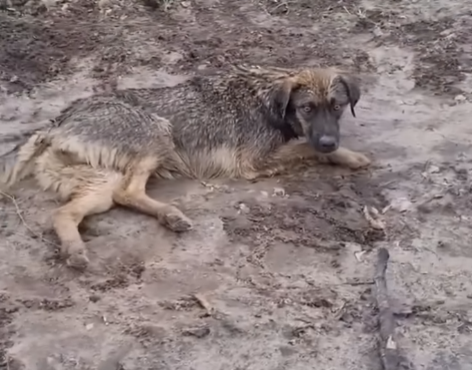
Minutes passed. The dog’s breathing gradually slowed. His eyes never left the volunteers, but the panic began to fade. When the woman gently touched his paw, he did not pull away. Instead, he rested his head on the ground and closed his eyes, as if he had finally run out of strength to be afraid.
They wrapped him carefully in a blanket and lifted him onto a stretcher. Even then, every distant car horn made him flinch. The volunteers shielded his head and spoke softly until they reached the rescue vehicle. Inside, away from the noise, his body slowly relaxed.
At the veterinary clinic, the full extent of his injuries became clear. His back leg was broken and badly infected. He was severely underweight and dehydrated, and there were signs that he had been on his own for a long time. The vet shook his head, saddened by how much the dog had endured.
But the dog was alive. And now, he was safe.
The first night was difficult. Even inside the quiet clinic, he startled at sudden sounds. He cried softly in his sleep, legs twitching as if he were still crawling across the road. Nurses stayed with him, offering gentle touch and soothing words whenever he woke in fear.
Over the next few days, treatment began. His leg was stabilized, his wounds cleaned, and fluids restored strength to his exhausted body. He ate cautiously at first, unsure if the food would disappear. But as meals came regularly, his trust began to grow.
They named him Chance—because that was what he had taken when he crawled onto the road. A chance at help, even when fear nearly drove him away.
As Chance healed, his personality slowly emerged. He was shy but gentle, leaning into hands that offered comfort. Loud noises still frightened him, but with time and care, he learned that not every sound meant danger. Volunteers worked patiently with him, helping him feel safe again.
Weeks later, Chance took his first steps without dragging his leg. The moment was quiet, but powerful. He stood, shaky but proud, and looked up at the people who had saved him. His tail wagged hesitantly, then with more confidence.
His story spread, touching many hearts. People were moved by the image of a dog crawling into traffic, begging for help, only to be chased away by fear. It was a reminder of how close hope and terror can be, separated by just one moment.
Today, Chance no longer lives in fear of the road. He sleeps on soft beds, far from the roar of engines. He walks slowly but happily, enjoying sunshine and gentle voices. The memory of that terrifying evening still lingers, but it no longer defines him.
He once crawled onto the road in desperation, driven away by deafening traffic.
Now, he runs toward a future filled with safety, patience, and love—proof that even when fear almost wins, kindness can still change everything.