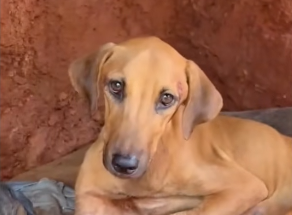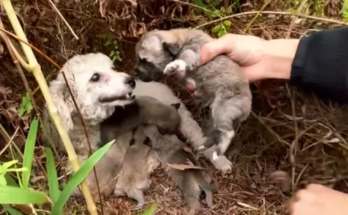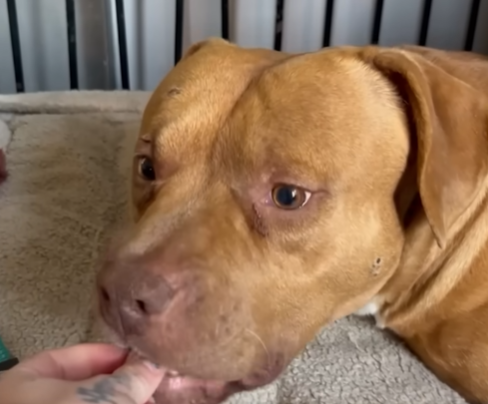
Some stories stay with you forever—not because they are perfect, but because they reveal something profoundly human through the eyes of an animal. This is one of those stories. A pittie story we’ll never forget, not for its pain alone, but for its courage, transformation, and the quiet power of love that changed everything.
Her name was Maya.
When animal control first found her, Maya was barely recognizable as a dog. She lay curled in the corner of an abandoned backyard, her gray coat patchy and dull, ribs visible beneath her skin. Heavy chains were wrapped around her neck, rusted and biting into her flesh. There was no food nearby, no water, no shelter—only silence. Neighbors later said she had been there for weeks, maybe months, ignored like an object that no longer mattered.
Pit bulls already carry an unfair weight in this world—judged before known, feared before understood. Maya carried even more: the burden of neglect, abuse, and abandonment. When rescuers approached her, they expected fear, maybe even aggression. Instead, Maya lifted her head weakly and wagged her tail.
That single gesture broke everyone’s heart.
She didn’t growl. She didn’t snap. She just hoped.
Maya was rushed to a veterinary clinic, where the extent of her suffering became clear. Severe malnutrition. Infected wounds around her neck. Scars—old and new—across her body. The vet estimated she had likely been used for breeding and then discarded when she was no longer “useful.” Her body told a story of long-term suffering, but her eyes told something else entirely.
They were gentle. Trusting. Still full of love.
The rescue team named her Maya because it means illusion—a reminder that what we see on the outside often hides a deeper truth. To the world, she might have looked like a “dangerous pit bull.” In reality, she was a survivor longing for kindness.
Recovery was slow. Maya had to be fed carefully to avoid shock. Her wounds required daily cleaning. At night, she whimpered softly in her sleep, likely reliving memories no animal should ever have. Volunteers took turns sitting with her, whispering to her, letting her know she wasn’t alone anymore.
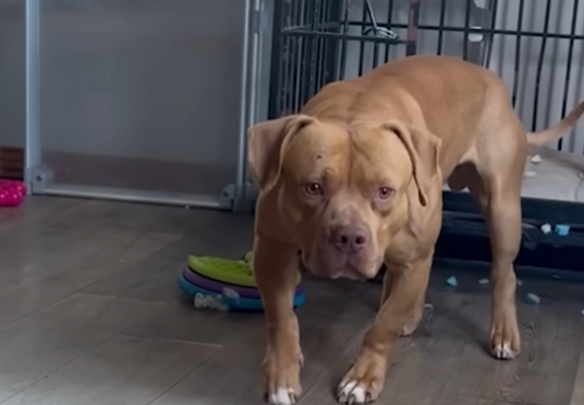
One volunteer, Emma, noticed something special. Every time Emma entered the room, Maya’s tail thumped against the floor. Not wildly—she was too weak—but with determination. Emma began spending more time with her, reading books aloud, gently brushing her coat, letting Maya rest her head in her lap.
“It felt like she was holding on,” Emma later said. “Like she was saying, ‘I’ve survived this far. Please don’t give up on me now.’”
As weeks passed, Maya grew stronger. Her coat began to shine. She gained weight. She learned how to play again—tentatively at first, then with joyful abandon. A tennis ball became her favorite treasure. She carried it everywhere, even to her food bowl, as if afraid happiness might disappear if she let it go.
But despite her progress, Maya faced another obstacle: adoption.
Potential adopters would stop in front of her kennel, smile at her gentle behavior, then read the sign.
Pit Bull.
Some walked away immediately. Others hesitated, asking questions filled with fear—Is she aggressive? Is she safe? The staff explained her calm temperament, her loving nature, her history of surviving abuse without losing trust. Still, many shook their heads.
Maya didn’t understand why days kept passing without anyone choosing her.
Yet she never stopped hoping.
Then one afternoon, a man named Carlos walked into the shelter with his teenage daughter, Lily. They weren’t looking for a pit bull. They had actually come “just to look.” But when Lily knelt down in front of Maya’s kennel, something happened.
Maya sat quietly and leaned forward, pressing her forehead gently against the bars.
Lily burst into tears.
“She chose us,” Lily said. “I don’t know how, but I feel it.”
Carlos was hesitant at first. He had heard the stereotypes. But he agreed to meet Maya in the yard. The moment Maya walked out, she calmly sat at his feet and looked up at him, tail wagging slowly. She didn’t jump. She didn’t pull. She simply waited.
Carlos knelt down, and Maya placed her paw on his knee.
That was it.
Maya went home.
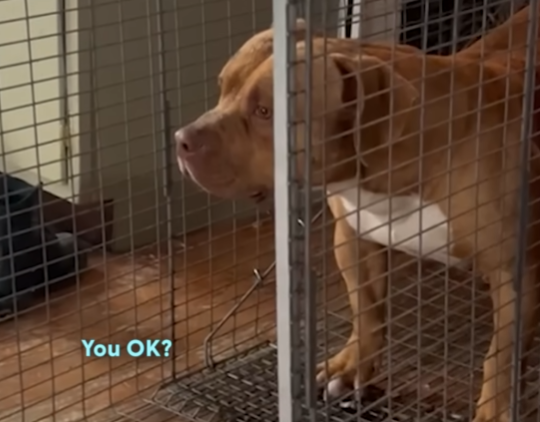
Life outside the shelter was overwhelming at first. New sounds, new smells, open spaces—it all took time to process. Maya followed Lily everywhere, like a shadow, sleeping beside her bed each night. Loud noises still startled her. Sudden movements made her flinch. But day by day, fear gave way to trust.
For the first time, Maya experienced what it meant to be a family dog.
She learned that couches were soft.
That food would always come.
That hands could be kind.
She discovered car rides, belly rubs, and the simple joy of lying in the sun. She made friends at the park, winning people over with her calm demeanor and soulful eyes. Slowly, she began changing minds—one wagging tail at a time.
Neighbors who once crossed the street now stopped to pet her. Children learned that pit bulls could be gentle. Maya became an ambassador without ever trying.
Years passed, and Maya grew older. Her muzzle turned white. Her steps slowed. But her love never faded. She stayed by Lily’s side through exams, heartbreaks, and milestones. She waited by the door every day for Carlos to come home from work. She was there—always steady, always present.

When Maya’s health finally declined, the family knew the time was coming. They stayed with her until the end, holding her, thanking her, loving her the way she had always loved them.
Maya passed peacefully, surrounded by the family who finally saw her for who she truly was.
Her story didn’t end there.
The rescue shared Maya’s journey online, and it reached millions. People cried. People shared. People questioned their assumptions. Many said Maya changed how they saw pit bulls forever.
Because that’s what these stories do.
They remind us that dogs are not labels.
They are not stereotypes.
They are hearts with fur, capable of unimaginable forgiveness.
Maya was abused, chained, and forgotten—but she chose love anyway. She trusted again. She lived fully. And through her, countless others learned that pit bulls are not something to fear, but something to protect.
A pittie story we’ll never forget—not because of how it began, but because of how bravely it ended.
And because somewhere, right now, another Maya is waiting for someone to look past the label and see the love underneath.