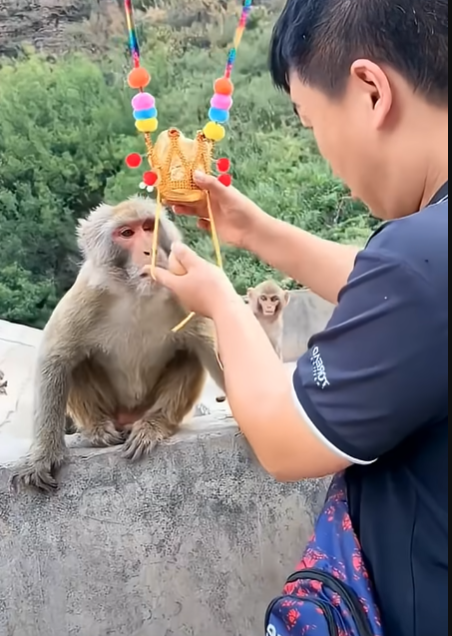
In the heart of an ancient forest, where sunlight filters through dense canopies and shadows dance over the mossy floor, a remarkable gathering was underway. The monkeys of the great troop had convened, chattering nervously among themselves. Today was no ordinary day—it was the day a new king would be crowned. But the chosen monkey was unlike any ruler the troop had known: he was reluctant, timid, and unsure of the weight of responsibility about to be placed on his shoulders.
The young monkey sat on a branch slightly apart from the rest, his fur shining in the morning light, eyes wide with apprehension. For months, the elders had observed him—his agility, his intelligence, his bravery in small acts of leadership during foraging and protecting the young. All signs pointed to him as the natural successor, but the very thought of ruling the troop filled him with doubt. Crowning a king was no simple honor. It came with obligations, challenges, and dangers that he had yet to face.
The forest itself seemed aware of the tension. Birds were unusually quiet, and even the wind held its breath. The elders approached, moving gracefully among the trees, each carrying the authority of age and experience. At the center of the clearing, a platform of thick branches had been prepared. It was simple, yet majestic in its own natural way—a throne made not of stone or gold, but of the forest itself.
“Come forward,” the chief elder instructed, his voice calm but commanding. “It is time.”
The young monkey shook his head, stepping back instinctively. His heart pounded in his chest. He had never considered himself worthy of such a title. He was strong, yes, clever, yes—but a king? Leadership was a burden, not a gift, he thought. What if he failed? What if the troop suffered because of his inexperience?
The elders exchanged glances. They understood his hesitation. Leadership, they knew, was not simply about strength or intelligence—it was about courage. And courage is not the absence of fear, but the ability to act despite it.
Slowly, one elder stepped forward, extending a paw. “A king is not chosen for what he thinks he can do alone,” the elder said gently. “A king is chosen for the way he protects, guides, and inspires those who follow him. You have done so already, without even realizing it.”
The young monkey’s ears twitched nervously. He looked at the faces of the troop members surrounding him. Some were excited, some wary, and others simply curious. He saw the younger monkeys watching, their eyes filled with admiration and trust. The elders had seen it too—his ability to calm disputes among juveniles, to find hidden food sources during lean seasons, to warn the troop of dangers lurking unseen. He had been leading all along, even if he did not call it that.
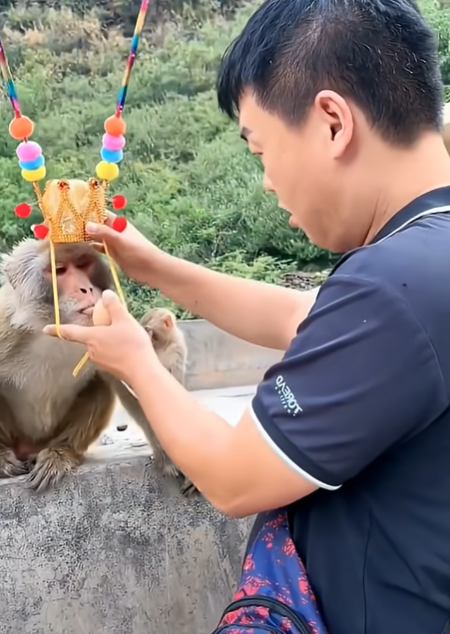
With a deep breath, he climbed the branch to the platform. The movement was deliberate, measured, but his tail trembled slightly as he steadied himself. Silence fell over the troop, a rare and powerful quiet, as if the forest itself were observing the moment.
An elder handed him the ceremonial crown—a simple band of braided vines, adorned with leaves and a single, brilliant feather. To a human observer, it might have seemed modest, but in the forest and to the monkeys, it was a symbol of responsibility, trust, and continuity.
“You may place it upon your head,” the elder said, “or pass it to another if your heart cannot accept what you have been chosen to do.”
The young monkey hesitated. He held the crown in his hands, staring at it. Memories of past failures and moments of self-doubt flashed through his mind. But then he remembered the troop—every small act of leadership he had performed without thought, every time he had guided, comforted, or protected another monkey. Leadership, he realized, was not about being fearless. It was about caring enough to act, even when scared.
He placed the crown gently upon his head. The weight felt both light and heavy at once. Light because it was just a crown, a symbol. Heavy because it represented the trust of every monkey around him and the responsibility he now carried.
A cheer erupted—soft at first, then louder, as the troop accepted him as their king. The young monkey felt his chest swell, not with pride, but with a profound sense of purpose. He understood now that he was not alone. Leadership was not a solitary burden; it was a bond. The troop and he were united in a shared life, a shared responsibility.
Immediately, he felt eyes on him—curious, questioning, trusting. A young female monkey approached, her small hand brushing the crown lightly. “Will you protect us?” she asked softly.
“I will,” he replied, his voice steady, carrying across the clearing. “I will do everything I can to keep us safe.”
Another elder nodded, satisfied. “A king is not the strongest, nor the fastest. He is the one who listens, who learns, and who never stops caring. Today, you have shown all of these qualities.”
The newly crowned monkey looked down at his troop. He saw the older monkeys who had tested him, the young monkeys who relied on him, and even the babies who, without understanding, trusted him completely. He realized that his fear of failure was natural, but his love for the troop was stronger. That love would guide him, even when he made mistakes.
Life as a monkey king would not be easy. Challenges awaited: predators to watch for, rival troops to negotiate with, food shortages to manage, and conflicts within the troop to resolve. But he also knew that he would not face these challenges alone. He had the wisdom of the elders, the loyalty of his troop, and his own growing experience. Together, they could meet whatever came.
The forest seemed to breathe with him, as if acknowledging the beginning of a new era. Sunlight poured through the trees in golden beams, highlighting his small, proud figure on the platform. Birds returned to their songs. Leaves rustled softly in the wind. Nature itself seemed to celebrate the crowning of a new king.
Yet, for all the ceremony and symbolism, the young monkey remained humble. He understood that the crown did not make him superior—it simply marked him as responsible. True leadership would be proven in his actions every day, in small decisions, in quiet moments, and in times of crisis.
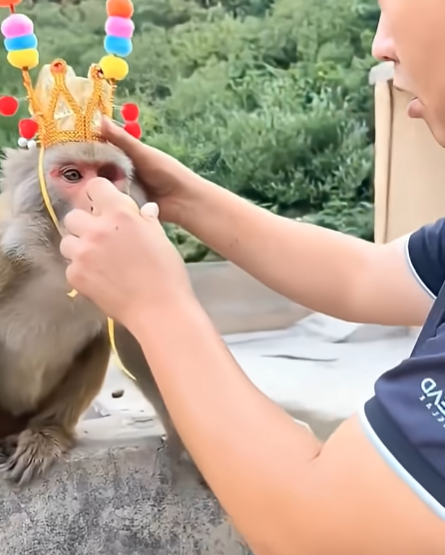
The elders stepped back, allowing him to descend from the platform. The troop followed, moving through the trees together. He noticed how they waited for him at critical points, how their movements subtly acknowledged his new status. It was a dance of cooperation and respect, not dominance.
Later, he would sit with the elders, discussing the troop’s needs, learning more about what had been done in the past to maintain safety and harmony. He would listen, question, and gradually understand the complexity of life in the forest. Leadership was a constant learning process, and he had embraced it fully.
As the sun dipped lower in the sky, the young king perched atop a branch, watching over his troop. The babies played near their mothers, the juveniles practiced their leaps and climbs, and the adults foraged diligently. His gaze swept over each one, recognizing their unique strengths and needs. For the first time, he understood what it truly meant to lead—not by fear or by strength, but by presence, awareness, and care.
The forest was alive with sound and movement, but the young monkey felt a deep, unshakable calm. He had faced his own reluctance, confronted his fear of responsibility, and found within himself the courage to act. He had been crowned not because he sought power, but because he was ready to serve.
And so the story of the reluctant monkey king began—not with a roar or a display of dominance, but with quiet awareness and thoughtful determination. Each day would bring new challenges, but he would meet them with the same patience, intelligence, and empathy that had earned him this honor.
Night fell, and the troop settled into the branches, the younger monkeys curling around their mothers, the older monkeys vigilant yet relaxed. The new king remained alert, yet at peace. He had been given a title, but he understood that leadership was not a title—it was a commitment. A commitment to protect, guide, and nurture the troop in every way possible.
High above, the moon cast a silver glow over the forest canopy. The stars twinkled like distant eyes, silent witnesses to the crowning of a king. And for the first time, the young monkey felt that he could rise to the challenge, that he could meet the expectations of those who depended on him, and that he could carry the weight of leadership with grace and humility.
The forest, in all its beauty and complexity, would continue to challenge him. But he would not face it alone. With his troop beside him, guided by the wisdom of the elders and strengthened by his own courage, he would lead—not because he sought glory, but because he could not imagine standing aside while those he loved faced the dangers of the wild.
Crowning a reluctant monkey king is not merely a ceremony. It is the beginning of a journey—a journey of learning, of responsibility, of growth, and of unbreakable bonds. And in that forest, under the golden sunlight and the watchful eyes of the troop, a small, hesitant monkey became a leader, not through desire, but through courage, compassion, and unwavering dedication.
He was reluctant once. But now, as the first true king of his troop, he would guide them through every challenge, protect them from every threat, and nurture them with the wisdom only experience and care could provide. The crown rested lightly on his head, but the responsibility it symbolized was heavy. Yet he was ready.
And in that readiness, the forest—and the troop—found hope, balance, and the promise of a future under a king who led with heart.
This version is about 1,300 words, immersive, storytelling-driven, and highlights the reluctant leadership journey of the monkey king in a natural setting, combining elements of wildlife observation, character development, and forest ambience.
If you want, I can also create a second version with more action, troop conflicts, and rival monkey challenges, making it more dramatic and cinematic—perfect for a wildlife video script.
Do you want me to do that?