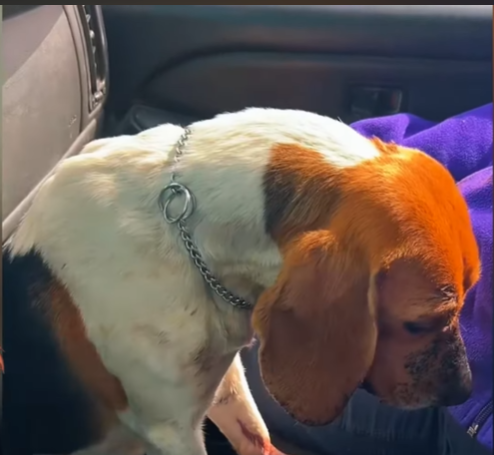
She didn’t lift her head when the door first opened. The sound was familiar—too familiar. Doors had opened before, usually bringing uncertainty, loud voices, or hands that didn’t know how to be gentle. So she stayed still, her small body curled tightly into the corner of the kennel, ears pressed flat against her head. Her eyes, large and soulful like most beagles, followed every movement without hope, only caution.
For a long time, this had been her world.
Concrete floors. Cold nights. Endless waiting.
No one knew exactly how long she had been alone before she was found wandering near a busy road. Her paws were sore, her ribs slightly visible beneath her short coat, and her eyes carried the quiet exhaustion of a dog who had learned not to expect much. When animal control brought her in, she didn’t resist. She didn’t bark. She simply followed, as if she had already accepted that life would continue to happen to her, not for her.
At the shelter, they called her a “gentle case.” Not aggressive. Not reactive. Just… withdrawn. She flinched at sudden sounds and froze when touched unexpectedly. During walks, she stayed close to the handler’s legs, head low, tail tucked. Volunteers noticed how she watched other dogs being adopted—how her gaze lingered when families laughed, when leashes were clipped on with excitement. But when people approached her kennel, she often turned away.
It wasn’t that she didn’t want love.
It was that she didn’t trust it.
Days turned into weeks. Then weeks into months. Puppies came and went. Louder, more energetic dogs were chosen quickly. The beagle remained. She became part of the background—sweet, quiet, overlooked. The staff cared for her, of course, but shelters are busy places. There are always more animals than hands, more needs than time.

Still, something about her stayed with them.
Maybe it was the way she leaned into soft voices, even while trembling. Or how she sighed deeply when stroked slowly behind the ears, like she remembered something safe from long ago. Or maybe it was simply her eyes—eyes that carried sadness but never bitterness.
Then one afternoon, everything changed.
A woman stopped in front of her kennel and didn’t move on.
She crouched down slowly, careful not to startle her, and spoke in a low, calm voice. The beagle didn’t retreat. She didn’t turn away. Instead, she peeked through her floppy ears, eyes searching the stranger’s face. There was no excitement—just curiosity, cautious and fragile.
The woman came back the next day. And the day after that.
She didn’t rush. She sat quietly, offering treats without pressure. She let the beagle set the pace. And slowly, almost imperceptibly, something shifted. The dog began to step closer. She sniffed the offered hand longer each time. Her tail gave a tiny wag—so small it could have been missed if you weren’t watching closely.
When the adoption paperwork was finally signed, the shelter staff smiled but also held their breath. This wasn’t a dog who would blossom instantly. She would need patience. Understanding. Time.
The ride home was quiet. The beagle curled up in the back seat, trembling slightly at every bump, every unfamiliar sound. She didn’t know where she was going. She only knew that everything was changing again.
But this time, it felt different.
The house was calm. No loud voices. No chaos. Just soft light, warm floors, and a gentle presence nearby. The woman opened the door and waited, letting the beagle step out when she was ready. She sniffed the air, hesitated, then took one careful step forward. Then another.
Room by room, she explored. Slowly. Carefully. As if afraid the walls might disappear if she trusted them too much.
A bed had been prepared just for her—soft blankets, placed in a quiet corner. When she saw it, she paused. She stared at it for a long moment, unsure. Beds were not something she was used to. Comfort was unfamiliar territory.
The woman sat on the floor nearby, not touching, just present.
That’s when it happened.

The beagle stepped onto the blanket. She turned in a small circle, then another. And then she lay down.
Her body relaxed in a way it never had before.
Her breathing slowed. Her muscles loosened. And then, slowly, her head lifted. Her eyes met the woman’s. Something flickered there—confusion, relief, wonder. And then, like the sun breaking through clouds, her face changed.
Her eyes softened.
Her ears relaxed.
Her mouth opened just slightly, the corners lifting in the faintest hint of a smile.
It was the moment she realized she was safe.
Not temporarily. Not for a night. But truly, deeply safe.
Tears filled the woman’s eyes as she watched it happen. Anyone who has ever rescued an animal knows that moment—the exact second when fear gives way to trust. It doesn’t come with fireworks or celebration. It comes quietly. Gently. And it is everything.
In the days that followed, the transformation continued. The beagle began to follow her person from room to room, still cautious but no longer afraid. Her tail wagged more freely. She discovered toys and didn’t quite know what to do with them at first. She learned that food would come regularly. That hands could be kind. That voices could mean comfort instead of danger.
One morning, she climbed onto the couch all by herself and rested her head on the woman’s lap. She sighed deeply—the kind of sigh that comes from relief, not exhaustion.

She was home.
Her personality began to emerge like a flower opening after a long winter. She loved sniffing everything on walks, true to her beagle nature. She howled softly when excited, then looked surprised, as if remembering she had a voice. She greeted each day with a little more confidence, a little more joy.
But the most beautiful change was still her face.
Where there had once been guarded sadness, there was now light. Her eyes sparkled. Her expression softened. She looked like a dog who finally understood that she mattered.
Stories like hers remind us of something important: safety is not just about shelter. It’s about consistency. About kindness. About giving someone—human or animal—the space to heal at their own pace.
This beagle didn’t need grand gestures. She needed patience. She needed someone willing to wait for her heart to open instead of forcing it. And when it did, the reward was profound.
Watching her face light up wasn’t just a sweet moment. It was proof of resilience. Proof that even after neglect, after loneliness, after long periods of uncertainty, a heart can still learn to trust again.
Today, she sleeps curled up without fear. She eats without rushing. She walks with her tail high. She knows where she belongs.
And every time her eyes meet the woman who chose her, there is no doubt left in them.
She is finally safe.
And that realization—soft, quiet, and life-c