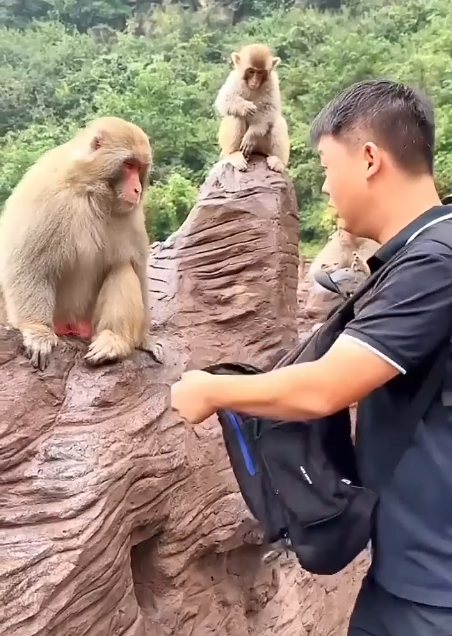
In the dense heart of the ancient jungle, where the sunlight pierced through the canopy in golden streams, there lived a monkey unlike any other. He was known far and wide among the forest creatures as the Monkey King—a showman, a trickster, and a ruler of mischief. His fur gleamed with an almost supernatural sheen, and his eyes held a cunning brilliance that hinted at both intelligence and danger.
From a young age, the Monkey King had shown a rare combination of charm and cruelty. He would entertain the troop with acrobatic feats, leaping effortlessly between trees, spinning in midair, and performing stunts that left even the most seasoned monkeys in awe. But behind the playful antics lurked a vicious streak. He was ruthless in disputes, often bullying weaker monkeys for the smallest offenses, hoarding food, and manipulating the troop for his own gain.
The forest had never seen a creature quite like him. His charisma drew followers, but his cruelty instilled fear. Monkeys, birds, and even some timid forest predators knew better than to cross him. And yet, his appetite for dominance and spectacle would set him on a path that no living being could contain.
The Rise of the Showman
Every morning, the Monkey King would gather his troop at the edge of the river. With dramatic gestures and bold leaps, he would perform daring acrobatics, drawing attention and admiration. He thrived on applause, though the applause often came from the fearful chuckles and gasps of those who dared not challenge him.
He did not stop at entertainment. The Monkey King began organizing contests, pitting monkeys against each other in dangerous games. He watched with amusement as the losers stumbled, fell, or got drenched in the river. The more chaos he caused, the more he relished it. The forest became his stage, and every creature an unwilling audience.
His power grew, but so did his notoriety. The elders whispered warnings: “He is clever, but cruelty cannot remain unchecked.” But the Monkey King laughed at such advice. He believed himself untouchable, his wit and strength far beyond the reach of any punishment the forest could offer.
The Turning Point
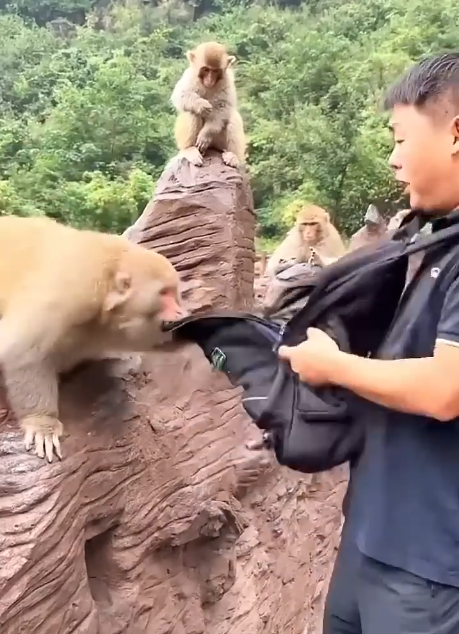
One fateful day, the Monkey King discovered a new form of entertainment—playing tricks on the humans who lived at the forest’s edge. He would steal their tools, snatch their food, and dangle from the trees just out of reach, mocking them with his cunning gestures. The humans grew frustrated, calling him “the vicious spirit of the trees.”
The Monkey King reveled in the title. It made him feel invincible. But it was a dangerous game. Humans, though slower and weaker physically, possessed tools and knowledge the Monkey King could not fully understand. And one day, a group of hunters came into the forest, armed not with spears, but with nets designed to capture creatures with minimal effort.
The Monkey King, confident as ever, tried to outwit them. He leaped from branch to branch, taunting the hunters, and performing stunts that would have amazed his troop. But the humans had planned carefully. One misstep—a slip on a mossy branch—and he found himself tangled in a net, struggling, furious, and humiliated.
Punishment Beyond the Living
The hunters did not kill him; they bound him and carried him to the forest edge, where an elder shaman awaited. The shaman had long been aware of the Monkey King’s reign of terror. With a grave expression, he spoke of balance and karma. “The jungle thrives on harmony, not fear. You have disrupted this harmony too long. Your cunning will now be tested beyond life itself.”
Before the Monkey King could protest, the shaman performed a ritual. Flames danced without burning, winds swirled without movement, and a bright, blinding light enveloped the Monkey King. When it faded, he was gone—vanished from the world of the living.
Yet, the forest trembled. The animals could feel a presence—a force unseen, powerful, and unnerving. The Monkey King had not died; he had transformed. His viciousness, cunning, and love for chaos had tethered him to the spirit world. He had become a spirit, neither fully alive nor entirely free.
The Spirit of Mischief
In his new form, the Monkey King retained all his abilities, but the forest no longer respected him. His leaps could carry him through the air with ghostly grace, his voice could mimic any creature, and his eyes glowed in the darkness like twin lanterns. But he could not touch the living in the same way. He could influence events, whisper into dreams, and create illusions, but he could not directly harm the creatures he once terrorized.
This frustrated him immensely. The thrill of domination, the applause of fearful audiences, and the tangible chaos he once enjoyed were gone. He could no longer feel the warmth of stolen fruit or the rush of a victorious prank. Now, all he had was his presence, eerie and untouchable, a reminder of what he had been and what he had lost.
Yet, his cunning found new outlets. The Monkey King began haunting the edges of the jungle, appearing to those who were greedy, cruel, or dishonest. He would whisper warnings, create illusions of danger, or rearrange objects to expose secrets. Though he could not directly harm the innocent, he found satisfaction in revealing the hidden flaws of others, teaching lessons through fear and cunning—a ghostly echo of the showman he once was.
Lessons from a Vicious Spirit
The legend of the Monkey King, now a spirit, spread far beyond the forest. Humans spoke of a monkey that could vanish in a blink, whose laughter echoed through the trees, and whose cunning could reveal the truth in terrifying ways. Mothers would warn their children: “Be kind, or the spirit of the Monkey King will see you.” Hunters would tremble when their traps failed inexplicably. And within the forest, the troop that once worshiped him from fear now avoided his territory, sensing his presence even without seeing him.
The Monkey King’s transformation served as a powerful reminder of balance in the natural world. Power without wisdom, cunning without compassion, and charisma without empathy are fleeting. Even the most brilliant showman, when vicious, may find that life has a way of demanding accountability beyond death.
The spirit learned too, though in a slow and frustrating way. Through centuries of haunting, observing, and whispering, he began to understand the true nature of influence. Power is not in fear alone; it lies in respect, in protecting, in guiding. Though he remained a mischievous and cunning presence, the Monkey King’s spirit slowly evolved from pure malice to a more balanced trickster—one who taught lessons rather than merely created chaos.
The Ghostly Showman
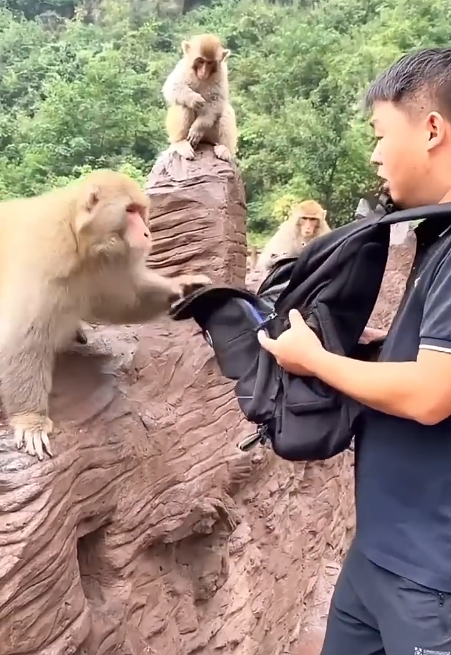
The forest eventually adapted to the presence of the Monkey King’s spirit. Animals and humans alike recognized patterns: shadows where he passed, rustling branches without a visible source, and distant laughter echoing at dusk. It became clear that this was no ordinary monkey, no ordinary ghost.
The Monkey King, in his spectral form, continued to show the same flair for the dramatic that had defined his life. He would leap between trees with supernatural grace, create illusions of waterfalls or fruits, and mimic the sounds of any creature. But this time, there was a purpose. Each trick carried a message—warning the cruel, protecting the innocent, or simply reminding all creatures that balance must be respected.
Though his viciousness remained a part of him, it was tempered by centuries of observation. The Monkey King, the showman, had become a force of eerie, supernatural justice.
Encounters with the Monkey King
Many humans claimed encounters with the spirit. Farmers spoke of bananas disappearing, only to return perfectly arranged in their baskets. Children playing in the forest would hear laughter and see shadows dancing just out of reach. Hunters often found traps destroyed mysteriously, or paths rearranged in ways that revealed their hidden motives.
Even animals seemed aware of the Monkey King’s spectral presence. Birds would alter their flight paths to avoid certain trees, while monkeys would cautiously observe areas where the showman’s spirit was most active. And always, in the distance, a faint echo of laughter reminded everyone that the cunning, mischievous spirit was never far.
These encounters fueled the legend. Stories passed down through generations depicted the Monkey King as a cunning trickster, a warning to those who misused power, and a spectral protector of the forest. His viciousness, once dangerous and uncontrolled, had transformed into a tool that maintained harmony—albeit in a ghostly, unpredictable way.
Reflection on Power and Consequence
The tale of the Monkey King is more than a story of mischief; it is a meditation on power, consequence, and transformation. His life reminds us that charisma and cunning can entertain and impress, but without compassion and respect, they can lead to downfall.
The Monkey King’s transition into a spirit represents the enduring influence of actions. Even in death—or beyond it—the consequences of cruelty follow. Yet, the story also demonstrates the possibility of change. In the spectral world, the Monkey King finds purpose beyond fear and chaos. His lessons, delivered in whispers, illusions, and ghostly laughter, guide the living toward balance and harmony.
Conclusion
The Monkey King, the showman, remains one of the most legendary figures of the forest. His life was marked by acrobatics, tricks, and viciousness, but his transformation into a spirit ensures that his story continues, teaching lessons in both fear and respect. He is neither fully alive nor fully dead, a cunning, mischievous presence that reminds the jungle and humans alike that power is tempered by responsibility, and that cruelty, unchecked, eventually demands reckoning.
From the vibrant acrobatics of his youth to the ghostly manipulations of his spirit, the Monkey King’s journey is a testament to the consequences of unchecked cunning, the persistence of influence, and the enduring lesson that even the most vicious of creatures can find purpose in the unseen realms of existence.
His laughter echoes through the treetops, his illusions shimmer in the mist, and his legend endures—forever the showman, forever cunning, forever a spirit of both warning and wonder.