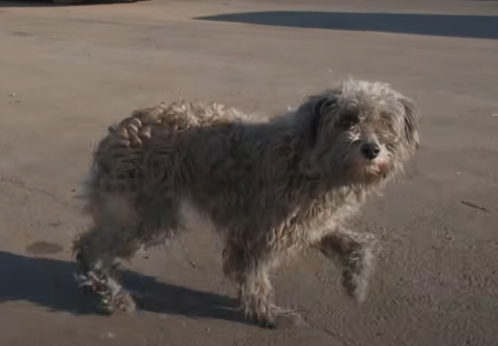
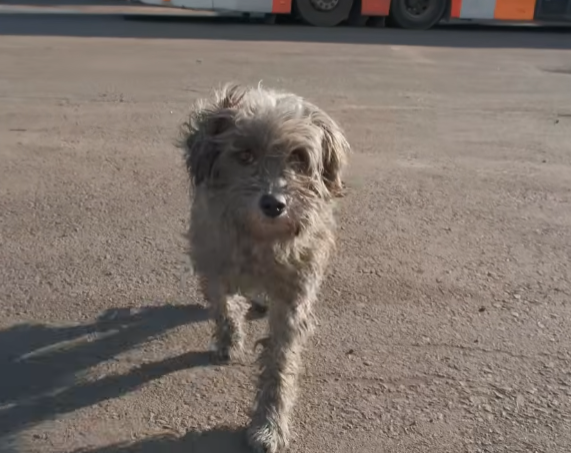
The bus station was already awake when the sun crept over the rooftops, spilling pale light across cracked concrete and rows of metal benches. Engines rumbled, doors hissed open and shut, and people hurried past with bags, phones pressed to ears, eyes fixed forward. It was a place of movement, of coming and going—never of staying. Yet in the middle of it all, a small brown dog stood trembling, as if the noise and motion might swallow her whole.
She did not bark.
Instead, she waited.
Her body was thin, her ribs faintly visible beneath short fur dulled by dust and grime. One ear drooped at an odd angle, the other scarred and torn. But what stopped people—what made a few slow their steps and look again—were the wounds along her side. Angry red gashes crossed her ribs, some fresh, others crusted over with dried blood. Each step she took caused her to flinch.
She walked carefully from person to person.
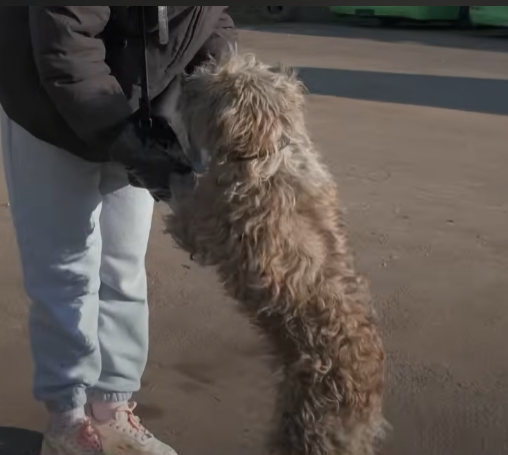
When someone paused, she did something unusual. She turned her body sideways and lifted her head just enough to reveal the injuries on her flank. Then she lowered herself to the ground, exposing her wounds openly, vulnerably—like she was offering proof of her suffering.
Like she was asking for help.
No one knew where she had come from. Maybe she had been beaten and thrown away. Maybe she had escaped a cruel place and followed the smell of people, believing humans could save her. Dogs don’t understand cruelty the way humans do. They only know pain—and hope.
And somehow, despite everything, she still hoped.
The first few people she approached hesitated. One man shook his head sadly and kept walking. A woman murmured, “Poor thing,” but followed her bus as it pulled in. Others avoided eye contact altogether, afraid that stopping would mean responsibility.
The dog watched each one leave.
Still, she tried again.
She limped toward a young couple standing near the ticket booth. Her tail did not wag—it was too tired for that—but it lifted slightly, just enough to show she meant no harm. When the woman crouched down, surprised, the dog moved closer and turned her wounded side outward.
The woman gasped.
“Oh my God,” she whispered, hand flying to her mouth.
The dog held still, eyes soft and dark, trusting. She did not pull away when the woman gently reached out. She did not growl. She only breathed—shallow, careful breaths—as if afraid even movement might scare away this chance.
The man looked around nervously. “We can’t miss the bus,” he said.
“I know,” the woman replied, her voice shaking. “But look at her.”
They stood there, torn, as the bus engine roared to life behind them. The woman reached into her bag and pulled out a bottle of water, pouring some into the cap. The dog drank greedily, water spilling down her chin. When she finished, she looked up again—expectant.
But the bus horn sounded.
“I’m sorry,” the woman whispered, tears in her eyes. She stood, stepped back, and boarded.
The dog watched them go.
She lay down for a moment, exhausted, the hard ground pressing into her wounds. Pain pulsed through her body, a constant, burning ache. Hunger twisted in her stomach. The noise of the station faded into a dull roar.
Still, she did not give up.
When she rose again, her legs trembled. She limped toward a security guard standing near the entrance. She stopped a few feet away and sat, then slowly leaned to one side, exposing her injuries.
The guard frowned.
“Hey, buddy,” he said softly, stepping closer. He knelt, careful. “What happened to you?”
The dog’s eyes met his. She did not understand his words, but she understood his tone. She inched closer, pressing her wounded side toward him, whimpering softly for the first time.
The guard cursed under his breath.
He radioed for help.
Within minutes, station staff gathered, forming a loose circle around the dog. Some shook their heads in disbelief. Others knelt and spoke gently. Someone fetched a clean cloth and dabbed carefully at the wounds. The dog flinched but did not move away.
“She came up to people,” one staff member said quietly. “Like she was showing them.”
“She was,” the guard replied. “She’s asking.”
Animal control was called. While they waited, a woman who ran a small food stall nearby brought scraps of chicken and rice. The dog ate slowly, savoring each bite, as if afraid it might be her last. Between mouthfuls, she kept looking up, checking the faces around her, making sure they were still there.
When the animal control vehicle arrived, the dog grew anxious. She had learned that vehicles could mean pain, separation, or abandonment. She tried to back away, but her legs gave out beneath her.
The officer knelt immediately.
“It’s okay,” she said softly. “You’re safe now.”
The dog did not know what “safe” meant—but she felt something in the woman’s touch. Calm. Steady. Hands that did not strike.
She allowed herself to be lifted into a blanket.
At the veterinary clinic, the truth of her condition became clear. The wounds along her side were deep, likely caused by a sharp object or repeated blows. Some were infected. She was severely underweight and dehydrated. Old scars on her legs and neck suggested a history of abuse.
“She’s been hurting for a long time,” the veterinarian said quietly.
As treatment began, the dog lay still on the exam table, eyes half-closed. She whimpered once when the wounds were cleaned, then fell silent. When the pain medication took effect, her body relaxed for the first time in what might have been months.
They named her Hope.
Because that was what she had shown.
Recovery was slow. For days, Hope barely moved, sleeping deeply as her body began to heal. Volunteers sat with her, speaking softly, letting her know she was not alone. Each time someone entered the room, she lifted her head, searching their face—not with fear, but with cautious curiosity.
She learned that hands could heal.
She learned that voices could be kind.
She learned that food would come regularly, that water would always be there, that pain would lessen instead of worsen.
One afternoon, a volunteer reached to change her bandages. Hope hesitated, then turned her body—presenting her wounded side just as she had done at the bus station. She stood still, trusting.
The volunteer’s eyes filled with tears.
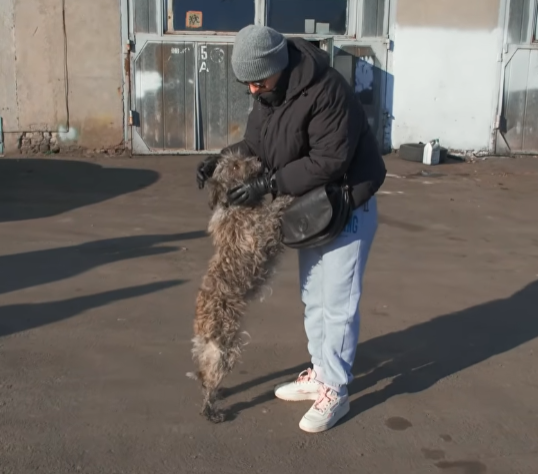
“She remembers,” she whispered. “She knows showing her wounds helped her survive.”
Weeks passed. The angry red gashes faded into pink scars. Hope gained weight. Her fur began to shine again. She started to wag her tail—tentatively at first, then with growing confidence. She discovered toys and learned how to play, though sudden movements still startled her.
But she was changing.
The day she walked outside without flinching at every sound, the staff cheered. The day she rolled onto her back for belly rubs, someone cried. Each small victory felt monumental, because they knew how close she had been to disappearing unnoticed in a crowded place.
A family came to meet her.
They sat on the floor of the shelter room, letting Hope approach at her own pace. She sniffed cautiously, then leaned against the woman’s leg. When the man gently touched her side, near the scars, Hope did not pull away. She only sighed and sat down.
As if saying, I’m ready.
On the day she left the shelter, wrapped in a new collar, Hope paused at the door. She looked back once—at the people who had saved her, at the place where she had healed. Then she walked forward, confident, her limp barely noticeable now.
Months later, she returned to the bus station—not as a victim, but as a visitor.
Her new family stopped there briefly during a trip. Hope stood calmly by their side, leash loose, eyes alert. The noise no longer overwhelmed her. She did not tremble.
She looked around, as if remembering.
If dogs could speak, perhaps she would have told them how she once stood there alone, bleeding, begging strangers with nothing but trust. How she showed her wounds not to frighten people—but to survive.
She didn’t need words.
Her scars told the story.
A story of pain—but also of courage. Of a dog who believed in humans even when humans had failed her. Of a moment when someone finally listened.
At a bus station full of people going nowhere together, one dog stopped—and asked for help.
And because she did, she lived.