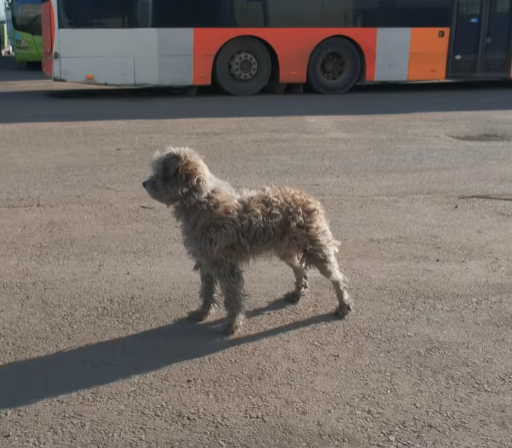
She lay curled beside the rusted bench at the far end of the bus station, barely visible to the hurried travelers rushing past. Most people saw only a thin shape on the cold concrete, something easy to ignore, something that blended into the background of noise, exhaust, and footsteps. But if they looked closer—if they truly looked—they would have seen a small dog whose body was broken and whose spirit was quietly fighting to survive.
Her fur was once white, perhaps soft and bright like fresh cotton. Now it was stained gray with dust and rain, matted into painful knots that pulled at her skin. One of her hind legs lay twisted beneath her at an unnatural angle, swollen and unmoving. Every breath she took was shallow, careful, as though even breathing hurt. Yet the deepest pain was not in her body—it lived in her eyes.
Her eyes were still searching.
No one knew how long she had been there. Some said she appeared overnight, dropped off in the darkness when the buses stopped running and the station fell silent. Others believed she had been there for days, slowly fading into the scenery. What everyone agreed on was this: someone had left her there on purpose.
She remembered that night.
She remembered the car stopping suddenly, the harsh sound of the door opening. She remembered being lifted roughly, her injured leg sending a sharp wave of pain through her body. She remembered the smell of fear mixed with gasoline, the cold air hitting her face. Then she remembered being placed on the ground and hearing the door slam shut.
The car drove away.
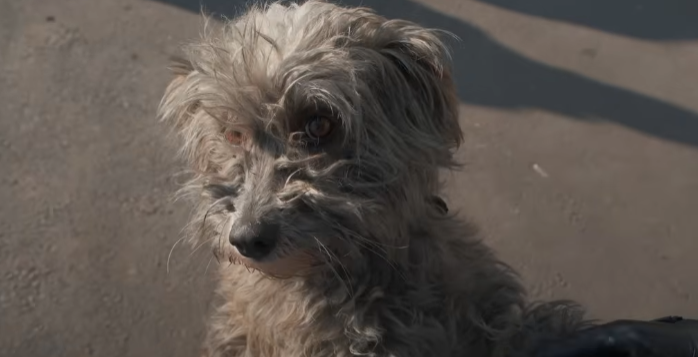
She tried to stand. She tried to follow. But her leg would not hold her weight, and she collapsed onto the concrete, crying out softly. The sound echoed in the empty station and then disappeared into the night. No one came.
At first, she believed they would return. Dogs always believe that. She dragged herself closer to where she had been left, inch by painful inch, and waited. Every engine sound made her lift her head. Every shadow made her heart race. But as the night stretched on and turned into morning, hope began to crack.
The bus station woke up around her.
People arrived with bags and tired faces. Buses roared in and out, shaking the ground beneath her fragile body. Some people noticed her and frowned. Some looked away quickly, as if her pain were contagious. A few whispered words of pity as they passed, but no one stopped. No one wanted to deal with a broken dog at a busy bus station.
Hunger soon followed.
Her stomach cramped painfully, but she was too weak to beg. She simply lay there, head resting on the ground, eyes following the movement of feet. A child pointed at her once, tugging at his mother’s sleeve, but the woman pulled him away, shaking her head.
“She’s hurt,” the child said.
“I know,” the mother replied quietly. “But we can’t help.”
Time lost its meaning. The sun climbed high, then sank again. Rain came suddenly in the afternoon, cold and relentless. Water soaked into her fur, chilling her body and making her shiver uncontrollably. She tried to lift her head, but it felt too heavy. Her eyes began to close, not from sleep, but from exhaustion.
She wondered if this was how it ended.
Then, something changed.
A woman stopped.
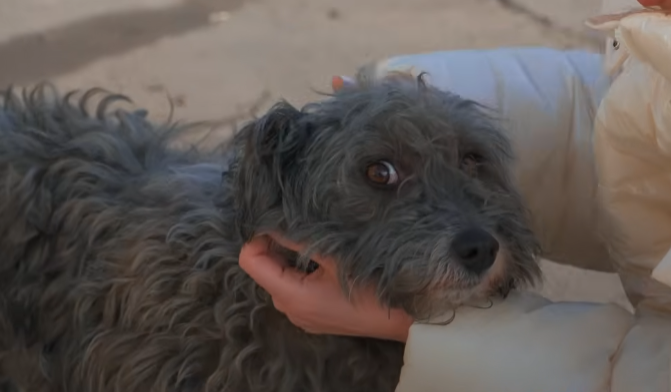
She was not in a hurry. She carried no large bag, no look of stress on her face. When she saw the dog, she slowed down, then stopped completely. She crouched a few steps away, careful not to startle her.
“Oh, sweetheart…” the woman whispered.
The dog forced her eyes open. She had learned not to expect anything—but the voice was gentle, different from the sharp sounds around her. She tried to lift her head and failed.
The woman noticed the twisted leg immediately. Her breath caught. Slowly, she reached into her bag and pulled out a bottle of water. She poured some into the cap and set it close.
The dog sniffed weakly. Thirst overcame fear. She dragged herself forward just enough to drink. The cool water soothed her dry throat, and for the first time in what felt like forever, relief washed through her.
The woman stayed.
She sat on the concrete floor of the bus station, ignoring the stares of strangers. She spoke softly, telling the dog she was not alone anymore. When the dog whimpered, the woman’s eyes filled with tears.
“This isn’t your fault,” she said, as if the dog could understand. “You didn’t deserve this.”
After making a few phone calls, the woman carefully lifted the dog into a blanket. The movement caused pain, but the woman was gentle, steady, and the dog did not fight. Somewhere deep inside, instinct told her this human was different.
The ride to the clinic was quiet.
At the veterinary hospital, bright lights and unfamiliar smells overwhelmed her senses. Hands touched her gently, voices murmured urgently. She felt a small prick, then warmth spreading through her body as pain faded into darkness.
When she woke up, she was somewhere else.
Soft bedding cradled her body. A warm blanket covered her back. Her leg was wrapped carefully, supported so it no longer bent the wrong way. For a moment, panic surged—then she saw the woman sitting nearby, watching her.
“You made it,” the woman whispered with a smile.
Recovery was slow.
The injury to her leg was severe—an old fracture that had never healed properly, worsened by being left untreated. Surgery was necessary. The woman visited every day, sitting with her, bringing gentle words and patience. The dog learned the sound of her footsteps, lifting her head when she approached.
After surgery came weeks of rest.
At first, the dog could barely move. She hated being dependent, hated the strange sensation of bandages and limited movement. But every time she grew restless or afraid, the woman was there, stroking her head, telling her she was brave.
Day by day, something remarkable happened.
The dog began to eat again. Her ribs slowly disappeared beneath healthier flesh. Her fur was cleaned, trimmed, and cared for, growing back soft and bright. Her eyes, once dull with pain and fear, began to shine with curiosity.
She learned to stand again.
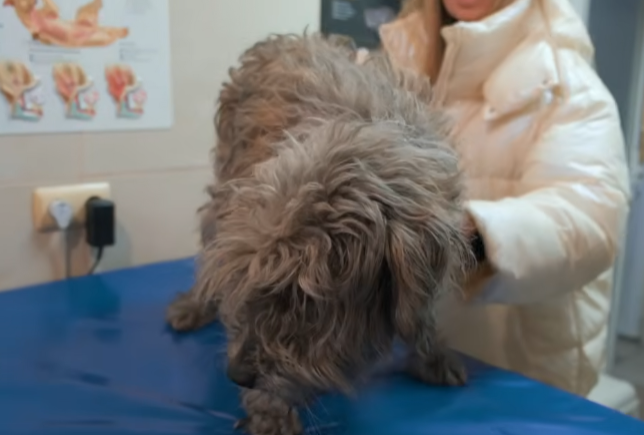
At first, it was only for a second. Her leg trembled, muscles weak and unsure. She fell and tried again. And again. Every small victory was celebrated as if it were a miracle.
When she finally took her first steps, the woman cried.
Months passed.
The dog no longer looked like the broken creature left at the bus station. She walked confidently now, a slight limp the only reminder of her past. She learned to play again—hesitant at first, then with growing joy. She chased toys, rolled in the grass, and slept peacefully for hours without fear.
Most importantly, she learned to trust.
The woman took her home.
It was not a big house, but it was warm. There was a soft bed just for her, bowls that were always filled, and hands that never hurt her. At night, she slept curled at the woman’s feet, breathing deeply, finally safe.
Sometimes, she still remembered the bus station.
Loud noises made her flinch. Strange places made her cling close. But those memories grew quieter with time, replaced by new ones—walks in the morning sun, gentle laughter, the sound of her name spoken with love.
She was no longer broken.
One afternoon, the woman took her back to the bus station—not to leave her, but to pass through on a trip. The dog hesitated as they entered. The smells and sounds rushed back, sharp and overwhelming. She froze for a moment.
The woman knelt beside her.
“You’re okay,” she said softly. “You’re not alone anymore.”
The dog looked around, then up at the woman. Slowly, she wagged her tail.
She walked forward.
She had been left broken at a bus station—discarded, ignored, forgotten. But now, she was standing tall, loved, and alive. Her story was no longer about abandonment.
It was about survival.
It was about kindness.
And it was proof that even the most broken hearts can heal—when someone finally chooses to stop and care.