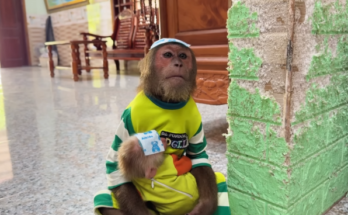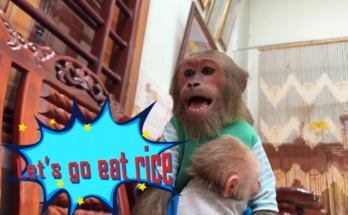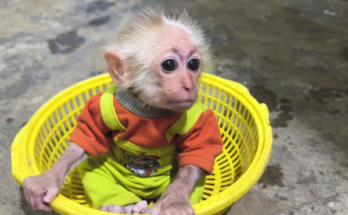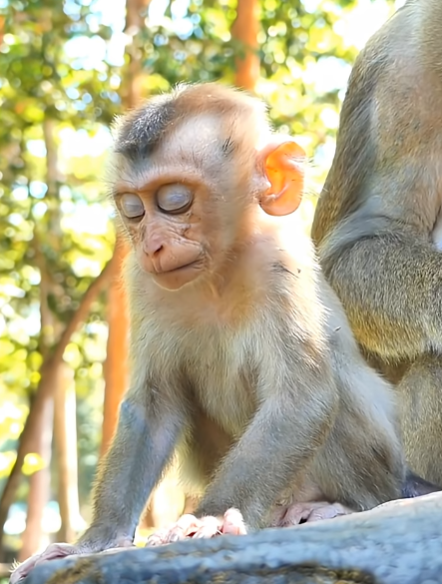
Time passes quietly in the forest. Seasons change, trees grow taller, and the monkeys who once fit in the palm of a hand now leap across branches with confidence and strength. Their faces look more mature, their bodies longer and faster, and their movements more skillful. Yet, if you watch closely—especially when they think no one is paying attention—you will see the truth. Even though they’ve grown older, they haven’t stopped being children.
Early in the morning, when the sun has just begun to warm the leaves, the troop gathers near their favorite trees. The younger ones chase each other in wide circles, shrieking with excitement, but the older monkeys are not much different. One will sneak up behind another and flick its tail, then immediately pretend innocence. Another will steal a piece of fruit and run, looking back with bright eyes, clearly hoping to be chased. Their laughter is not human, but it is unmistakable—high-pitched sounds of pure mischief that echo through the forest.
These monkeys may have scars now, small lines on their faces or missing patches of fur that tell stories of past fights and narrow escapes. They have responsibilities too: protecting territory, finding food, watching over babies. But none of that has erased their playful hearts. Inside every grown monkey lives the same curious child who once clung to its mother’s chest, afraid of the world but eager to explore it.
Sometimes they play games that make no sense at all. One monkey will pick up a dry leaf and examine it seriously, as if it holds great importance. Another will suddenly snatch it away and dash off, triggering an entire chase across branches and rocks. Within seconds, half the troop is involved, leaping, sliding, tumbling over each other in a chaotic but joyful mess. The leaf, the original treasure, is long forgotten. The fun was never about the object—it was about the moment.
Their faces are especially expressive. A raised eyebrow, a tilted head, a dramatic pout when things don’t go their way. When an older monkey loses a playful wrestling match, it might throw itself on the ground in exaggerated defeat, as if the world has ended. The others pause, watching. Then, as if on cue, someone pokes it. Instantly, the “defeated” monkey springs back to life, chasing the offender with renewed energy. Drama, laughter, repeat. Children in grown bodies.
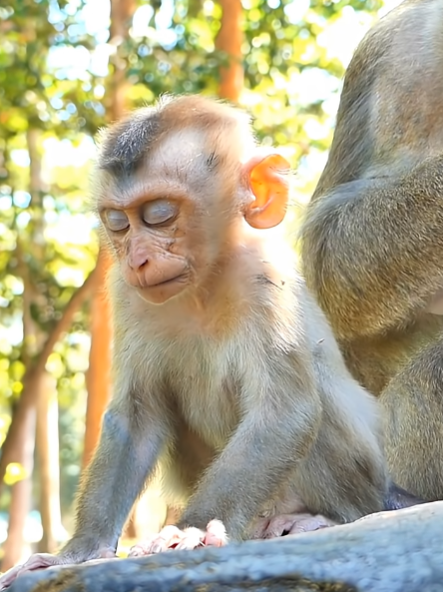
Mealtime reveals this truth even more clearly. You would think older monkeys, with all their experience, would eat calmly and wisely. But no. They still argue over the best pieces, even when there is plenty for everyone. One monkey will grab more than it can carry, stuffing its cheeks until it looks ridiculous, only to drop half of it while climbing. Another will try to sneak food from behind, fail, and then act shocked—as if caught in a crime it never expected to be noticed.
And then there is sharing… or the lack of it. A monkey might scream loudly if someone touches its food, only to lose interest moments later and wander off, leaving the treasure behind. A younger monkey approaches carefully, takes a bite, and suddenly the original owner rushes back, offended, as if saying, “Hey! I still wanted that!” Their emotions change faster than the wind, just like children who cry one moment and laugh the next.
When rain falls, their inner child shines brightest. Instead of hiding quietly, some monkeys jump into puddles, splash water, and shake their fur wildly, sending droplets everywhere. Others cling dramatically to branches, pretending the rain is unbearable, only to peek out moments later and join the fun. The forest becomes their playground, and the weather is just another excuse to play.
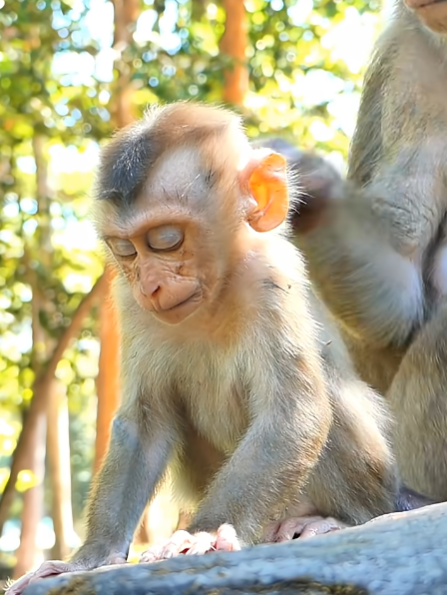
Even their friendships look childlike. They have best friends they follow everywhere, sitting close, grooming each other, sharing secrets only they understand. If one friend disappears for a short time, the other becomes restless, scanning the area, calling out softly. When they reunite, there is no big ceremony—just a quick touch, a nudge, and suddenly they are inseparable again, as if nothing ever happened.
Of course, they also get jealous. If one monkey starts playing with someone new, its usual partner might sit nearby, pretending not to care while clearly watching every move. Eventually, it will insert itself into the game, pushing between them or starting a new distraction. These small emotional dramas feel incredibly familiar, echoing the behavior of human children everywhere.
As the sun sets and the forest quiets down, the monkeys finally slow their pace. They gather together, older and younger, forming a warm, noisy cluster. Some continue to play even as their eyes grow heavy, hands still reaching out to poke or pull a tail. Others rest their heads on a friend’s back, comforted by closeness. The day may have been full of challenges, but it also overflowed with laughter.
Watching them like this, it becomes clear: growing older does not mean growing serious. Experience does not erase playfulness. These monkeys have faced danger, hunger, and loss, yet they still choose joy whenever they can. They still laugh too loudly, play too hard, and sulk too dramatically. They still find magic in ordinary things and excitement in simple games.
Even though they’ve grown older, they haven’t stopped being children 😹🐒. And maybe that is their greatest wisdom. In a world that can be harsh and unpredictable, they remind us that keeping a playful heart is not weakness—it is survival. It is a way of saying, “I am still alive, still curious, still capable of joy.” And perhaps, if we learn from them, we can remember how to be children again too.