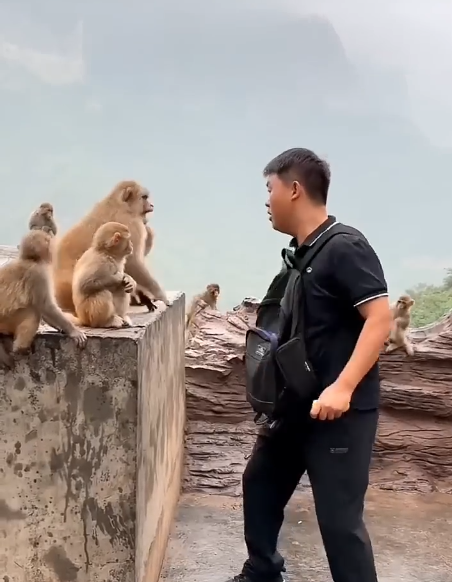
In a quiet, sun-drenched village surrounded by rolling hills and dense bamboo forests, a small but mischievous monkey lived freely among the trees. This monkey, known for its curious nature and playful antics, had a reputation among the villagers as a little trickster. It would snatch fruits from markets, tease dogs, and even hide the villagers’ tools in the most unexpected places. Its escapades were well-known, and while everyone secretly loved watching its mischief, they also knew one had to be careful—especially around Master Kuang.
Master Kuang was a wise, elderly man who had lived in the village for decades. Known for his calm demeanor and incredible skill in martial arts and spiritual practices, he was both respected and slightly feared. Villagers often whispered that Master Kuang could sense intentions before they happened and that his very gaze could make the bravest soul rethink their actions. The monkey, however, had never been intimidated by anyone—until one fateful morning.
It began as an ordinary day. The mischievous monkey, bright-eyed and full of energy, leapt from branch to branch in the forest, keeping an eye out for unattended fruits or a loose bag of rice from the market. In its playful arrogance, it often thought itself the cleverest creature around. Today, it had set its sights on a basket of oranges left outside Master Kuang’s house. The monkey, sneaky as ever, tiptoed along the fence and reached for the basket—but in doing so, it stepped on a hidden bamboo stick. A loud crack echoed through the morning air.
Master Kuang appeared instantly. He did not run or shout; he simply stared at the monkey, his eyes calm but piercing, filled with a strange, almost otherworldly intensity. The monkey froze mid-step, its tiny hands clutching the basket as if it could vanish into the air. The usual mischievous glint in its eyes disappeared, replaced by pure, unfiltered fear. The villagers nearby could not help but laugh silently—they had never seen the little rascal look so terrified.
What happened next was nothing short of magical—or comical, depending on one’s perspective. The monkey, overwhelmed by fear, leapt high into the air and landed in a most unusual stance. Its body twisted and contorted, its eyes widened to near cartoonish proportions, and for a brief moment, it seemed to levitate above the ground. Villagers swore that its fur stood on end, and that a faint, shimmering aura surrounded it. “It has become a spirit!” one of the children exclaimed, pointing with wide eyes. The phrase, half-joking and half-serious, spread like wildfire: The monkey became a spirit! Please do not imitate!
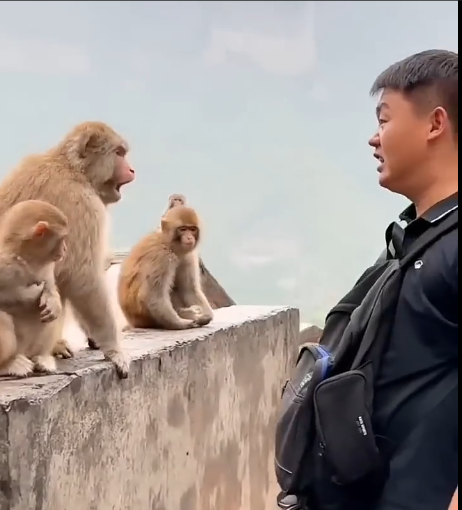
Master Kuang, calm as ever, simply shook his head and muttered a quiet warning. His voice was soft but carried authority: “Fear can make even the smallest heart appear enormous. Learn respect, little one.” The monkey, however, was not listening to words—it was too busy hopping, spinning, and squeaking in an attempt to regain its composure. Every movement was exaggerated, dramatic, and utterly hilarious. It was as if it had temporarily become a creature from another realm, a spirit of the forest caught between panic and mischief.
The villagers could not contain their laughter. Even the normally stern elders chuckled at the spectacle. The monkey, known for being clever and fearless, had been completely undone by Master Kuang’s presence. It scampered up trees, climbed poles, and even tried hiding behind rocks, only to peek out and realize that Master Kuang’s calm, steady gaze followed every move. The childlike terror mixed with absurd theatrics created a scene that was both awe-inspiring and ridiculously funny.
Interestingly, the monkey’s behavior was not just about fear—it was a learning moment. Master Kuang believed that creatures, even monkeys, could learn discipline and respect through observation and experience. By maintaining his presence and demonstrating unwavering calm, he conveyed authority without aggression. The monkey, though panicked, gradually began to understand that it had overstepped boundaries. It learned that cleverness without caution could lead to unexpected consequences, and that some beings—humans, in this case, especially those like Master Kuang—deserved respect.
After several minutes of acrobatics, spinning, and squeaking, the monkey slowly descended from its “spirit state.” It clung to a nearby tree branch, panting and wide-eyed, occasionally glancing at Master Kuang as if to apologize silently. The villagers, still giggling, encouraged it gently. They knew that while the monkey was mischievous, it was also intelligent and capable of learning. This encounter, though comical, was a turning point in the little monkey’s life.
What made this incident so memorable was the mix of fear, humor, and a touch of the supernatural—or at least the appearance of it. The monkey’s dramatic reaction had been so over-the-top that stories of “the spirit monkey” spread quickly throughout the village. Children ran to retell the tale, parents chuckled as they recalled the scene, and even travelers passing through wanted to catch a glimpse of the monkey that had supposedly become a spirit. Yet Master Kuang’s message remained clear: respect and awareness are essential, no matter how small or seemingly inconsequential one might be.
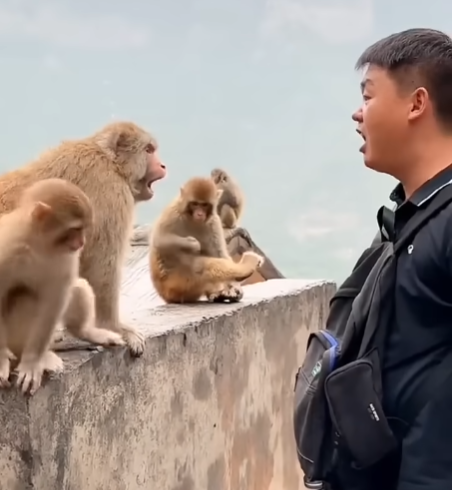
In the days following the incident, the monkey’s behavior changed subtly but noticeably. It no longer leapt recklessly at baskets or mocked the villagers as brazenly. There was a cautious respect in its movements, an awareness that Master Kuang could appear at any moment. Yet, the monkey remained mischievous—it simply adapted its antics with cleverness rather than recklessness. The villagers continued to enjoy its playful tricks, but now with a sense of admiration for its newfound humility.
This story, shared as a reel or a social media post with hashtags like #fyp, #viral, and #funny, quickly became popular. Viewers laughed at the exaggerated antics, marveled at the monkey’s “spiritual transformation,” and shared warnings jokingly: “Do not imitate!” The humor, combined with the subtle life lesson about respect and consequences, resonated widely. People from all over expressed their delight, commenting on the monkey’s expressions, the villagers’ reactions, and Master Kuang’s serene composure.
The moral of the story is both simple and profound. Even the cleverest, most playful creatures can be humbled by circumstances that demand respect. Humor and fear can coexist, creating moments that are unforgettable and educational. And sometimes, the most memorable lessons come wrapped in laughter, drama, and a hint of the extraordinary. In this case, a mischievous baby monkey, confronted by the calm authority of Master Kuang, became a “spirit” in the eyes of the villagers, leaving everyone with a tale they would tell for years.
In conclusion, the encounter between the monkey and Master Kuang is a perfect example of how humor, mischief, and life lessons can intertwine. The monkey’s exaggerated fear, its temporary transformation into a “spirit,” and the villagers’ amusement all highlight the beauty of unexpected moments in nature. It reminds us that respect, caution, and awareness are important, even for those who are playful and clever. And perhaps most importantly, it shows that laughter and learning can go hand in hand—especially when a tiny monkey thinks it has encountered something far more powerful than itself.
The story ends on a lighthearted note, with the monkey perched safely on a branch, occasionally glancing toward Master Kuang, who smiles knowingly. The lesson has been learned, the spectacle enjoyed, and the tale immortalized as a hilarious, viral moment. And as the villagers continue their daily routines, they often glance at the little monkey, chuckle, and whisper: “Remember, do not imitate!” 😂😂