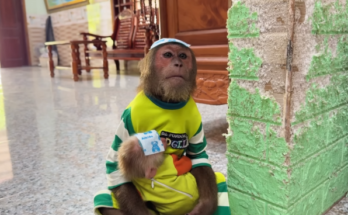
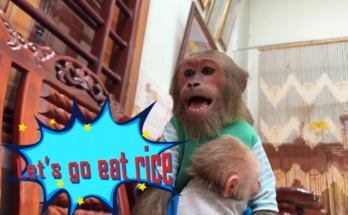
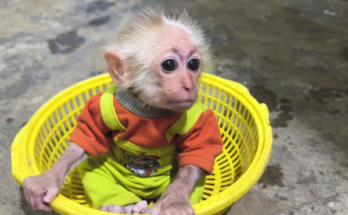
The dense canopy of the jungle rustled gently in the early morning breeze, sunlight streaking through in golden shafts that danced across the forest floor. A chorus of birds sang high above, and the faint hum of insects created a natural rhythm to the day. In a tall fig tree, a young mother monkey sat quietly, her fur slightly ruffled from a restless night, cradling her baby close to her chest. Today was an important day. Today, she would begin the delicate process of weaning her little one.
Weaning is a critical stage in a baby monkey’s life, a transition from the secure warmth and nourishment of maternal milk to the independent exploration of solid foods. For the mother, it is equally challenging—a balance between providing care and teaching her infant that he must begin to rely on his own instincts.
The baby monkey, no more than a few months old, clung tightly to his mother as she shifted her weight on the branch. His small, bright eyes were full of curiosity, and his tiny hands reached out constantly, seeking comfort and nourishment. Each time he nuzzled for milk, the mother gently pulled him back just enough to signal that today, things would be a little different.
“Not yet, little one,” she seemed to whisper through her trills and soft gestures. “It’s time to try something new.”
The baby protested softly, emitting little squeaks and whines that tugged at the heart of anyone who heard them. He had grown accustomed to the rhythm of nursing, the soothing warmth of his mother’s body, and the sense of safety that came with being held close. Change was unsettling.
Around them, the troop began their morning routine. Older juveniles swung through the trees, playfully chasing each other, while adult females foraged for fruits, leaves, and insects. The mother monkey’s gaze remained steady, focused on her baby. She knew that while the jungle was full of life, it could also be dangerous, especially for a small, dependent infant who was learning to navigate the world.
The first step in the weaning process was subtle. The mother allowed the baby to reach for her chest, but she only offered brief nursing sessions. She would slowly remove him after just a few seconds, gently nudging him toward a nearby cluster of berries she had already tested for safety. The baby looked confused and frustrated. His tiny hands fumbled as he tried to grasp the soft fruit. The mother watched patiently, giving him encouragement through gentle nudges and soft vocalizations.
Other troop members observed the scene with quiet interest. Weaning is not only a physical process but a social lesson. Baby monkeys learn to interact with others, to forage, and to understand limits. Older juveniles often act as subtle guides, showing younger monkeys how to peel fruit or crack nuts, while adult females provide supervision and protection. In this way, the jungle itself becomes a classroom.
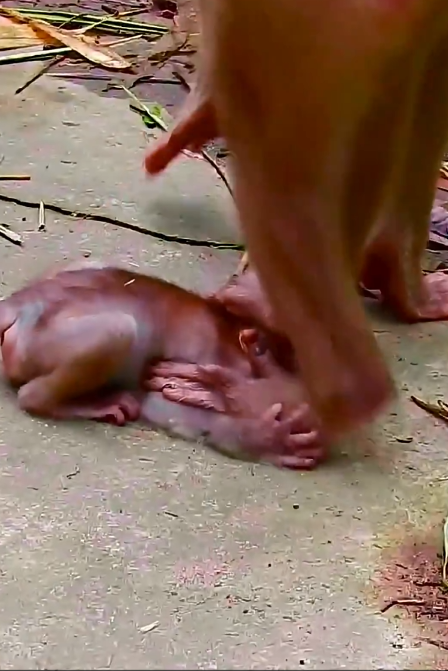
The baby monkey’s first attempts at solid food were clumsy. He dropped berries repeatedly, his tiny hands sticky with juice. Each time, the mother gently guided him, lifting the fruit and placing it near his mouth. Her touch was firm but loving, a combination of discipline and reassurance. She wanted him to succeed but also to understand that he would eventually have to provide for himself.
As the day progressed, the mother increased the intervals between nursing sessions. The baby’s frustration grew. He squealed softly, clinging tightly, trying to coax milk with small, desperate tugs. The mother remained calm, her eyes soft but unwavering. She shifted position slightly, holding him close enough to feel warmth but not giving in completely. This was the art of weaning—balancing care with the necessity of independence.
The baby tried to mimic the older juveniles, picking up leaves and inspecting them with curious fingers. Occasionally, he would bring a leaf to his mother’s mouth, as if asking for approval. She responded with small trills of encouragement, allowing him to explore while remaining close enough to intervene if danger appeared.
By midday, the baby monkey’s energy began to wane. Nursing was limited, and his small stomach struggled to adjust to solid foods. The mother noticed his fatigue and held him close, wrapping her arms and tail around him for support. The hug was sweet and protective—a moment of comfort amid the challenging transition. The baby rested against her chest, eyes half-closed, learning that while independence was necessary, he was still safe in her care.
The process continued throughout the afternoon. The mother monkey demonstrated eating techniques by peeling a fruit with deft fingers, showing her baby how to do the same. Occasionally, she would place a small piece of fruit directly in his hands, letting him explore textures and tastes on his own. Each success, no matter how small, was celebrated with a gentle trill or a soft nuzzle.
Occasionally, the baby became impatient. He squealed and tried to climb onto his mother’s chest, demanding milk. The mother held firm, gently pushing him toward the fruit she had prepared. The baby’s tiny arms flailed, but he gradually began to accept the new routine, understanding that nourishment came not only from milk but from the world around him.
Other troop members played nearby, providing a model for social learning. Young monkeys chased each other, shared fruits, and even comforted one another when minor squabbles occurred. The baby watched intently, absorbing the subtle cues of behavior, learning to forage, interact, and navigate the social complexities of troop life.
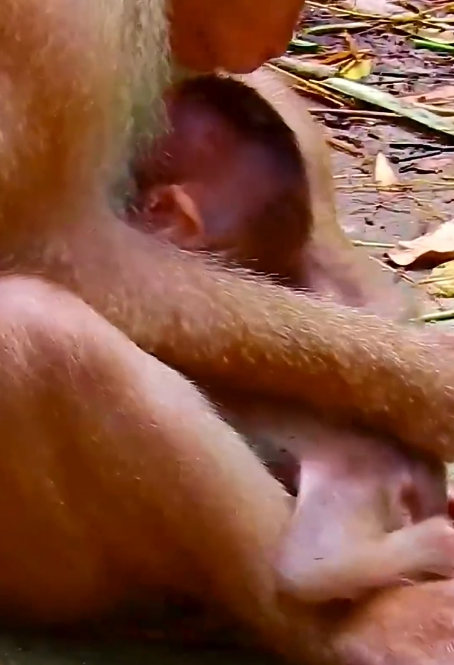
By late afternoon, the baby monkey had made significant progress. He successfully ate several small pieces of fruit, though nursing sessions were still requested occasionally. The mother rewarded these successes with soft trills and gentle embraces, reinforcing positive behavior. The hug became both a reward and reassurance—a way to say, “You are doing well. I am proud of you.”
As the sun began to dip toward the horizon, casting a warm, orange glow across the forest, the mother found a sturdy branch to rest. She wrapped her baby in her arms, tail curled protectively around them both. The baby nestled against her chest, eyes closing with contentment. The day had been challenging, but progress had been made. Independence was being taught, and the bond between mother and baby remained unbroken.
Even in the quiet of dusk, the mother monkey’s soft humming and the gentle embrace of her hug communicated love, security, and guidance. The baby, learning through touch, observation, and experience, began to understand that growing up was a gradual process. Independence did not mean abandonment. Care and protection could coexist with learning and exploration.
Throughout the night, the mother and baby slept together on the branch. Other troop members settled nearby, maintaining a protective watch. The jungle was alive with nocturnal sounds, but the baby slept peacefully, comforted by the constant warmth of his mother’s embrace.
The next morning would bring more challenges—climbing, exploring, and learning to forage more independently—but for now, the baby monkey rested safely in his mother’s sweet hug. 💚 The process of weaning was gradual, but it was also full of love, patience, and mutual learning. The mother taught not only survival skills but also the value of comfort, reassurance, and emotional connection.
In the life of monkeys, moments like these are ordinary yet profound. They illustrate the balance between independence and care, teaching lessons that shape the baby’s behavior, confidence, and social skills for life. Through gentle guidance, loving hugs, and careful attention, young mother monkeys ensure that their offspring grow up strong, resilient, and capable—all while never losing the warmth and love of maternal care.
As the jungle quieted under the soft glow of twilight, the baby monkey slept curled against his mother’s chest, a small bundle of trust and love. The mother’s soft trills and protective embrace served as a reminder: even in the journey toward independence, love remains the most powerful force of all. 💚