The alley smelled of damp concrete and old food, the kind of place most people hurried past without looking twice. Trash bags were stacked against the wall, torn open by stray cats and the wind. It was there, between shadows and silence, that a tiny puppy cried out—not loudly, not with anger, but with desperation.
“Please… I’m just looking for scraps.”
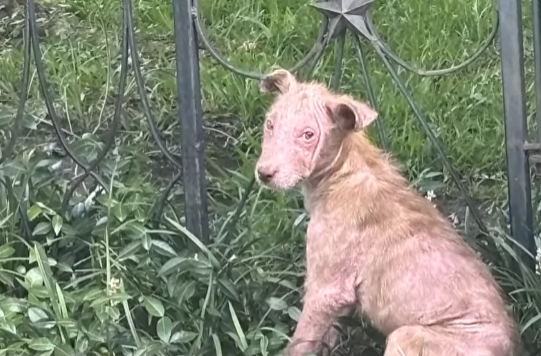
If puppies could speak, that would have been his plea. His body was small, far too small to survive on its own, ribs visible beneath thin, dirty fur. His legs shook as he stood near an overturned bin, nose buried in scraps of soggy cardboard and food wrappers, hoping for even a bite of something forgotten.
He hadn’t always been alone. Somewhere, once, there had been warmth. A smell he remembered but couldn’t find again. A place where hunger didn’t twist his stomach into knots. But that memory was fading, replaced by cold nights and empty days.
The man appeared suddenly, his footsteps heavy and angry.
“What are you doing here?” he shouted, his voice sharp like broken glass.
The puppy froze. His ears flattened against his head. Instinct told him to run, but weakness glued his paws to the ground. He let out a small, frightened cry, tail tucked tightly beneath him. He wasn’t stealing. He wasn’t threatening. He was only searching for food.
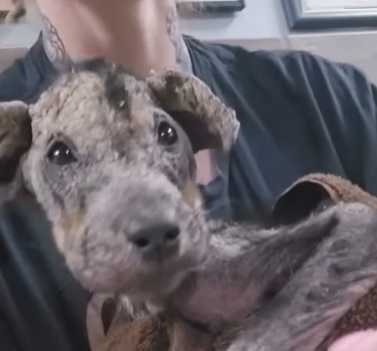
The man didn’t care.
“Get away!” he yelled, waving his arms, his anger spilling out without reason. He kicked near the puppy—not to kill, but to scare, to hurt, to remind something smaller that it didn’t belong.
The puppy cried out again, a thin, piercing sound that echoed down the alley. He stumbled backward, slipping on the wet ground. Fear flooded his tiny body. He didn’t understand why this was happening. He didn’t understand why being hungry was something to be punished for.
All he knew was pain and fear.
He crouched low, curling into himself, trying to disappear. His cries weren’t loud anymore. They were broken, hoarse, exhausted. Each sound felt like it took the last of his strength.
“Please,” his eyes seemed to say. “I’m not bad. I’m just hungry.”
A door slammed somewhere above. A window opened.
“Hey! Stop that!” a woman’s voice shouted.
The man cursed under his breath, threw one last angry look at the trembling puppy, and walked away. His footsteps faded, leaving behind silence and a tiny life shaking uncontrollably on the cold ground.
The puppy didn’t move for a long time.
Rain began to fall lightly, mixing with dirt on his fur. He tried to stand, but his legs gave out. So he crawled—inch by inch—toward the wall, pressing his small body against it. He didn’t cry anymore. Crying took too much energy.
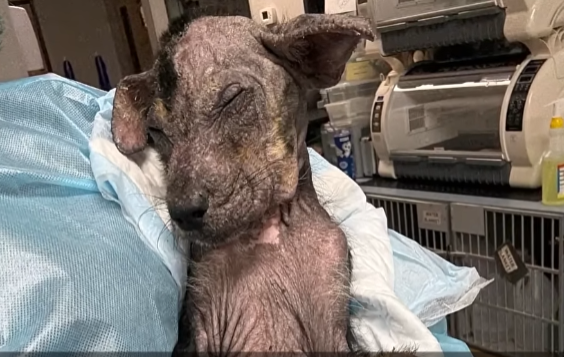
People passed the alley. Most didn’t notice him. Some saw him and looked away. It was easier not to see.
Until someone did.
A young woman carrying a bag of groceries slowed her steps. Something caught her eye—a small shape that didn’t move, eyes too big for such a thin face. She stopped. Her heart tightened.
“Oh no…” she whispered.
She knelt carefully, keeping her movements slow. The puppy lifted his head weakly, panic flashing in his eyes. Another human. Another chance to be hurt. He tried to growl, but the sound came out as a whimper.
“It’s okay,” she said softly. “I’m not going to hurt you.”
She set her bag down and took out a piece of bread, breaking it into tiny bits and placing them on the ground between them. She didn’t push it toward him. She didn’t reach for him. She waited.
The puppy stared at the food. His stomach screamed. But fear screamed louder. What if this was another trick? What if reaching for it meant pain?
Minutes passed.
Then, slowly, painfully, he crawled forward and sniffed the bread. His body trembled as he took the smallest bite. Nothing happened. No shouting. No anger. Just quiet.
He ate.

Each bite seemed to bring him back to life. When he finished, he looked up at the woman, crumbs on his nose, eyes full of confusion and disbelief.
She gently wrapped him in her jacket, careful not to startle him. He was so light it broke her heart. She could feel every bone.
“You’re safe now,” she whispered, though she knew safety wasn’t something he would believe easily.
At the vet clinic, they learned the truth. He was severely malnourished. Dehydrated. Bruised—not badly enough to be fatal, but enough to tell a story of cruelty he couldn’t speak aloud.
“He’s been treated roughly,” the vet said quietly. “And for a puppy this young… it stays with them.”
The first nights were the hardest.
The puppy cried in his sleep, waking suddenly, heart racing, searching for danger. Sudden movements made him flinch. Raised voices—even laughter—made him hide. Sometimes, when food was placed in front of him, he waited, unsure if he was allowed to eat.
But the woman stayed patient.
She sat on the floor with him. She spoke gently. She never raised her voice. She never punished mistakes. She let him come to her when he was ready.
Days turned into weeks.
The puppy gained weight. His fur grew softer. His eyes lost some of their fear. One morning, as the woman sat reading, she felt something warm press against her leg. She looked down.
The puppy had chosen to lie beside her.
His tail wagged once. Then again.
It wasn’t loud. It wasn’t dramatic. But it was everything.
He would never forget the alley. He would never forget the hunger or the fear. But slowly, he learned something new—that not all humans hurt, that looking for scraps didn’t make him worthless, that his life mattered.
Somewhere out there, cruelty still exists. People still turn anger on the innocent. Tiny puppies still cry where no one listens.
But sometimes, someone stops. Someone hears. Someone chooses kindness.
And for one tiny puppy who only wanted scraps, that kindness became the difference between surviving—and finally, truly living.