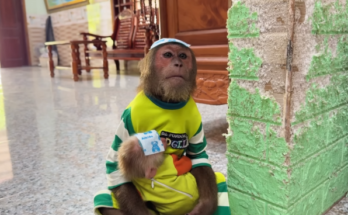
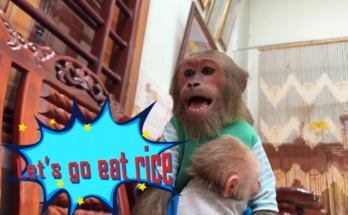
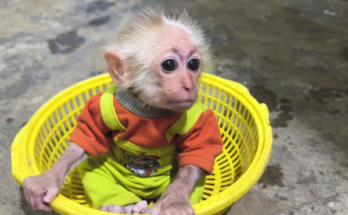
In the early morning, when the forest was still wrapped in silver mist, the monkeys began their day as they always did—leaping between branches, calling to one another, and searching for fruit warmed by the sun. Among them was a young monkey named Lumo. He was curious and playful, with bright eyes that usually sparkled with mischief. But on this day, those eyes would change, carrying a sadness far heavier than his small body should ever have known.
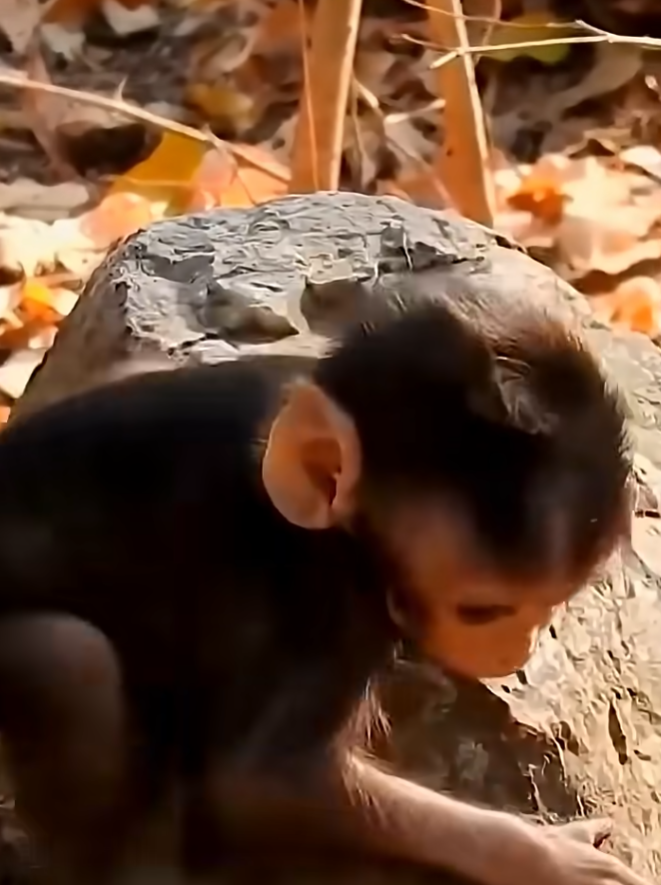
Lumo followed his troop along a narrow path of branches that crossed above a shallow ravine. The forest was alive with sounds: birds greeting the dawn, leaves whispering in the breeze, and the gentle hum of insects. Lumo tried to keep up with the older monkeys, eager to prove he was brave and strong. His mother, Mara, stayed close, watching him with quiet care. She had raised him since birth, teaching him which fruits were safe, how to grip the bark just right, and when to listen for danger.
Then, in a sudden moment that felt like the forest itself held its breath, the branch beneath Lumo shifted. It did not break loudly or fall dramatically; it simply slipped. Lumo lost his balance and tumbled down to a lower level of the forest floor. The fall was not long, but it was enough to leave him stunned and frightened. When he looked up, the world seemed bigger and colder than before.
Lumo tried to stand, but fear froze him. His eyes, once full of joy, now reflected confusion and loneliness. He was separated from his troop, surrounded by unfamiliar shadows and towering roots. The forest that had always felt like home suddenly felt overwhelming. He called out, a small, trembling sound that echoed between the trees.
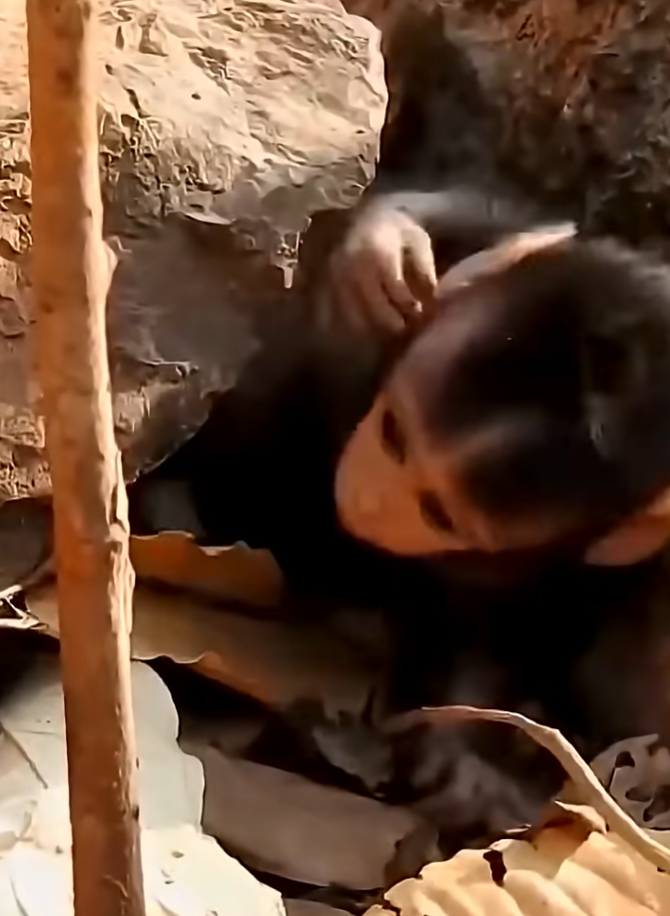
Up above, the troop had stopped. Mara’s heart knew something was wrong even before her ears caught Lumo’s cry. She moved quickly, pushing through branches and vines, her focus sharp and unshakable. A mother monkey’s bond is strong, woven from countless days of protection and love. No distance, no obstacle, could weaken it.
When Mara reached Lumo, she slowed her steps. She did not rush in a way that might scare him more. Instead, she made soft, reassuring sounds, the kind she used when he was a newborn clinging to her chest. Lumo’s eyes found her, and in that instant, the loneliness faded. Tears did not fall, but his expression told a story of relief so deep it was almost painful to witness.
Mara sat beside him, checking him carefully. She touched his arm, then his leg, gently and patiently. Lumo leaned into her, his small body shaking. He was not badly hurt, but the fear lingered, like a shadow that refused to leave. Mara wrapped her arms around him, holding him close. Her warmth reminded him that he was not alone, that even when the forest felt dangerous, he was loved.
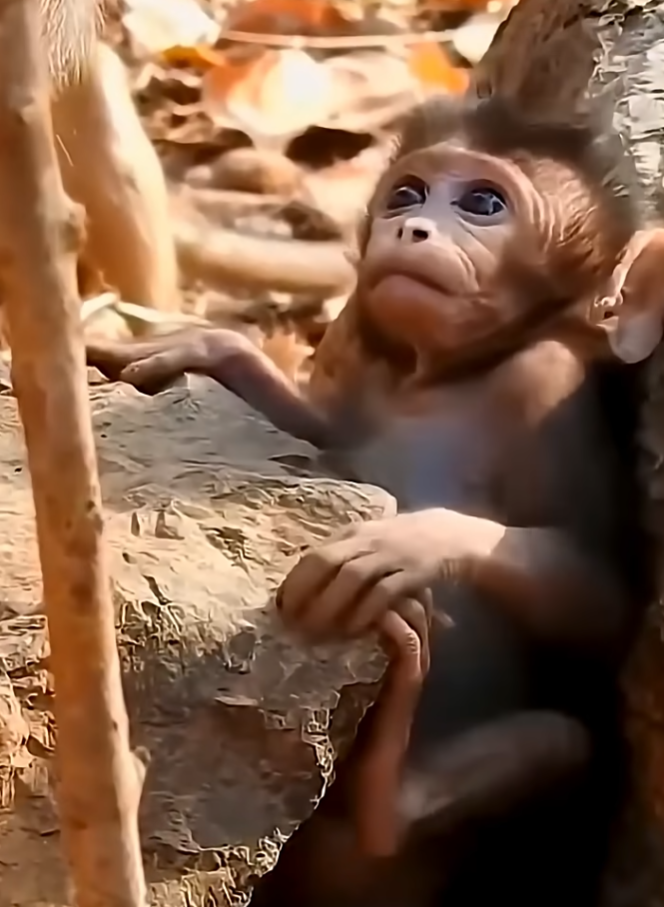
The troop gathered nearby, forming a quiet circle. They did not crowd Lumo; they respected the space between mother and child. In monkey society, care is shared, but a mother’s role is sacred. The older monkeys watched silently, understanding the importance of this moment. Even the forest seemed to soften, the wind easing as sunlight filtered gently through the leaves.
As time passed, Lumo’s breathing slowed. He listened to the steady rhythm of his mother’s heartbeat, a sound more comforting than any lullaby. His eyes, still sad, began to regain a little light. He looked around, noticing familiar faces and familiar scents. The forest was still the same place, but now it felt safer again.
Mara helped Lumo stand. This time, he did not hesitate. He placed his weight carefully, trusting his body and his mother’s guidance. When he wobbled, she steadied him. Step by step, he grew more confident. The accident had shaken him, but it had not broken his spirit.
The troop began to move again, slowly, so Lumo could keep up. They chose wider branches and lower paths, adjusting their pace for him. This was the unspoken rule of their community: no one is left behind. Lumo stayed close to Mara, his hand gripping her fur. He did not try to race ahead anymore. For now, being close was enough.
As the sun climbed higher, the forest brightened. Birds darted between trees, and the scent of ripe fruit filled the air. Lumo watched the world with new eyes. He noticed how his mother paused to listen, how she scanned the branches before moving forward. He realized that bravery was not about rushing ahead, but about knowing when to be careful and when to trust.
By midday, the troop rested near a fig tree heavy with fruit. Lumo ate slowly, savoring each bite. He felt tired, but it was a gentle tiredness, the kind that comes after strong emotions. Mara sat beside him, calm and watchful. She groomed his fur, a simple act that spoke of comfort and belonging.
The sadness in Lumo’s eyes did not disappear completely that day. Experiences like accidents leave marks, even when the body heals quickly. But those marks can become lessons. Lumo learned that fear does not mean weakness, and that asking for help is a strength. Most importantly, he learned that his mother’s love was a constant, steady presence, no matter what happened.
As evening approached, the forest glowed with warm colors. The troop settled into their sleeping places, high in the trees where the night felt safer. Lumo curled up close to Mara, his head resting against her side. The loneliness he had felt in the morning seemed like a distant memory now.
In the quiet of the night, as stars peeked through the canopy, Lumo drifted into sleep. His dreams were softer, filled with gentle swings between branches and the comforting sound of his mother’s voice. The life of monkeys is full of challenges—falls, fears, and moments of deep sadness—but it is also filled with resilience, care, and unbreakable bonds.
And so, in the heart of the forest, a young monkey learned that even after an accident, even after loneliness, love always finds its way back.