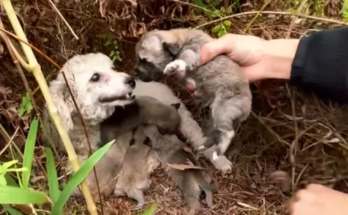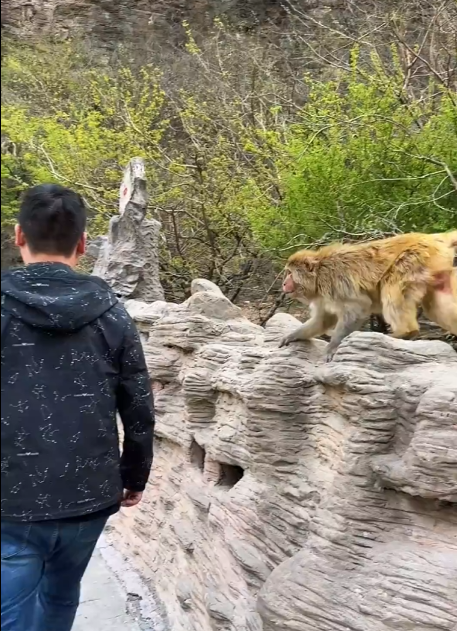
It was a bright morning in the little village where the forest met the edges of the town, and the air was filled with the sounds of nature—birds chirping, leaves rustling, and the faint, distant calls of monkeys from the treetops. For as long as she could remember, Lila had loved animals. Dogs, cats, birds—they all brought her joy. But lately, she had become fascinated by one particular monkey, a lively little creature that lived near the edge of the forest.
This monkey, whom the villagers called Kiko, was small but incredibly clever. His fur was a golden-brown shade that shone in the sunlight, and his eyes sparkled with intelligence. Unlike other monkeys who often played together or leapt between trees carelessly, Kiko was cautious, observant, and surprisingly independent.
For weeks, Lila had been trying to befriend Kiko. She brought fruits—mangoes, bananas, and even tiny pieces of apple—hoping to entice him into a game. She would sit quietly under the trees, smiling and talking to him gently, offering small pieces of fruit with an outstretched hand. But every time she tried to engage, Kiko would dart away, scampering to the safety of higher branches, or sometimes disappearing entirely into the dense foliage.
Lila grew frustrated. “Why won’t he play with me?” she wondered aloud, her voice tinged with disappointment. She had been patient, kind, and consistent, but Kiko’s independence seemed unshakable. Each day she tried something new—sitting quietly, mimicking his movements, offering shiny leaves as toys—but nothing seemed to work. The monkey, though curious, refused to engage on her terms.
Her grandmother, noticing her frustration, gently advised, “Lila, sometimes you cannot force a wild creature to play. You must learn to understand their world, their rules, and their pace. Animals have feelings too, and Kiko has his own ways of living. Patience and respect are the keys.”
Lila nodded thoughtfully but didn’t feel entirely satisfied. She loved Kiko, wanted to interact with him, and wished he would trust her enough to play. Over the next few days, she decided to observe rather than try to force friendship. She watched from a distance as Kiko leapt across branches, foraged for food, and interacted with other monkeys in the forest. Slowly, she began to notice patterns.
Kiko was highly intelligent. He was cautious because he had learned to survive in a world full of dangers—other animals, humans, and environmental hazards. He valued his independence and was wary of approaching anyone too closely. Lila realized that it wasn’t that he disliked her—it was that he needed to feel safe and in control of the interaction.
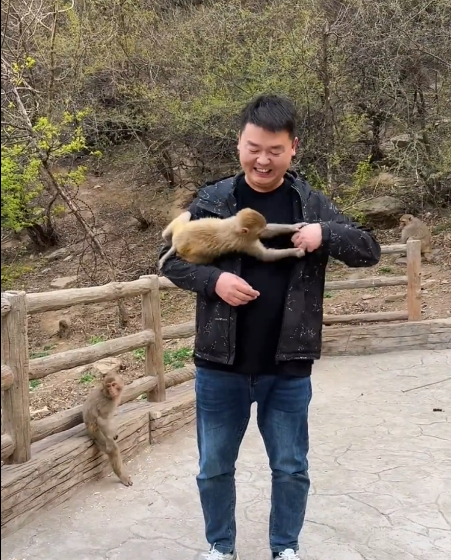
Armed with this understanding, Lila changed her approach. Instead of trying to initiate games, she began to create an environment where Kiko could choose to approach her. She placed fruits at a distance from herself, allowing him to take them freely without being touched. She built a small “play station” with ropes, leaves, and branches where he could explore safely. She mimicked the sounds of the forest—chirping, rustling leaves—so that her presence felt less foreign and more familiar.
Days passed, and Kiko’s curiosity gradually overcame his caution. He began to approach the fruit, eyes scanning her for any sign of danger, then quickly snatching it before retreating to a nearby branch. Lila clapped softly, encouraging him, but never moved too close. She learned that respect was far more important than speed or force.
One afternoon, a breakthrough happened. Lila had placed a small rope swing near the tree where Kiko often rested. She hid behind a bush, pretending not to watch. Moments later, Kiko approached, sniffing the swing cautiously. He jumped onto it, tested its movement with his tiny hands, and began to play, swinging back and forth with an energy that seemed boundless. Lila watched quietly, heart swelling with happiness. For the first time, Kiko was engaging in play—but on his own terms.
This moment taught Lila an important lesson: you cannot control wild animals, but you can earn their trust. Play isn’t something that can be forced; it’s a choice, a gift given when the animal feels safe and respected. Kiko’s joy in swinging on the rope, testing his environment, and exploring freely was the closest she could get to sharing in his world.
Over the weeks, their relationship grew. Kiko began to recognize Lila’s presence, sometimes approaching her slowly and taking fruit directly from her hand. Occasionally, he would mimic her movements, a small gesture of connection and trust. They had found a rhythm—he initiated play and exploration, and she offered encouragement without intrusion.
Other villagers noticed the change. They came to observe Lila and Kiko from a distance, amazed at the patience and respect that had allowed this connection to blossom. “You can’t force animals to love you,” an elder remarked. “You have to meet them where they are. Kiko shows you that.”
One day, Lila sat under the trees, notebook in hand, sketching Kiko as he played. She realized that their bond wasn’t measured by games or physical interaction, but by mutual understanding and respect. She had spent weeks asking, “Why won’t he play with me?” and now she understood that the question itself was misguided. The real question was, “How can I create a world where he chooses to play?”
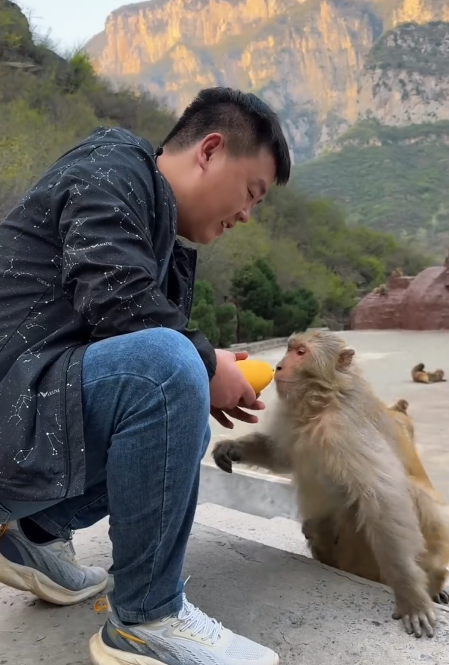
Kiko’s behavior also changed in subtle ways. He no longer darted away at the slightest movement. He allowed her to observe him more closely, sometimes letting her hear the small noises he made—chirps, whistles, and soft squeaks that were like laughter in monkey language. Lila learned to interpret these sounds as communication, a way of sharing feelings without direct contact.
This slow, mutual understanding became the essence of their friendship. Lila realized that play isn’t always physical; it’s emotional, intellectual, and sometimes just being present together. She had initially wanted to control the interaction, but Kiko had taught her that true connection comes from respect, observation, and patience.
Months passed, and the villagers began to see other benefits. Children learned from Lila how to approach wild animals safely and respectfully. They observed Kiko and other monkeys in the forest, understanding that independence and trust were fundamental. The community developed a deeper appreciation for the intelligence and emotions of the animals living nearby.
Eventually, Lila accepted that while Kiko might never play in the way she originally imagined—jumping, hugging, or performing tricks—he had given her something far more valuable: insight into the mind of a wild creature and the importance of patience and empathy.
One day, as the sun set and painted the sky with orange and pink hues, Kiko perched on a branch, munching on a piece of banana. Lila sat nearby, notebook in hand, smiling softly. Kiko looked at her, tilted his head, and let out a small chirp. It was an invitation—not to play in the human sense, but to share the moment, to acknowledge trust and presence.
Lila whispered, “I understand now. You don’t have to play with me. I just need to be here with you.”
Kiko’s little chirp seemed to answer, a simple sound that said, thank you for understanding me.
From that day forward, their bond continued to grow, quiet and profound. Lila no longer asked, “Why won’t he play with me?” Instead, she asked, “How can I respect his world while sharing mine?”
And in answering that question, she found a connection deeper than she had ever imagined—one built not on control or expectation, but on trust, patience, and understanding.
Because sometimes, the best way to play with a monkey—or any wild animal—is simply to let them choose to play with you.