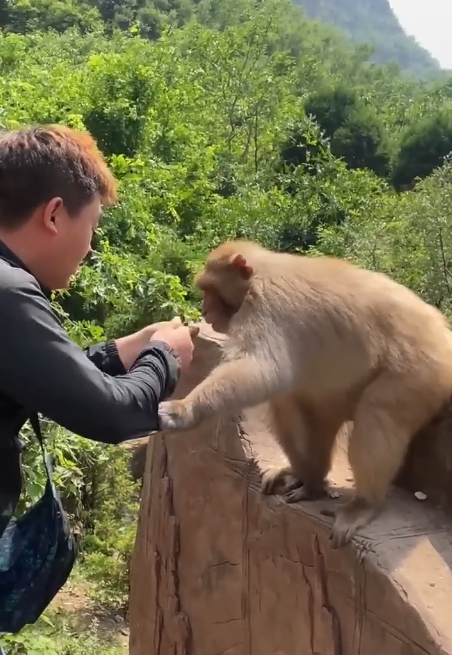
In the mist-laden valleys of southern China, where bamboo forests whispered secrets and ancient temples clung precariously to cliffs, the legend of Monkey King Yingjun lived vividly among the animals. Unlike the tales of mischief that often followed him, Yingjun was known for his wisdom as well as his playful cunning. He was the leader of a great troop of monkeys, revered not only for his strength and agility but for his uncanny ability to see the unseen—the hidden threads of destiny that connected all living beings.
One evening, as the sun dipped below the horizon and painted the sky in shades of gold and crimson, a peculiar event unfolded in the heart of the forest. A young monkey, known among the troop as Lian, had fallen ill. Lian was not an ordinary monkey; he carried the quiet aura of the spiritual, the subtle energy that made other creatures pause when he approached. The elders whispered among themselves, saying that Lian might be on the threshold between the living and the spirit world. Some believed that he might transform into a spirit monkey—a being capable of passing between realms, guiding others, and even influencing fate itself.
The troop gathered in anxious circles as Monkey King Yingjun approached. His golden fur gleamed in the last light of day, and his eyes, sharp and intelligent, scanned the young monkeys with deliberate care. Yingjun was known for his rituals of foresight, which combined observation, intuition, and the silent language of the forest. Tonight, he had to decide whether Lian—the left-hand monkey of the troop, a name given because he often led from the left during foraging—was destined to become a spirit.
Yingjun crouched beside Lian, his tail curling around the roots of an ancient banyan tree. He studied the young monkey’s breathing, the subtle shimmer in his fur, and the quiet stillness that surrounded him. Spirit monkeys, Yingjun knew, were often marked by small, almost imperceptible signs: a glint in the eye that reflected the moonlight differently, a subtle sway of the tail that mimicked the rhythms of unseen worlds, and a faint, melodic hum in their heartbeat that resonated with the forest itself.
He tapped Lian gently on the shoulder and whispered a question that only the spirits of the forest could answer. The leaves above rustled as if responding, and a distant owl hooted once—long and low. Yingjun listened carefully. To a casual observer, it might seem as though he was merely attending to a sick young monkey. But those who knew him understood that he was tuning into forces far beyond ordinary perception, reading patterns that connected the past, present, and future.
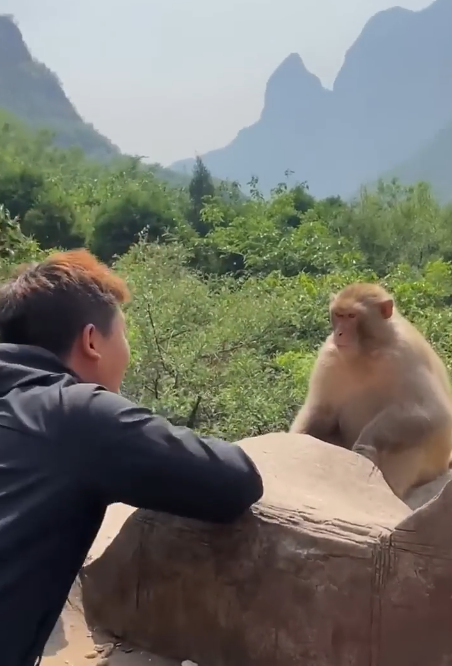
The troop waited silently. Even the most boisterous monkeys seemed subdued by the gravity of the moment. Yingjun’s gaze shifted to the left, toward the path where the shadows of the mountains merged with the night. The left-hand monkey, Lian, twitched in his sleep, and Yingjun noted the peculiar symmetry of his movements. Yingjun had long believed that destiny often revealed itself through patterns: which foot moved first, which hand reached out, which side led in balance. The left-hand alignment, he thought, was significant—it often indicated receptivity to spiritual energy, a connection to hidden dimensions.
Yingjun began a ritual known only to the eldest monkeys. He circled Lian three times clockwise, then two times counterclockwise, murmuring an ancient chant that had been passed down through generations. The chant was soft, almost musical, like the tinkling of a distant stream, and it carried meaning in ways that words could not fully capture. It was not merely a plea for guidance; it was a conversation with the invisible forces that danced between the trees, the stones, and the wind.
Suddenly, Lian’s fur began to shimmer faintly, like morning dew catching the first rays of sun. Yingjun paused, observing the subtle glow. Spirit energy, he knew, did not announce itself loudly. It emerged gently, quietly, revealing potential rather than certainty. Yingjun placed a hand near Lian’s shoulder and felt a vibration—a pulse that was both familiar and strange. The left-hand monkey’s body seemed to be vibrating in harmony with the unseen currents of the forest.
Yingjun closed his eyes, centering himself. To guess whether Lian would become a spirit was a delicate task. Too much certainty might blind him; too much doubt might prevent recognition. He inhaled deeply, letting the forest fill his senses. The wind carried the faint scent of bamboo and moss. The distant river sang a gentle tune. Somewhere in the darkness, a cricket chirped steadily. Yingjun felt these elements intertwine with Lian’s energy, a symphony of the natural and supernatural converging in that single moment.
Opening his eyes, Yingjun spoke softly, addressing the troop but also Lian and the spirits alike. “The left-hand monkey,” he began, “carries a spark that is neither here nor there, a whisper that belongs to both this world and the next. Whether he becomes a spirit depends not only on the forest or the stars but on the choices he makes in life—his courage, his compassion, and his understanding of the balance between mischief and wisdom.”
The troop leaned closer. Lian’s eyes fluttered open, reflecting a light that seemed deeper than the usual curiosity of youth. Yingjun continued, “I cannot tell you with certainty what will come. But I can say this: the potential is there. A spirit is not given; it is earned, nurtured through trials, care for others, and the respect of the unseen. Lian, the left-hand monkey, already shows the signs. Now it is a question of how he will walk the path.”
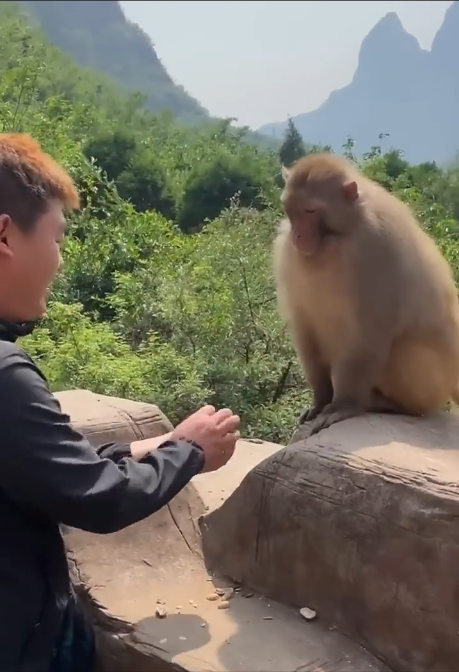
Lian, weak but aware, reached out a trembling hand. Yingjun grasped it, feeling the faint pulse of latent power. There was hope, but there was also responsibility. Yingjun knew that guiding a future spirit required patience, protection, and subtle teaching. He looked at the troop and said, “We must help him, not push him. Let him learn from the forest, from the animals, from the wind that carries stories older than our troop. Let the lessons come naturally, as spirit energy itself comes—not forced, but discovered.”
The night deepened, and the stars emerged like scattered jewels above the bamboo canopy. Lian rested against the roots, the subtle glow fading but not disappearing, a quiet promise lingering in the air. Yingjun remained vigilant, his eyes scanning the shadows for any sign of disruption, any threat to the fragile balance between the worlds. He knew that a spirit’s awakening could be sudden or gradual, a moment of insight or a lifetime of preparation.
As the troop settled for the night, Yingjun reflected on the nature of destiny. To guess whether a monkey becomes a spirit was never about certainty—it was about perception, patience, and respect for the mysterious currents of life. He understood that his role was not to dictate fate but to nurture it, to be both guardian and observer, playful yet wise.
In the coming days, Lian would continue to grow, guided by Yingjun and the forest itself. He would face trials, small and large, each shaping his spirit in ways no mirror or human hand could replicate. And one day, perhaps, the left-hand monkey would walk the fine line between worlds, carrying the wisdom of Yingjun’s guidance and the quiet magic of the forest within him.
For now, the guess remained a delicate balance of hope and observation. The Monkey King Yingjun, ever patient, watched and waited, knowing that true awakening cannot be forced—it is revealed only when the time is right, when the spirit is ready to rise.