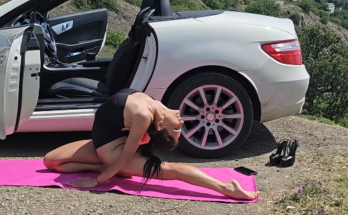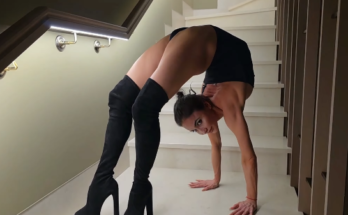
At first glance, it almost seems impossible. A performer slowly leans backward, her spine arching gracefully as she lowers her hands toward the floor. The movement continues until her body forms a deep, elegant curve. But what truly surprises the audience is not just the extreme flexibility—it’s the fact that she’s wearing high heels.
For many people watching, the immediate question is simple: Is this even possible?
The combination of deep backbends and high heels might sound like something that defies balance, strength, and physics all at once. Yet for trained flexibility artists, dancers, and contortionists, this impressive skill is the result of years of dedication, conditioning, and practice.
Backbends themselves are already a challenging movement. They require the spine to extend backward in a controlled and balanced arc. Achieving a deep backbend involves flexibility in several areas of the body, including the spine, shoulders, hips, and even the ankles.
When done properly, a backbend can look incredibly smooth and graceful. The chest opens, the shoulders rotate, and the spine bends into a curved shape that appears almost effortless.
But maintaining that position requires far more than flexibility alone.
Strong muscles play an important role in supporting the body during deep bends. Core muscles stabilize the spine, leg muscles maintain balance, and shoulder muscles help control the upper body as it moves toward the ground.

Now imagine performing that same movement while wearing high heels.
High heels shift the body’s center of gravity forward. Instead of standing flat on the ground, the heel lifts the back of the foot and places more weight toward the toes. This change may look small, but it significantly affects balance and posture.
When someone attempts a backbend in high heels, the challenge becomes much greater.
The performer must carefully adjust their body alignment to maintain stability. Every muscle—from the ankles to the spine—must work together to prevent wobbling or falling.
That’s why this combination of flexibility and footwear often amazes audiences.
In dance and performance art, high heels are sometimes used to add elegance and style to a routine. They create longer visual lines in the legs and can enhance the dramatic effect of certain movements. When paired with advanced flexibility skills like deep backbends, the result can look both powerful and graceful.
However, achieving this level of control requires careful preparation.
Most flexibility athletes spend years training their bodies before attempting extreme movements. They begin with basic stretches that improve spinal mobility and shoulder flexibility. Over time, they gradually deepen their backbends, allowing the muscles and joints to adapt safely.
One of the first backbend positions many athletes learn is the bridge pose.
In this position, the hands and feet remain on the ground while the body arches upward. It helps strengthen the back, shoulders, and legs while gently increasing spinal flexibility.
As the body becomes stronger and more flexible, athletes progress to more advanced variations, such as standing backbends or walkovers. These movements require not only flexibility but also coordination and balance.
Only after mastering these skills might a performer experiment with doing them in high heels.
Even then, the process is gradual.

Some performers begin practicing in low heels or platform shoes that provide extra stability. This allows them to become comfortable with the altered balance before moving to higher heels.
Another important factor is body awareness.
Professional dancers and contortionists develop a strong sense of where their body is in space. This awareness helps them control movements precisely, even when performing in unusual positions.
When executing a deep backbend in heels, every part of the body must remain engaged.
The legs provide a stable base, the core protects the spine, and the arms guide the movement safely toward the floor. Without this coordination, the movement would be difficult to control.
The visual effect, however, can be breathtaking.
Imagine a performer slowly leaning backward, her long hair nearly brushing the floor while her heels remain perfectly balanced. The graceful curve of the spine, combined with the elegance of the heels, creates a moment that feels almost surreal.
For audiences, it often appears as if gravity itself has been challenged.
Social media has helped bring these impressive skills to a wider audience. Videos of performers demonstrating extreme flexibility—especially unusual combinations like backbends in high heels—often attract millions of views.
People are fascinated by the human body’s ability to adapt and perform movements that seem beyond ordinary limits.
But experts in flexibility training often remind viewers of something important: what looks effortless usually represents years of consistent practice.
Behind every smooth backbend is a long journey of stretching, strengthening, and learning proper technique.
Warm-ups play a crucial role in this process. Before attempting deep backbends, performers typically prepare their bodies with dynamic movements that increase blood flow and loosen the muscles.
Shoulder stretches, hip openers, and gentle spinal movements all help prepare the body for deeper extension.
Cooling down afterward is equally important. Gentle stretching helps the muscles relax and prevents stiffness or injury.

Safety is always a priority in flexibility training.
Attempting advanced movements too quickly can strain the spine or surrounding muscles. That’s why beginners are encouraged to practice under the guidance of experienced instructors who understand proper alignment and technique.
In the end, the combination of incredible backbends and high heels represents more than just an impressive visual trick.
It reflects the dedication, patience, and discipline required to master the art of movement. The performer’s body becomes both strong and flexible, capable of creating shapes and motions that seem almost unbelievable.
So when someone watches a dancer or contortionist gracefully lowering into a deep backbend while standing in high heels, it’s natural to wonder:
Is this even possible?
The answer is yes—but only through years of practice, careful training, and a deep understanding of the body’s incredible potential.
And when it’s done well, the result is not just a demonstration of flexibility—it’s a moment of pure artistry that leaves audiences amazed and inspired.