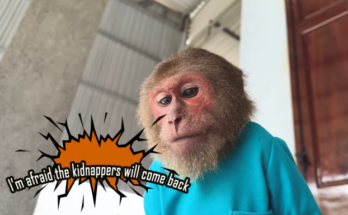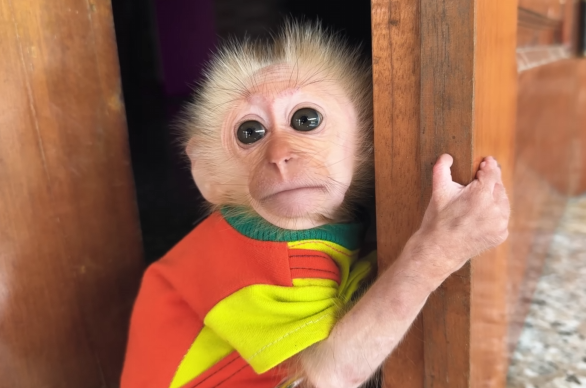
The rain had just stopped when the little monkey was found.
Drops still clung to the broad green leaves like tiny mirrors, reflecting a sky that was slowly turning gold with the late afternoon sun. The forest smelled fresh — a mix of wet earth, wild flowers, and the quiet promise of life continuing as it always had. But beneath a tall fig tree, where roots twisted like old fingers, a tiny figure trembled.
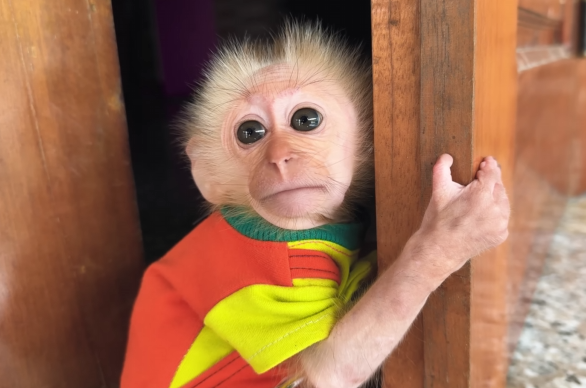
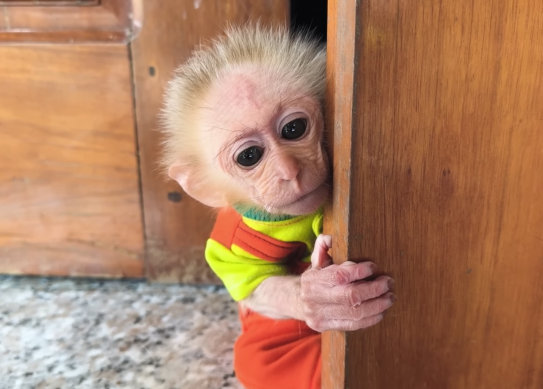
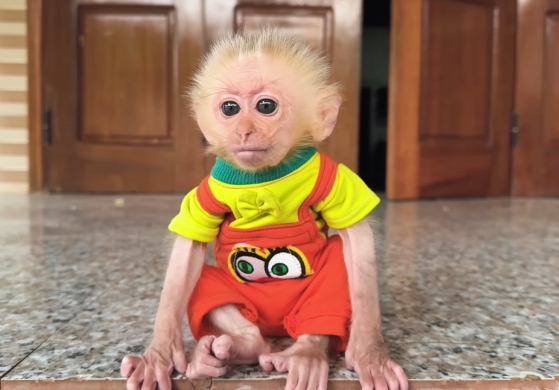
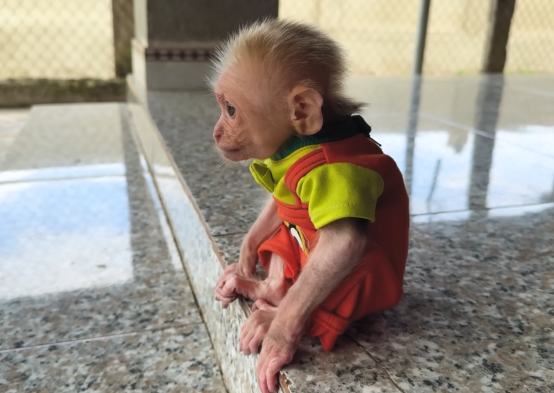
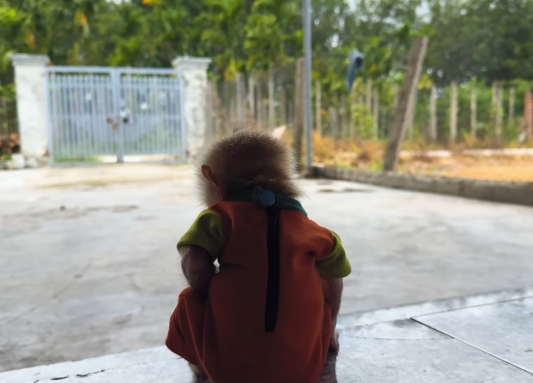
He was barely more than a baby — soft brown fur matted with mud, eyes wide with confusion. A thin rope was looped loosely around his waist, snagged on a low branch. Every time he tried to climb, he slipped back down, letting out small, frightened chirps that echoed through the trees.
Not far away, hidden behind a fallen log, a young girl named Dara watched.
She had come to gather mushrooms with her grandmother, but the soft cries had led her here. At first she thought it was a bird, then maybe a kitten. But when she saw the little monkey struggling, her heart squeezed.
“Poor thing…” she whispered.
She stepped closer, slowly, the way her grandmother had taught her when approaching animals. The monkey froze, eyes locking onto hers. For a moment, neither moved — just two young creatures sharing the same quiet space.
“It’s okay,” Dara said softly. “I won’t hurt you.”
The baby monkey tilted his head, as if trying to understand.
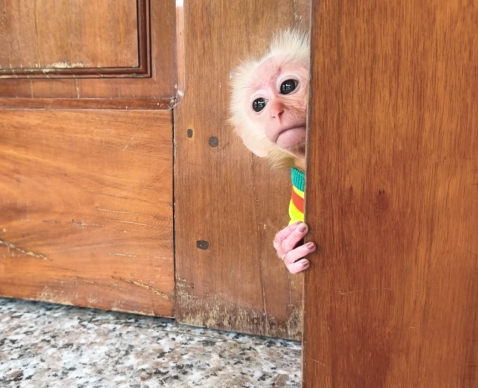
Dara crouched and gently untangled the rope from the branch. It wasn’t tied tightly — more like it had been left there carelessly. Perhaps someone had tried to keep him as a pet and he had escaped. Or maybe he had been abandoned.
As soon as the rope came free, the monkey didn’t run. Instead, he clung to Dara’s sleeve, tiny fingers gripping the fabric as if she were the only safe thing in the world.
Her chest warmed with both joy and worry.
“What should I do with you?” she murmured.
Back in the village, news traveled fast.
By evening, several neighbors had gathered around Dara’s house, peering curiously at the small bundle curled in a basket lined with cloth. The baby monkey slept, exhausted, one hand wrapped around a piece of banana.
“He’s adorable,” said one woman. “You should keep him.”
Another shook his head. “Monkeys belong in the forest. If people keep them, they forget how to survive.”
Dara listened quietly, torn.
Her grandmother placed a gentle hand on her shoulder. “Sometimes love means letting go,” she said.
That night, Dara lay awake, listening to the soft breathing from the basket beside her bed. The monkey stirred occasionally, making tiny sounds as if dreaming of trees and open skies.
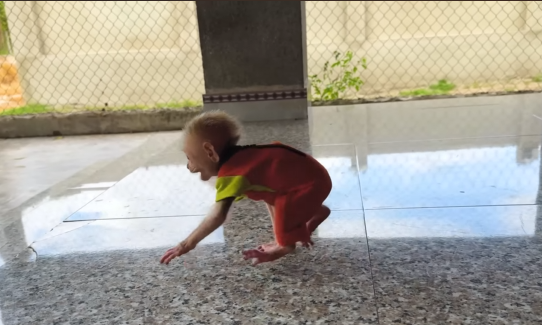
She thought of the way he had clung to her — trusting, helpless.
But she also thought of the forest… of branches swaying high above, of families of monkeys calling to one another at dawn.
The next morning, Dara carried the basket toward the forest path.
Her grandmother walked beside her, silent but supportive.
Halfway there, they encountered an old man known for trapping animals. He leaned on a stick, eyes narrowing as he spotted the basket.
“Well now,” he said. “That’s a fine little monkey. I could take him off your hands. Raise him. He’d fetch a good price.”
Dara’s heart pounded.
She hugged the basket closer. The baby monkey peeked out, sensing tension.
“No,” she said firmly.
The man chuckled. “You’re just a child. What will you do with him?”
Dara swallowed, then met his gaze. “I’m taking him home — to his real home.”
The old man shrugged and walked on, but his words lingered like a shadow.
Deeper in the forest, the sounds grew louder — birds calling, insects humming, leaves whispering in the breeze.
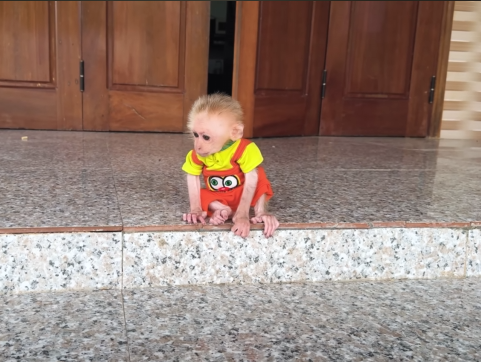
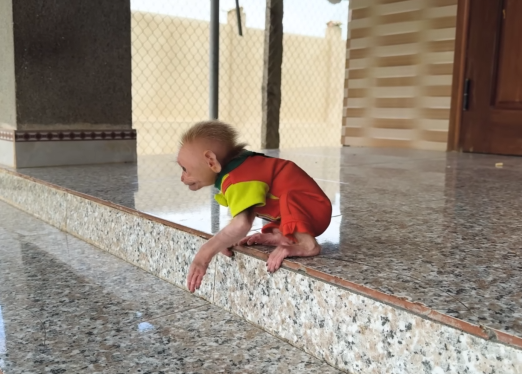
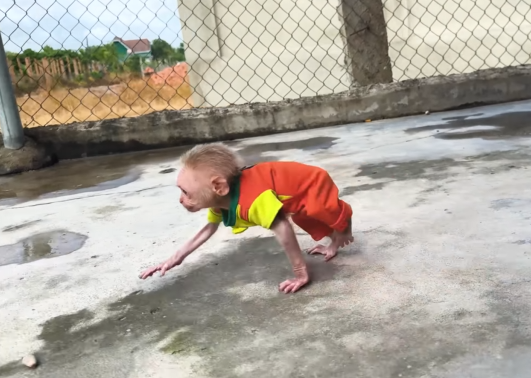
Dara stopped near a cluster of tall trees where she often saw monkeys playing. She set the basket down and opened it slowly.
The baby monkey blinked at the light.
For a moment, he stayed inside, uncertain. Then he climbed onto the edge, looking around with growing curiosity.
High above, a rustle sounded.
A group of monkeys watched from the branches — cautious, alert.
Dara’s throat tightened.
She knelt, hands resting gently on her knees.
“Please,” she whispered — though she wasn’t sure if she was speaking to the monkeys or to the moment itself. “Please, let Baby monkey go.”
The little one glanced back at her, eyes shining.
He reached out, touching her hand with surprising gentleness — a silent thank you, or maybe a goodbye.
Then, slowly, he turned toward the trees.
At first his climb was clumsy, but instinct guided him. Branch by branch, he moved higher, pausing once to look down.
Dara smiled through tears.
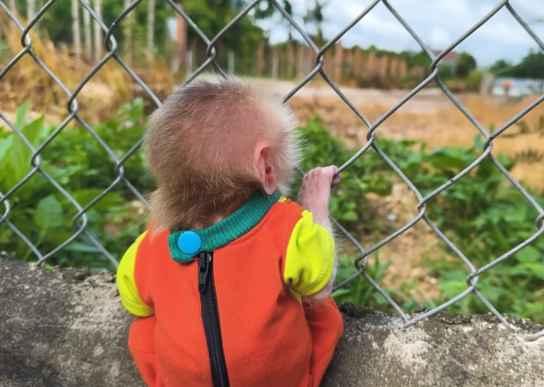
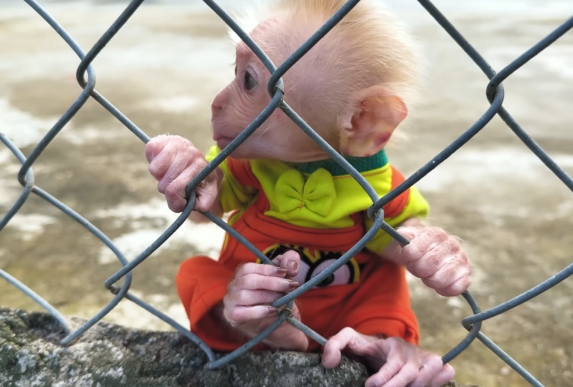
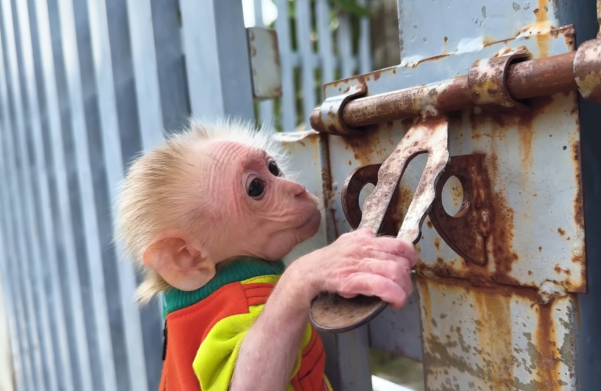
From above, a larger monkey — perhaps his mother, perhaps another adult — descended cautiously. They touched noses, soft chirps passing between them.
The troop shifted, welcoming him.
Within minutes, they disappeared into the green canopy, leaving only the whisper of leaves behind.
Dara sat there for a long time, feeling both empty and full.
Her grandmother eventually spoke. “You did a brave thing.”
Dara nodded. “I was scared he’d forget me.”
Her grandmother smiled. “He won’t. But more importantly, he won’t forget how to be a monkey.”
They began the walk home, sunlight flickering through the branches like tiny blessings.
Days passed.
Sometimes Dara returned to the forest with fruit, leaving it near the trees. Occasionally she caught glimpses of monkeys moving through the branches — quick flashes of fur and playful calls.
One afternoon, as she sat quietly, a familiar small figure appeared on a low branch.
The baby monkey — now a little more confident — watched her with bright eyes.
He chirped softly.
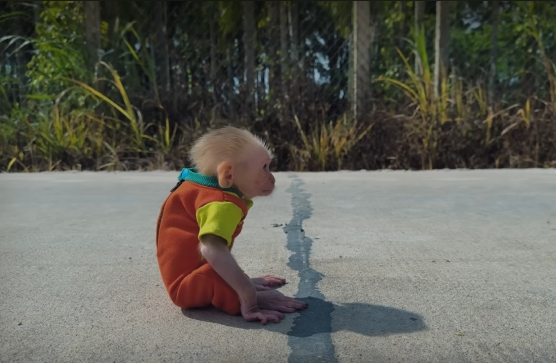
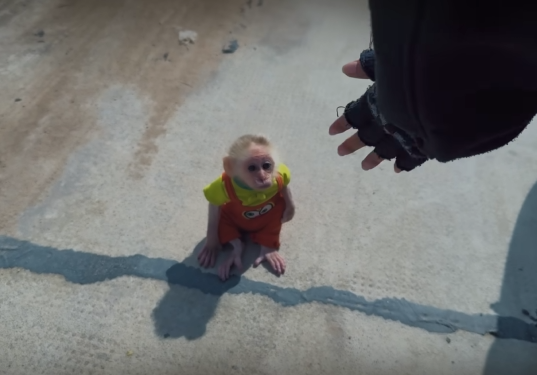
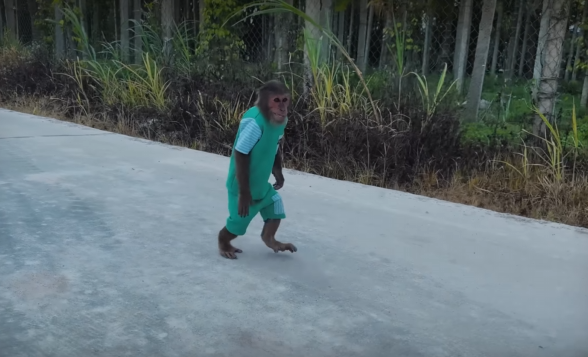
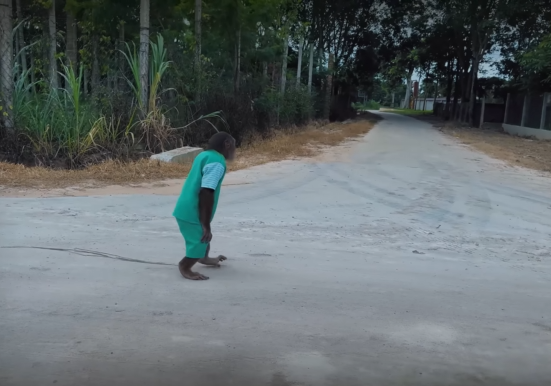
Dara laughed, her heart lifting. “Hello.”
He didn’t come closer, and she didn’t try to approach. They simply shared the space, each respecting the other’s world.
After a moment, he bounded back into the trees, free and wild.
Years later, Dara would still remember that day.
Whenever she heard someone speak about owning animals, she would gently tell the story of the little monkey who taught her what true kindness means.
Not the kind that holds tightly out of fear of losing — but the kind that opens its hands and trusts life to unfold.
And sometimes, when walking near the forest at dusk, she would hear distant calls echoing through the trees — a reminder that somewhere up there, a once-frightened baby had grown strong, leaping from branch to branch under open skies.
She would pause, smile, and whisper into the rustling leaves:
“Be free, little one.”
Because love, she had learned, is not about possession.
It is about courage.
It is about listening to the quiet voice that says:
Please… let Baby monkey go.