The first thing anyone noticed was the sound.
Not loud, not demanding — just a thin, broken whimper carried by the wind that moved lazily across the sprawling dump on the outskirts of town. It was a place where the air smelled of rot and smoke, where gulls circled endlessly and stray dogs picked through mountains of discarded lives.
On that gray morning, as the sun struggled to rise through a veil of haze, a man named Dara drove his small truck toward the dumping grounds, as he did every Tuesday. He wasn’t a scavenger by trade, but he had learned long ago that sometimes treasures — or at least things worth saving — could be found among what others threw away.
He parked near a heap of twisted metal and broken furniture. The whimper came again.
At first, he thought it might be a puppy. There were always puppies — unwanted, abandoned, left to fend for themselves. But something in the sound felt different, more fragile, more desperate.
He followed the noise, stepping carefully over shards of glass and soggy cardboard. Flies buzzed around him in thick clouds.
Then he saw her.
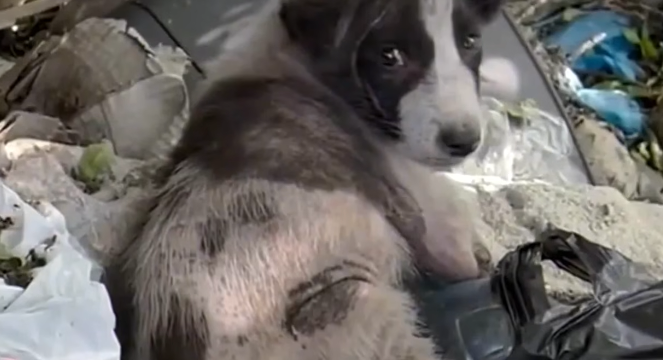
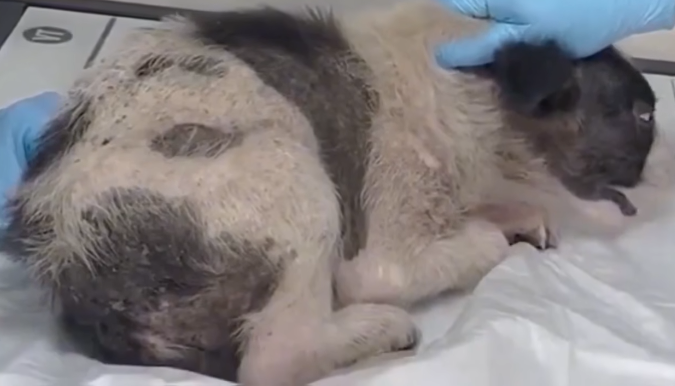
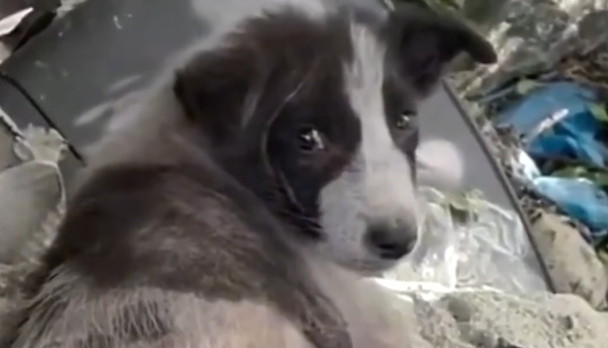
Curled beside a torn mattress, half-hidden beneath a pile of plastic bags, lay a small figure — a dog, thin as a shadow. Her fur was matted with dirt and blood. One ear drooped unnaturally, and her ribs pressed sharply against her skin. Her eyes, swollen and wet, flickered toward him with a mixture of fear and fading hope.
For a moment, Dara froze.
He had seen suffering before — animals hit by cars, strays with infections — but this felt different. There was a stillness about her, as if she had already begun to drift away from the world.
She tried to lift her head but could not. A faint cry escaped her throat.
“Hey… hey, little one,” Dara whispered, kneeling slowly so as not to frighten her.
He could see bruises along her body, dark patches beneath the fur. Someone had hurt her badly. And then — as if that were not enough — someone had brought her here, to the dump, to die alone among the trash.
Dara felt a tightness in his chest.
“Don’t worry,” he said softly. “You’re not alone anymore.”
He removed his jacket and gently wrapped it around her fragile body. She trembled at his touch, but after a moment, she let out a small sigh — the first sign of relief she might have felt in days.
Carefully, he lifted her into his arms.
She was so light it startled him.
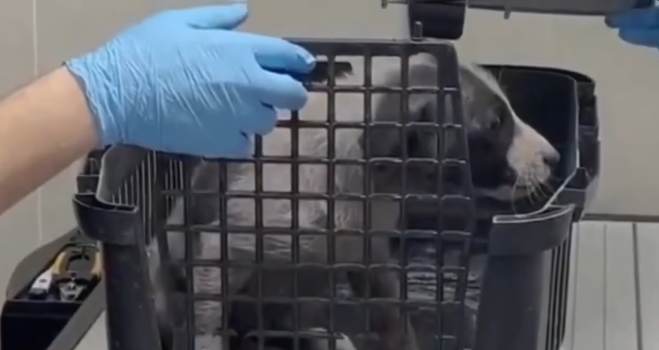
At the local veterinary clinic, the staff rushed to help as soon as Dara carried her in.
“What happened?” asked the veterinarian, a woman named Lina.
“Found her at the dump,” Dara said. “She’s been beaten… I think abandoned.”
Lina’s expression hardened with quiet anger. “Let’s get her inside.”
They placed the dog on a soft blanket under bright lights. Lina examined her gently, speaking in a calm voice.
“She’s severely dehydrated,” Lina said. “Multiple bruises. Possible fractures. And she’s malnourished… very weak.”
“Will she make it?” Dara asked.
Lina paused. “If she has the will — and with care — yes. But it will take time.”
Dara nodded. “Do whatever she needs.”
The first few days were critical.
She drifted in and out of sleep, barely responding to the world around her. Lina and the staff fed her small amounts through a syringe, cleaned her wounds, and kept her warm.
They named her Hope — because it was the only word that seemed to fit.
On the third day, Hope opened her eyes fully for the first time.
Dara was there, sitting quietly beside her kennel.
Her gaze met his, uncertain but curious.
He smiled. “Hi, Hope.”
Her tail moved — just a tiny flick — but it was enough to bring tears to his eyes.
As weeks passed, Hope slowly began to heal.
Her wounds closed. Her appetite returned. Though she still moved carefully, the light in her eyes grew stronger each day.
But healing was not only physical.
Whenever someone moved too quickly or raised their voice, Hope would flinch, shrinking back into the corner of her bed. The memory of what she had endured lingered deep within her.
Dara visited every evening.
He would sit on the floor, reading softly or simply talking about his day. Sometimes he brought small treats, sometimes just his quiet presence.
One evening, as the golden light of sunset filtered through the clinic windows, Hope did something unexpected.
She walked over and rested her head on his knee.
Dara held his breath.
Slowly, he reached down and stroked her back.
“You’re safe,” he murmured.
Her eyes closed.
By the second month, Hope was strong enough to leave the clinic.
Lina smiled as she handed Dara the leash. “I think she’s ready.”
Dara knelt beside Hope. “Ready to go home?”
Her tail wagged — hesitant but hopeful.
Life at Dara’s small house was simple but full of warmth.
There was a shady yard where birds sang in the mornings, and a soft bed by the window where sunlight pooled in gentle patches.
At first, Hope explored cautiously, sniffing every corner. She startled at unfamiliar sounds, but Dara’s calm presence reassured her.
Each day brought small victories.
The first time she ran — a clumsy, joyful dash across the grass.
The first time she barked at a passing butterfly.
The first time she fell asleep without trembling.
Dara watched her transformation with quiet gratitude.
One afternoon, as rain tapped softly against the roof, Dara sat on the porch with Hope curled beside him.
“You know,” he said thoughtfully, “someone once told me that broken things can still be beautiful.”
Hope looked up at him, ears perked.
He smiled. “I think they were right.”
Months passed.
Hope’s coat grew thick and glossy. Her eyes sparkled with curiosity. Though she still carried faint scars, they were reminders not only of pain but of survival.
Neighbors began to notice her gentle nature. Children would stop to greet her, and she would wag her tail shyly, accepting their affection.
One day, a little girl asked, “Where did you get her?”
Dara glanced at Hope, who sat proudly at his side.
“From a place where she needed help,” he said.
The girl knelt and hugged Hope gently. “She’s lucky.”
Dara shook his head softly. “No… I’m the lucky one.”
On the anniversary of the day he found her, Dara took Hope back to the edge of the dump — not to revisit sorrow, but to honor how far she had come.
They stood together, watching the wind move across the landscape.
Hope sniffed the air, then looked up at Dara.
He knelt and wrapped his arms around her.
“You’re not that scared little soul anymore,” he said quietly. “You’re strong. You’re loved.”
Hope leaned into him, tail wagging.
That evening, as they returned home, the sky glowed with shades of orange and purple.
Hope ran ahead, then turned back, as if inviting Dara to follow — her movements full of life and joy.
In that moment, it was impossible to imagine that she had once lain crying among the refuse of the world.
Because sometimes, even in the darkest places, compassion can find a way.
And sometimes, the ones who are beaten and abandoned can rise again — not only to survive, but to love, to trust, and to remind us of the quiet power of kindness.
As the stars began to appear, Hope curled beside Dara, her breathing steady and peaceful.
He stroked her gently and whispered, “You’re home.”
And for the first time in a long time — perhaps for the first time ever — she truly was.