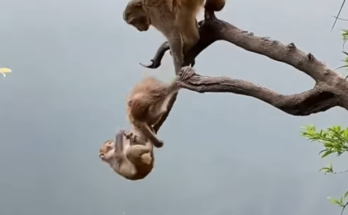
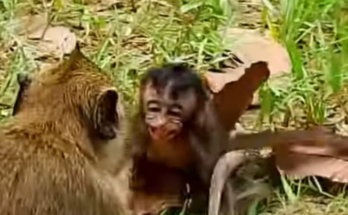
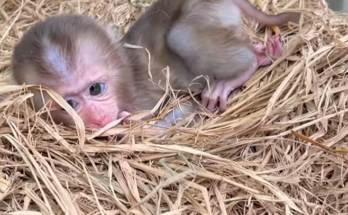
In the heart of the jungle, where sunlight filters through tangled vines and the air hums with life, there lives a tiny troublemaker known by everyone in the troop. He’s small, quick, wide-eyed, and endlessly energetic. The older monkeys call him a “little demon,” not because he’s bad—but because he never, ever gives up when he sets his mind to something… especially when that something involves mischief.
From the moment he wakes up, he’s already planning his next move.
While the rest of the troop stretches lazily on warm branches, he’s alert. His tail flicks. His ears twitch. His bright eyes scan the surroundings for opportunity. It could be a dangling vine. A sibling’s tail hanging just a little too close. Or a pile of freshly gathered fruit waiting innocently on a flat rock.
He doesn’t walk. He bounces.
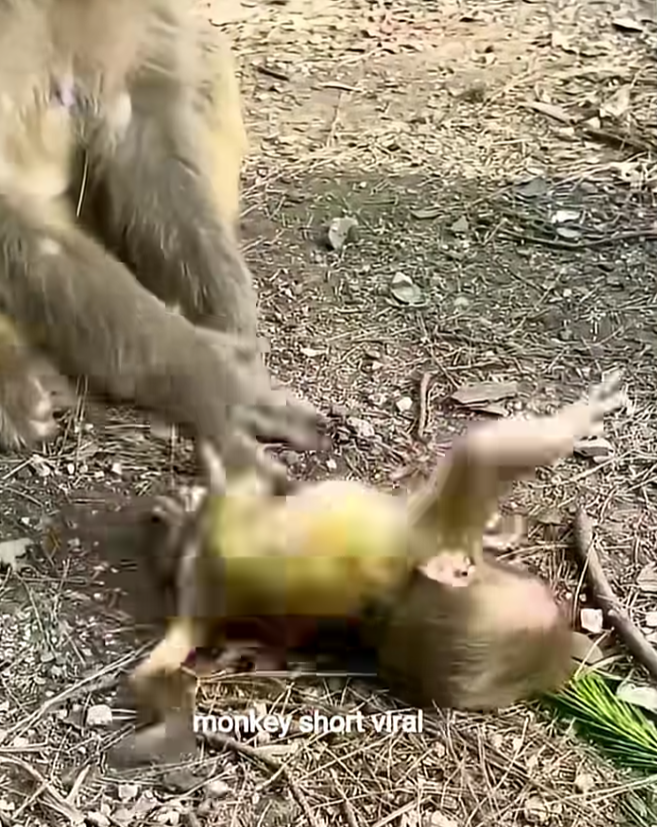
One morning, the troop gathered near a large tree heavy with ripe fruit. The adults carefully plucked the best pieces and placed them in a small pile before dividing them fairly. The little monkey sat quietly at first, watching. Too quietly.
An older monkey narrowed her eyes suspiciously.
Suddenly—whoosh!
The little demon darted forward, grabbed the biggest fruit in the pile, and sprinted away with lightning speed. The adults shouted in surprise. Two juveniles gave chase, but he was already halfway up a tree, clinging to a branch and grinning with fruit juice dripping down his chin.
Did he feel guilty?
Not even a little.
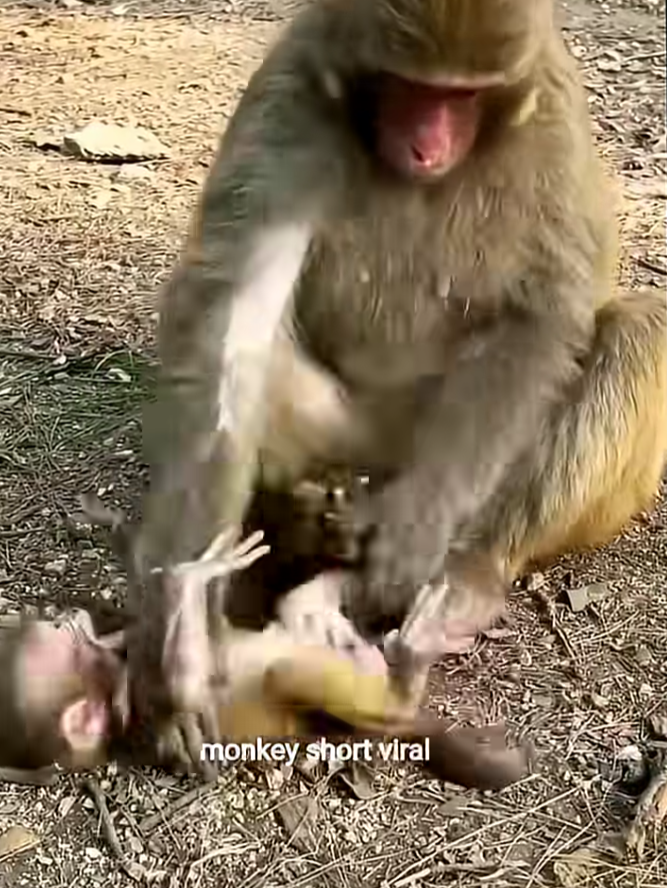
He took one exaggerated bite and dropped the rest just to see their reaction.
The troop scolded him loudly. His mother gave him a firm look, the kind that usually means “enough.” But he only tilted his head, pretending not to understand, as if the entire situation had simply happened by accident.
This wasn’t the first time.
If there’s a vine, he swings it too hard.
If there’s a puddle, he splashes it too wildly.
If there’s silence, he fills it with noise.
One afternoon, he discovered that if he tugged on the tail of a sleeping juvenile just right, the startled monkey would leap up in confusion. That discovery alone entertained him for nearly an hour. Every time the older monkey tried to nap, there he was again—tug, leap, squeal, run.
The older monkey finally chased him across three trees before giving up, exhausted. Meanwhile, the little demon swung upside down from a branch, chattering victoriously.
But beneath all the chaos, there’s something deeper.
He doesn’t give up.
Not when he falls trying to leap a wide gap between trees. He scrambles back up and tries again. Not when an older sibling blocks his path. He finds another route. Not when his mother scolds him sharply and pulls him close to settle him down. He waits… and then, the moment her grip loosens, he’s off again.
Once, he tried to carry a coconut nearly half his size. The older monkeys laughed at the sight of him wobbling under its weight. He dropped it. Tried again. Dropped it again. Rolled it accidentally into a bush. Disappeared after it. Re-emerged scratched but determined. In the end, he didn’t manage to lift it—but he did manage to roll it triumphantly across the clearing, as if he had conquered the jungle itself.
His persistence is almost impressive.
Even when disciplined, he studies the limits. If his mother gently pushes him away from a dangerous branch, he waits five minutes and edges closer again—just to see if the rule still applies. If he’s told “no” with a sharp bark, he tries a softer approach, inching forward slowly like a shadow.
It’s exhausting for the adults.
But fascinating to watch.
One evening, as the troop prepared to settle for the night, he wasn’t ready. He bounced from branch to branch, poking, prodding, whispering little monkey sounds into sleeping ears. He attempted to climb over three different backs before someone finally grabbed him mid-bounce.
His mother pulled him close, wrapping her arms firmly around him.
For a few minutes, he squirmed and protested. His tail flicked in frustration. But gradually, his movements slowed. His breathing steadied.
Even little demons need rest.
And as he lay there against her chest, something changed. His tiny fingers gripped her fur, not in mischief, but in comfort. His eyes, still bright with leftover energy, softened.
Because here’s the truth: he doesn’t cause chaos out of cruelty.
He’s curious. Fearless. Restless. Determined.
When he keeps “up the crap,” as the older monkeys dramatically put it, he’s really testing himself. Testing the world. Seeing how far he can go, how high he can climb, how fast he can think.
The next morning, of course, he was at it again.
This time, he discovered that jumping from a low branch onto a pile of dry leaves made a satisfying crunch. So he did it once. Then twice. Then repeatedly, dragging other young monkeys into his discovery. Soon, the entire clearing echoed with crunching and laughter.
Even the adults couldn’t help but watch with reluctant amusement.
Because despite the trouble, despite the chaos, despite the constant need to watch him—he brings energy to the troop. He keeps them alert. He makes them move. He challenges their patience and sharpens their instincts.
And perhaps one day, that persistence will serve him well.
The jungle is not forgiving. It requires courage. Quick thinking. Relentless determination. The same stubborn spirit that now drives him to steal fruit and tug tails might one day help him escape danger or protect his family.
For now, though, he remains the tiny whirlwind of the troop.
The little demon who doesn’t give up.
The one who keeps up the chaos, climbs too high, runs too fast, and pushes every boundary.
And even when the adults sigh, even when his mother shakes her head in exhausted disbelief, there’s something unmistakable in their eyes.
A spark of pride.
Because deep down, they know:
That unstoppable little troublemaker isn’t just making noise.
He’s growing.