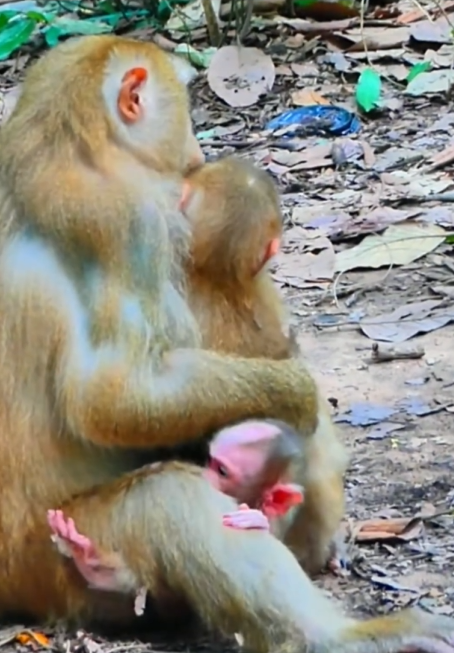
The sun was just beginning to climb above the horizon, casting a golden glow over the dense forest. Birds sang their morning songs, insects buzzed in the underbrush, and the air smelled sweet with the fragrance of damp earth and blooming flowers. In a quiet clearing, a family of monkeys was already awake, going about the daily routines of the jungle: grooming, foraging, and exploring. But among them, one small monkey seemed unusually quiet, his usual mischievous energy replaced by a sulky demeanor.
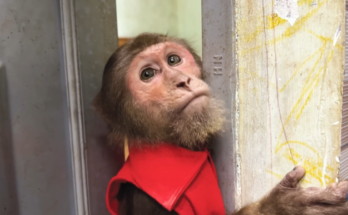
The little monkey sat on a low branch, his tiny arms folded across his chest, tail curling around the branch in a tense, stubborn coil. His face was expressive, even to someone who merely glanced from a distance. The slight pout, the furrowed brow, the way his little eyes avoided looking at the other monkeys—all signs of a mood that did not go unnoticed in the troop.
Mother monkeys are instinctively attentive to their young, and this family was no exception. The mother monkey, a strong, experienced figure with fur a rich tawny brown, noticed her offspring’s unusual behavior immediately. She had been grooming the younger juveniles when her gaze fell on the sulky little one. With a subtle flick of her tail and a careful, measured step, she approached him.
The little monkey made no effort to hide his displeasure. He glared off to the side, occasionally huffing softly and shifting his weight from one foot to the other. It was clear that something had upset him, though the reason was not immediately obvious. Perhaps he had been scolded earlier, or maybe another young monkey had snatched a piece of fruit from him. Whatever the cause, his sulkiness was real, and his mother knew that patience and gentle reassurance would be necessary.
As the mother approached, the little monkey gave a faint grunt, signaling both irritation and recognition. He didn’t want to be comforted just yet; he wanted to stew, to process his feelings, to assert his independence. But the mother, wise from years of experience, understood that such moods were natural in the life of a young monkey. Sulky behavior, she knew, was often a way for them to communicate frustration or seek attention without words.
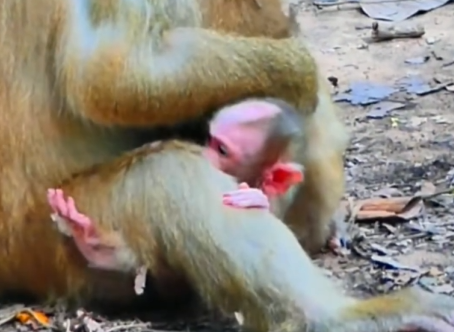
Gently, she sat beside him, placing her tail carefully around his back in a subtle embrace. The little monkey stiffened for a moment, but the warmth of his mother’s presence was soothing in ways he could not articulate. She leaned in slightly, nuzzling him softly, her movements slow and deliberate. In the world of monkeys, these gestures spoke volumes: reassurance, comfort, and unconditional support.
The little monkey’s face softened slightly, though he didn’t yet speak—or squeak, or whine. His eyes met hers briefly, flicking away, then returning as if testing the security she offered. The mother understood perfectly. It wasn’t about forcing him to be happy immediately; it was about giving him space while showing he wasn’t alone. This delicate balance of patience and attention is a skill every mother monkey learns, refined over years of raising offspring in the unpredictable jungle.
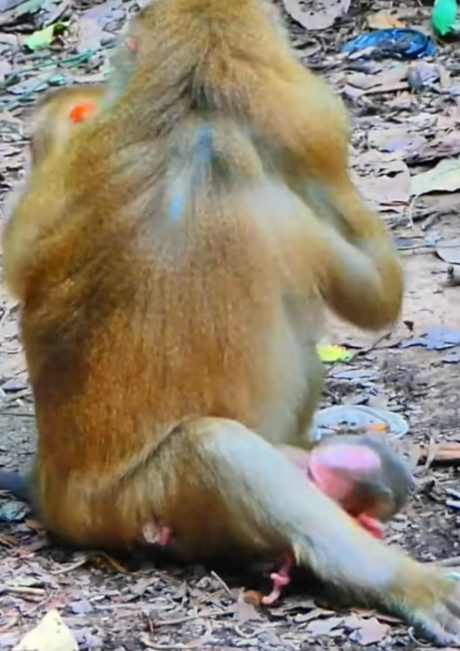
Nearby, other young monkeys observed the interaction with curiosity. They were learning from example, seeing how the mother responded to moods and emotions. In the jungle, such lessons were invaluable. Social dynamics among monkeys are complex, and the ability to soothe, communicate, and negotiate feelings is critical for survival. By watching, these little ones were absorbing the skills they would one day need for their own families and troop interactions.
The mother monkey began to make soft, comforting sounds, low coos that seemed almost like words but were part of the instinctive language of the troop. The little monkey twitched his ears and blinked slowly, the tension in his small body beginning to release. One hand tentatively reached out to touch her arm, then withdrew. The act itself was small, but in monkey language, it was a significant step toward reconciliation and emotional release.
Slowly, the sulky expression on his face began to soften. The furrowed brow relaxed, the pout eased, and his tail untwisted from the branch. He allowed himself to be held for a brief moment, leaning against his mother. She stroked his back gently, her hand moving in circular motions that seemed designed to calm and reassure. For a moment, the jungle noises faded into the background, and it was just the two of them—mother and child, connected through touch, gaze, and the subtle communication that defines monkey family life.
The little monkey, still small and inexperienced, was learning an important lesson about emotions and social interaction. Sulkiness, frustration, and irritation are natural, but they can be eased with patience, understanding, and care. The mother’s attentive presence was a guide, showing him that emotions are manageable and that support is always available within the troop.
After a few minutes, the little monkey’s mood had improved noticeably. He glanced around at the other young monkeys, who were now playing more freely, and then back at his mother. A faint, almost mischievous smile appeared on his face, signaling that the sulkiness had been replaced with curiosity and renewed energy. The mother, sensing the shift, gave a small nod, satisfied that her gentle approach had worked.
Together, they moved closer to the center of the troop, where other young monkeys were chasing each other and exploring the low branches. The little monkey’s confidence grew as he rejoined them, occasionally glancing back at his mother for reassurance. Her presence was a safety net, allowing him to explore, play, and learn without fear.
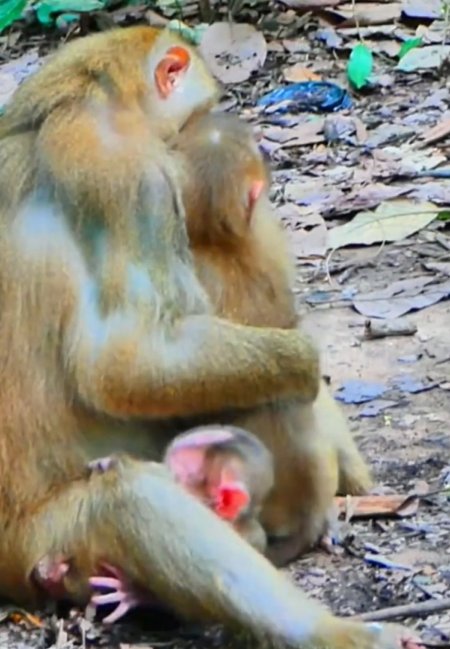
The jungle continued its rhythm around them. Sunlight filtered through the canopy, casting dancing shadows across the forest floor. Birds chirped, insects hummed, and the soft rustle of leaves accompanied the monkeys’ play. Life in the jungle was full of unpredictability, challenges, and moments of tension, but within the troop, family bonds and social learning created stability and security.
Later in the day, the little monkey would stumble, tumble, or argue with a peer, and the mother would again be there, ready to soothe, guide, or correct him. Her vigilance was constant, her understanding profound. She knew that each small interaction shaped the young monkey’s social skills, emotional intelligence, and survival instincts.
By evening, the little monkey had fully recovered from his sulky mood. He climbed higher, jumped between branches, and engaged in playful tussles with his peers. His mother observed from nearby, attentive but allowing him space to grow, to experiment, and to learn. The sulky moment had passed, replaced by vitality, curiosity, and a readiness to face the jungle once more.
In the life of monkeys, these daily interactions—sulking, soothing, playing, and learning—form the foundation of the next generation. Mothers teach through action, patience, and presence. Young monkeys learn not just survival skills but emotional intelligence, social cohesion, and trust. What might seem like a small moment—a sulky little monkey being soothed—carries profound significance in the intricate web of jungle life.
As night fell and the forest settled into quiet, the mother monkey gathered the young ones closer, including her once-sulky child. They huddled together, a warm, furry cluster under the protection of the dense canopy. The little monkey nestled against her chest, tail wrapped around her body, eyes drooping with the fatigue of a day full of learning and play. The mother’s presence remained a constant, unwavering reassurance that even in moments of frustration, care and comfort were always near.
And so life in the jungle continued—moments of mischief, sulkiness, joy, and learning intertwined seamlessly. The little monkey, now soothed and content, drifted off to sleep, surrounded by his family, under the vigilant gaze of the mother who had taught him the most important lesson of all: that love, patience, and understanding are as vital to life as food, shelter, and safety.