It was an ordinary afternoon, the kind that usually slips by without leaving a mark. The street was busy but not loud, filled with the low hum of traffic, distant conversations, and the occasional bark echoing from somewhere unseen. I was standing near a small roadside shop, waiting for a friend, half-lost in my phone and half-lost in my thoughts.
That was when I noticed the dog.
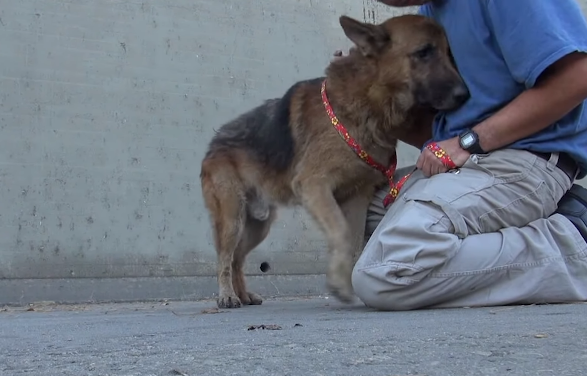
He lay near the edge of the sidewalk, pressed against the wall as if trying to make himself invisible. His fur was rough and uneven, stained with dust and old rain. One ear stood upright while the other drooped, as though it had given up trying to match its partner. His ribs showed faintly when he breathed. He wasn’t sleeping—his eyes followed every pair of passing feet with quiet caution—but he didn’t beg, didn’t bark, didn’t move.
People stepped around him without slowing.
Some glanced down briefly and looked away. Others didn’t look at all. He was just another stray, another sad shape in a city full of them. I felt that familiar tug of guilt, the one that comes when you see suffering but don’t know what to do with it. I told myself the same excuses everyone tells themselves: Someone else will help. I can’t right now. He’s probably used to it.
Then the man appeared.
He wasn’t remarkable in any obvious way—middle-aged, neatly dressed, carrying a small bag of groceries. He walked with the steady pace of someone who knew exactly where he was going. I assumed he would pass the dog like everyone else.
But he didn’t.
He stopped.
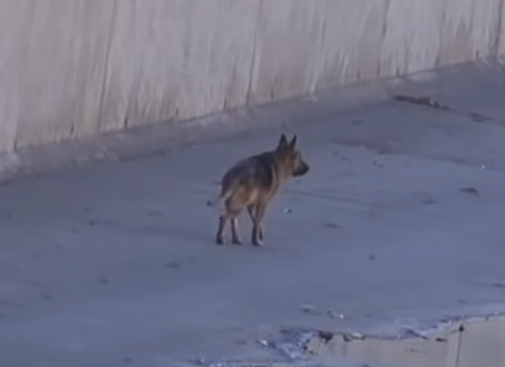
Not abruptly, not dramatically. Just a pause, as natural as breathing. He looked down at the dog, and for a moment they regarded each other in silence. The dog didn’t flinch. He didn’t retreat or bare his teeth. He simply watched, eyes dark and wary, body still as stone.
The man set his grocery bag down.
I felt myself straighten, curiosity nudging aside distraction. People often stopped to shoo strays away or scold them. I expected a gesture like that—a wave of the hand, a muttered complaint.
Instead, the man crouched.
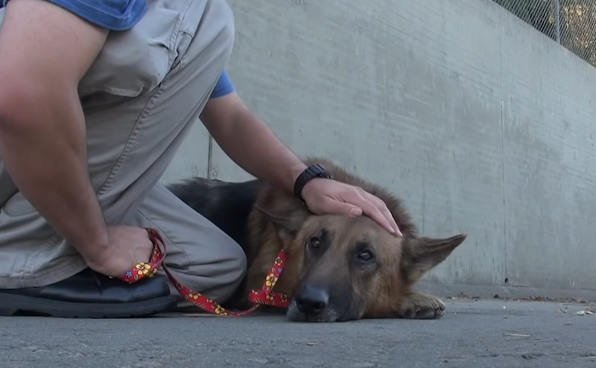
Slowly. Carefully. As if he didn’t want to scare the fragile trust holding the moment together. He extended one hand and gently placed it on the dog’s head.
That was all.
Just a pat.
No food. No leash. No dramatic rescue. Just a warm hand resting briefly on tired fur.
The dog froze.
For half a second, nothing happened. And then—so softly I almost missed it—the dog leaned into the touch.
It wasn’t a big movement. Just a slight shift, a small tilt of the head, as if he were testing whether the contact was real. The man smiled faintly and patted him again, fingers brushing behind the dog’s ear.
That’s when the dog did something I will never forget.
He lifted his head and pressed it firmly into the man’s palm. His eyes closed, tight, as if holding back something too large to show all at once. His body trembled—not from fear, but from effort, like he was fighting against an invisible weight.
Then his tail began to wag.
Not fast. Not joyful in the way of puppies or well-loved pets. It wagged slowly, hesitantly, as though the dog wasn’t quite sure he was allowed to feel happiness. Each movement seemed to ask a question: Is this really for me?
The man didn’t pull away.
He stayed there, crouched on the concrete, grocery bag forgotten, gently stroking the dog’s head and neck. He spoke quietly—words I couldn’t hear, but the tone mattered more than the language. It was soft. Respectful. Kind.
The dog sat up.
With visible effort, he shifted his weight, straightening his back and sitting beside the man like a dog who remembered, suddenly, what it meant to be someone’s companion. He leaned his whole body against the man’s knee, placing his trust there without hesitation now.
And then he did it.
He lifted one paw and placed it carefully on the man’s shoe.
That simple gesture shattered something in me.
It wasn’t trained behavior. It wasn’t a trick. It was a plea and a thank-you wrapped into one small, deliberate act. A way of saying, I’m here. I see you. Please don’t go.
My chest tightened. My vision blurred.
That dog—who had been ignored all day, maybe all week, maybe all his life—responded to a single moment of kindness with complete, unguarded devotion. He didn’t demand more. He didn’t bark or jump. He just offered himself in the only way he knew how.
The man noticed.
He paused, looking down at the paw resting on his shoe, and his expression changed. His smile softened, then faltered. He swallowed and took a breath, clearly affected himself. For a moment, the world around them seemed to slow, as if giving space to something sacred and fragile.
“I know,” he murmured, his voice just audible.
He reached into his bag and pulled out a small container of food. He opened it and set it down gently. The dog didn’t rush forward. He waited, eyes flicking between the food and the man’s face, seeking permission.
When the man nodded, the dog ate slowly, carefully, as if afraid the food might disappear if he moved too fast.
People had started to notice by then.
A few stopped. A woman whispered something to her child. A cyclist slowed, watching quietly before moving on. No one spoke loudly. No one interrupted. It felt like we all understood that this was not a moment to disturb.
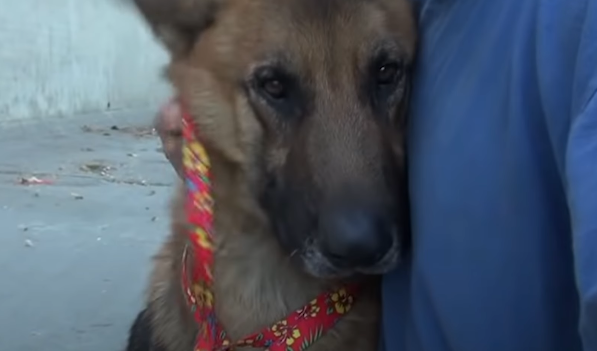
When the dog finished eating, he licked the container clean and then looked up at the man again. His tail wagged a little faster now. He leaned in once more, pressing his head against the man’s knee.
The man stood eventually, brushing dust from his pants. He hesitated, then reached down and patted the dog one last time, longer than before.
“I can’t take you with me,” he said softly, more to himself than anyone else. “But I hope… I hope this helps.”
The dog watched him pick up his bag.
He didn’t chase him.
He didn’t cry out.
He simply sat there, eyes following the man as he walked away, tail wagging gently until he was out of sight.
Then the dog lay down again—but this time, his head was higher, his posture different. He looked… lighter. As if something heavy had been lifted, even briefly.
I stood there long after the man had gone, tears running freely down my face.
It wasn’t because the dog was saved. It wasn’t because everything was suddenly okay. It was because I had just witnessed how powerful the smallest kindness can be. How a single touch can remind someone—human or animal—that they exist, that they matter.
That dog didn’t need a miracle in that moment.
He needed to be seen.
And all it took was a pat on the head for him to give everything he had in return.
That was what broke me.
That was what stayed with me long after I left the street.