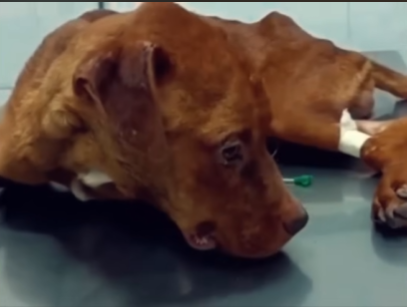
The hungry dog looked at the food with appetite but no longer had the energy to eat it. His eyes followed every movement of the bowl as if it were a dream drifting past him, something beautiful yet unreachable. The smell of warm rice and meat filled the air, awakening memories buried deep inside his tired body—memories of days when his legs were strong enough to run, when his tail still wagged without pain, when hunger was only a passing feeling, not a permanent companion.
He lay on the cold ground beside an abandoned road, ribs clearly visible beneath his dirty, matted fur. Each breath came slowly, carefully, as though even breathing required permission from his exhausted body. Hunger twisted inside his stomach, sharp and familiar, yet when the food was placed in front of him, his head barely lifted. His tongue moved slightly, dry and cracked, but his body refused to follow his desire.
People passed by without stopping. Some glanced at him quickly and looked away. Others shook their heads with pity, whispering words like “poor thing” before continuing on with their lives. The dog had long learned not to expect anything. Hope, like strength, had been worn thin by time and neglect.
Once, he had belonged to someone. He remembered hands—rough but kind—scratching behind his ears. He remembered a small yard, a rusted bowl that was filled most days, and a child who laughed whenever he chased shadows. But those memories were fading now, dissolving into the fog of hunger and pain. He didn’t know when he had been left behind or why. He only knew that one day the voices were gone, the gate was closed, and the road became his home.

Days turned into weeks. Hunger became constant. Rain soaked his fur, sun burned his skin, and nights were filled with shivering and loneliness. He learned to conserve his energy, moving only when necessary, curling into himself to protect what little warmth he had left. Barking felt pointless. No one came.
So when the bowl appeared in front of him that day, it felt unreal. A shadow fell over his body, and for a moment he thought it was another passerby who would leave him disappointed once again. But the shadow stayed. Gentle hands set the bowl down slowly, carefully, as if afraid he might break.
The smell was overwhelming. His stomach clenched painfully, and instinct told him to eat—to survive. His head lowered a little, his nose almost touching the food. His body trembled with effort. He wanted it so badly. Yet his legs refused to support him. His neck felt too heavy. Even lifting his head felt like climbing a mountain.
The person knelt beside him, saying nothing at first. There was no rush, no pressure. Just quiet presence. The dog sensed something different in that silence. It wasn’t pity or disgust. It was patience.
He tried again. His tongue flicked out weakly, barely touching the food. A small whimper escaped his throat—not from pain alone, but from frustration. Hunger had kept him alive this long, pushing him forward day after day. Now it mocked him, standing so close yet impossible to satisfy.
The person noticed. Carefully, they scooped a small portion of food with their fingers and brought it closer to his mouth. The dog flinched slightly, unsure, but the smell was too tempting. He licked slowly, clumsily. A few grains of rice stuck to his tongue. It wasn’t much, but it was enough to remind his body of what eating felt like.
Tears filled the person’s eyes as they watched him struggle. This wasn’t just a hungry dog—it was a life hanging by a thread. Each lick was an act of courage. Each swallow was a victory.
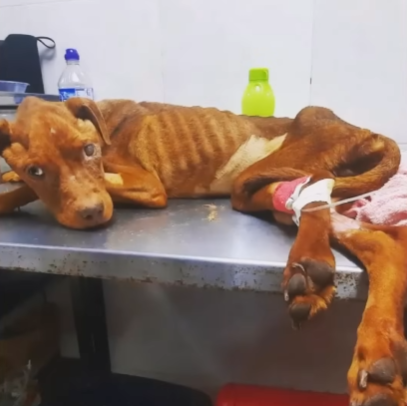
Time seemed to slow. The world narrowed to the space between the dog’s mouth and the food. Little by little, he managed to eat a few more bites. His body shook with effort, and between mouthfuls, he had to rest, his eyes closing as if he might slip away at any moment.
But he didn’t.
When he could eat no more, the person didn’t leave. They wrapped him gently in a blanket, lifting him with care. The dog was so light it frightened them. He barely reacted, too tired to resist, too weak to fear. Instead, he leaned into the warmth, his head resting against the stranger’s arm.
For the first time in a long while, he felt safe.
At the clinic, bright lights and unfamiliar smells surrounded him. The vet spoke softly, examining his fragile body. Severe malnutrition. Dehydration. Infection. His chances were uncertain. But uncertain didn’t mean impossible.
They started slowly—fluids, warmth, tiny portions of food given throughout the day. His body protested at first, unused to kindness, unused to regular nourishment. But something inside him responded. Maybe it was instinct. Maybe it was hope.
The first night, he barely moved. The second day, he opened his eyes a little wider. On the third day, his tail twitched ever so slightly when the person who found him entered the room. It was a small movement, almost unnoticeable, but it felt like a miracle.

Days passed. Strength returned in fragments. He learned to eat again, slowly, carefully. Each meal brought color back into his gums, life back into his eyes. His fur was cleaned, his wounds treated. He was given a name—one spoken gently, often, until he began to recognize it as his own.
One afternoon, weeks later, a bowl of food was placed in front of him. This time, he lifted his head without shaking. He stood—unsteady but determined—and walked toward the bowl. His appetite was still there, but now his body could answer it.
As he ate, the person watched with a smile through tears. The memory of that first day—the dog staring at food he was too weak to eat—felt distant now, like a bad dream slowly losing its power.
The dog finished his meal and looked up, eyes bright, tail wagging softly. In that moment, he wasn’t just surviving. He was living.
Hunger had once stripped him of everything—his strength, his dignity, his will. But kindness had given it all back, one small bite at a time. And though the road ahead was still long, he no longer walked it alone.
Because sometimes, all it takes to save a life is noticing the quiet suffering—the hungry dog who wants to eat but no longer has the energy—and choosing to stop, to care, and to stay.