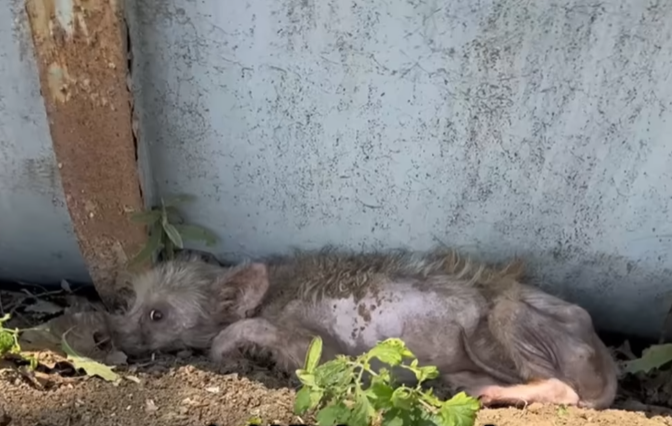
She appeared at the edge of the road like a shadow—thin, trembling, and unsure whether to run or collapse where she stood. Her ribs showed beneath matted fur, her eyes dull with exhaustion and fear. Every step looked painful, as if her body had forgotten how to move without hurting. She had learned, somewhere along the way, that humans were not safe. When cars slowed or footsteps approached, she flinched, ready to flee. Hunger kept her close; terror pushed her away. She lived in that narrow space between survival and surrender.
Neighbors had seen her before. Some waved their arms to chase her off. Others threw stones, not out of cruelty they admitted, but impatience—she rummaged through trash, slept near doorways, and reminded them of problems they didn’t want to see. “She’ll go away,” they said. “She always does.” And she did—each time a little weaker, a little slower, a little closer to disappearing altogether.
When we first saw her, it was the way she watched us that broke our hearts. Not begging. Not trusting. Just watching, measuring the distance between hope and harm. She stood angled away, ready to bolt, yet her eyes followed every movement of our hands. She was sick—there was no doubt about it. Her breathing was shallow, her gait uneven. Fleas crawled through her coat. Old wounds marked her skin like memories that wouldn’t heal.
We didn’t rush her. We had learned that second chances begin with patience. We sat down, lowered our voices, and placed food on the ground far enough away that she didn’t feel trapped. She hesitated for a long time. Hunger won. She ate like she had learned to eat—fast, anxious, stopping every few bites to scan for danger. When she finished, she backed away and waited for the blow that never came.
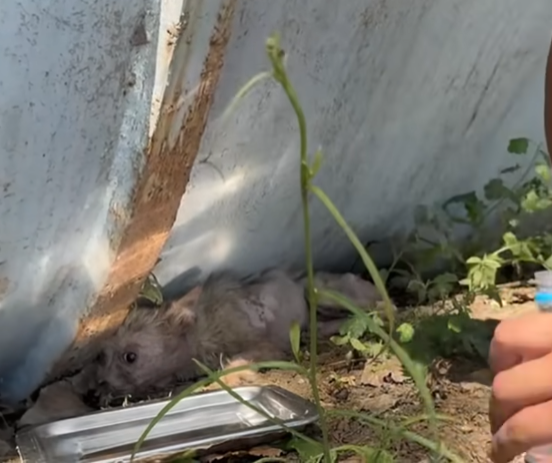
That was the first crack in the wall she had built.
The next day we came back. Same place. Same quiet presence. More food. Clean water. She was there already, thinner than we remembered, eyes sunken deeper into her face. She ate again, a little closer this time. When we stood up to leave, she didn’t run. She watched us go.
Trust is not a switch. It is a series of small agreements kept.
Over the next week, we returned daily. We spoke softly. We moved slowly. We learned her rhythms and respected them. We noticed how she favored one leg, how she coughed when the nights turned cold. We saw how she slept with one eye open, even while eating. Survival had taught her vigilance; kindness had taught her nothing—yet.
One morning, she didn’t show up. Panic crept in. Had someone chased her farther away? Had her body finally given up? We searched the nearby alleys and fields until we found her curled behind a stack of broken crates, shaking with fever. She tried to stand when she saw us, but her legs failed. That was the moment we knew waiting was no longer an option.
We wrapped her in a blanket, expecting resistance. There was none. She was too tired to fight. As we lifted her, she let out a small sound—not a growl, not a bark, just a breath that felt like relief and fear tangled together. She pressed her head against the fabric, as if deciding, for the first time, to trust the unknown.
At the clinic, the list of problems was long. Severe malnutrition. Infection. Parasites. Dehydration. Old injuries that had never been treated. The vet spoke gently but honestly. “She’s been surviving on nothing for a long time,” they said. “Recovery won’t be easy.” We nodded. Easy was never the goal. Living was.
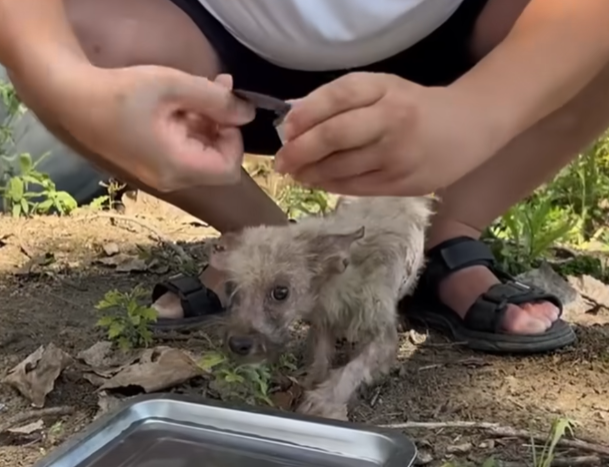
The first nights were the hardest. She cried softly in her sleep, waking in a panic, unsure where she was. We sat beside her crate, speaking her name—one we had finally chosen for her, something warm and steady. We fed her in small amounts, monitored every breath, celebrated tiny victories: a tail flick, a deeper sleep, a meal finished without fear.
Day by day, she changed.
Her eyes grew brighter. Her coat began to soften. She learned that hands could heal instead of hurt. She learned that food came regularly, that water didn’t disappear, that no one chased her away for resting. She still startled at sudden noises. She still hesitated at doorways. Trauma does not vanish just because safety arrives. But she was learning new rules for living.
The first time she wagged her tail, it felt like a miracle. The first time she leaned into a touch instead of pulling away, it felt like forgiveness. She was not erasing her past; she was expanding beyond it.
We took her for short walks when her strength returned. The world overwhelmed her at first—cars, voices, movement—but she stayed close, checking back with her eyes as if asking, Is this okay? Are you still here? And every time, we answered by staying.
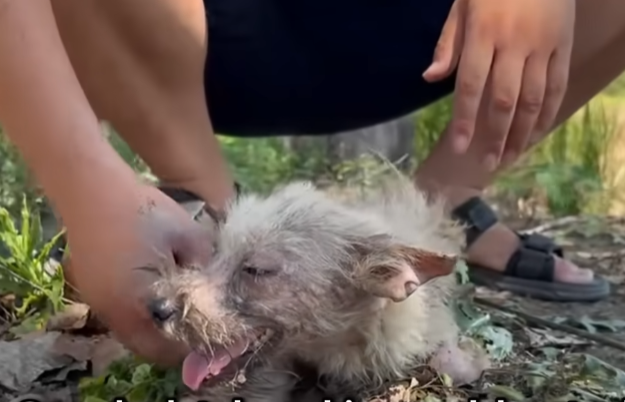
People noticed her transformation. “She looks different,” they said. “Healthier.” Few asked where she had come from. Fewer still asked why she had been left to suffer in the first place. But she knew. And we knew. And together, we chose not to let that be the end of her story.
The day she ran—not away, but toward us—was the day we understood what a second chance really means. It means more than rescue. It means consistency. It means choosing compassion even when it’s inconvenient. It means seeing worth where others saw nuisance.
She still carries her past in quiet ways. A flinch here. A pause there. But she also carries joy now—real, unguarded joy. She stretches in the sun. She sleeps deeply. She eats without fear. She trusts.
Abandoned, sick, and starving—chased off by humans—she was written off as invisible. But all she needed was someone to stop chasing her away and start standing beside her.
We didn’t save her alone. She saved herself, step by fragile step, by daring to believe that the world could be different. We just gave her the chance.
And sometimes, that’s everything.